
What is the Correct Pressure for a Boiler? Complete Guide 2026
Quick Answer: The correct boiler pressure when the heating is off is between 1.0 and 1.5 bar. When the heating is running, pressure should sit between 1.5 and 2.0 bar — the slight rise is normal as heated water expands. A reading below 1.0 bar is too low and requires repressurising via the filling loop. A reading above 2.5 bar is too high and requires bleeding the radiators to release pressure. Check the pressure gauge monthly to catch developing issues before they cause damage.
Boiler pressure is one of the simplest and most important aspects of central heating system maintenance. It costs nothing to check, takes under a minute, and a reading outside the correct range is one of the earliest indicators that something in the system needs attention. Despite this, most homeowners check the pressure gauge only when the heating stops working — by which point an easily preventable issue has already caused a lockout or, in persistent cases, system damage. This guide explains what boiler pressure is, what the correct readings are at every system state, and exactly what to do when pressure is too high or too low. Monitoring boiler pressure levels for safety is essential to ensure optimal performance and longevity of the system. Regular checks help prevent unnecessary stress on components and reduce the risk of costly repairs. Taking proactive measures to maintain appropriate pressure can greatly improve energy efficiency and overall comfort in your home.
What is Boiler Pressure?
A central heating system is a sealed circuit — a closed loop of pipework, radiators, and the boiler through which the same water circulates continuously. Because the circuit is sealed, the water is maintained under pressure, which allows the pump to move it efficiently around the system and ensures it heats to the correct temperature without cavitating or flashing to steam at high temperatures.
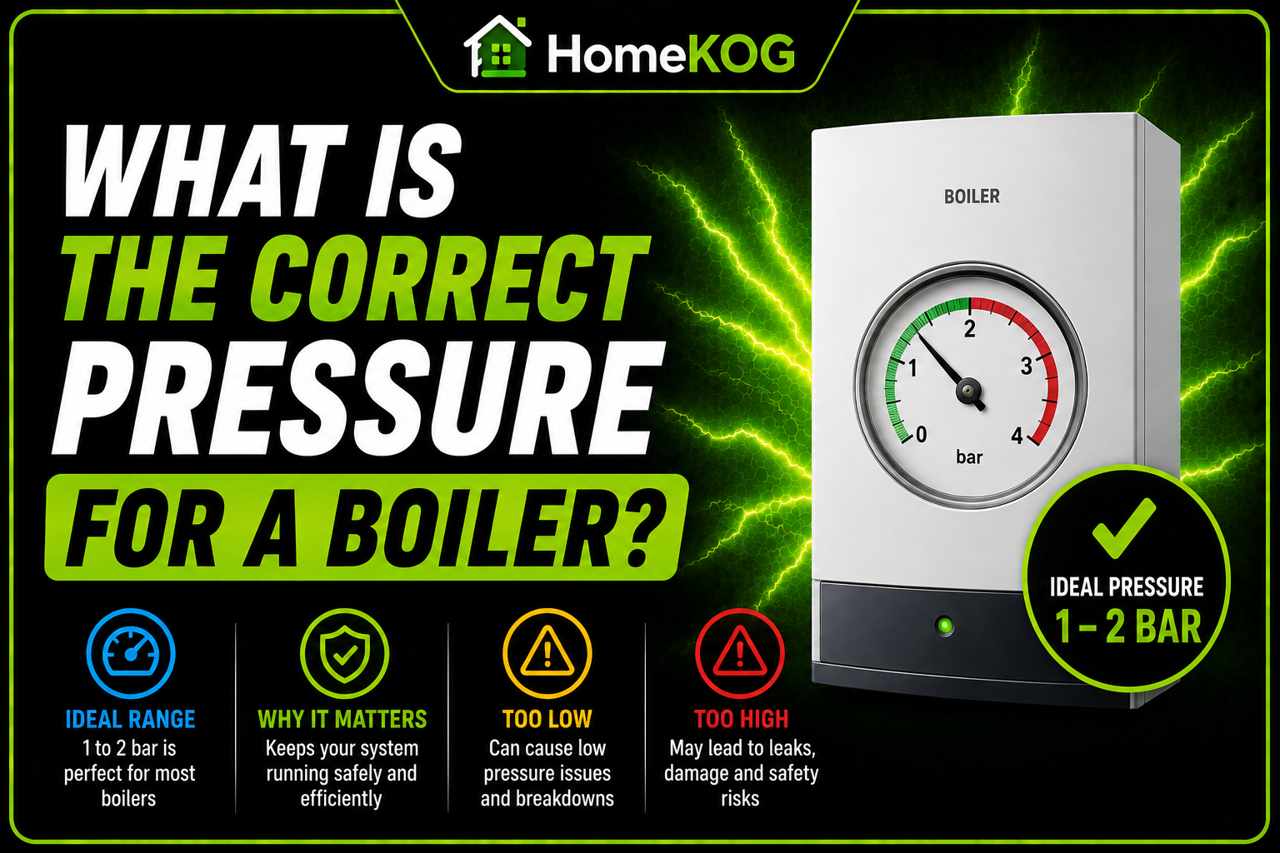
The pressure gauge on the boiler front panel measures this system pressure. It will either be an analogue dial with a coloured zone indicator — green for the correct range, red for too high or too low — or a digital display showing a numeric bar reading. Both display the same information. The green or safe zone on analogue gauges typically runs from 1.0 to 2.0 bar, with the red zone beginning below 1.0 and above 2.0 to 2.5 bar depending on the model.

What is the Correct Boiler Pressure?
The correct pressure depends on whether the heating system is currently running or at rest.
| System State | Correct Pressure Range |
|---|---|
| Heating off (cold system) | 1.0 – 1.5 bar |
| Heating on (system running) | 1.5 – 2.0 bar |
| Too low (action required) | Below 1.0 bar |
| Too high (action required) | Above 2.5 bar |
The rise in pressure when the heating is running is entirely normal and expected. As water heats up, it expands slightly, and because the system is sealed, this expansion increases the pressure reading on the gauge by approximately 0.3 to 0.5 bar. This is managed by the expansion vessel — a small pressurised chamber within the boiler that absorbs the expanded water volume. A cold system reading of 1.2 bar rising to 1.7 bar when the heating is on is perfectly healthy. Always check the boiler manual for the manufacturer’s specific recommended pressure range, as some models have slightly different parameters.
How to Check Boiler Pressure
Checking the boiler pressure takes under a minute. Locate the pressure gauge on the boiler front panel — on most modern boilers this is a digital display, on older models a circular analogue gauge with a needle. The reading should be taken with the heating off and the system at its cold resting state for the most representative baseline measurement. Monthly checks at the same point in the day and with the same system state — consistently cold or consistently after a heating cycle — give the most useful picture of how pressure is trending over time.
A pressure that is drifting consistently downward month to month, requiring regular topping up, indicates a small leak somewhere in the system that should be investigated by a Gas Safe engineer before it develops further.
What Causes High Boiler Pressure?
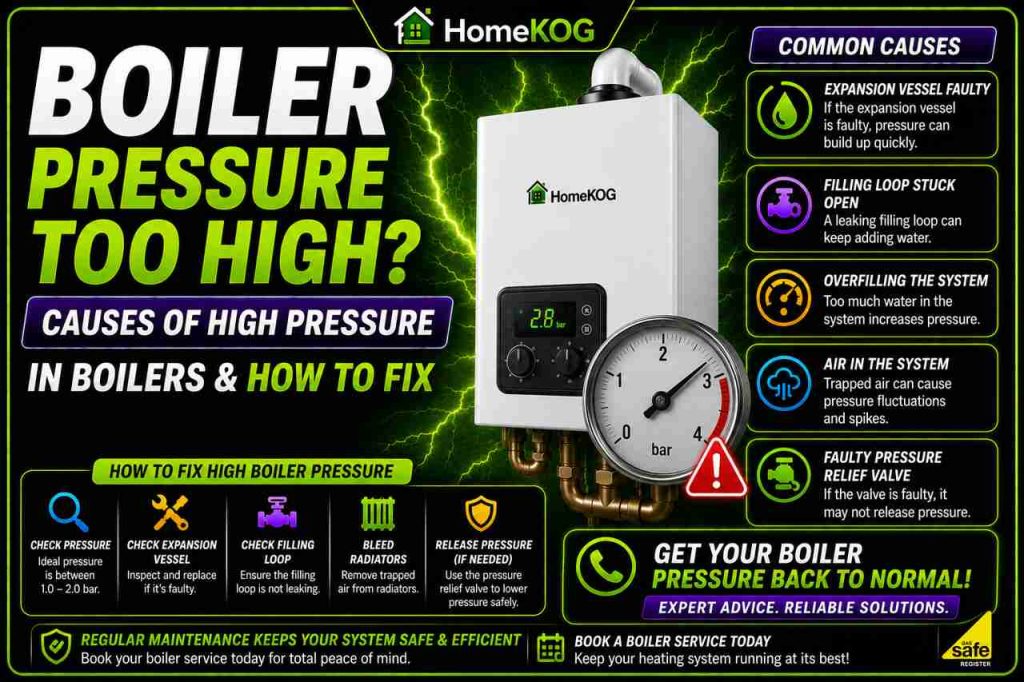
High boiler pressure — above 2.5 bar — is most commonly caused by overfilling the system via the filling loop. If the filling loop valves are not fully closed after repressurisation, they continue to admit mains water into the sealed circuit, raising pressure progressively. A filling loop valve that appears closed but has a slow internal leak past the valve seat can cause the same effect over a longer period.
A faulty expansion vessel is another common cause of recurring high pressure. The expansion vessel contains a sealed air charge that compresses to absorb the expanding water volume when the heating fires. If the air charge has depleted — which happens naturally over years of operation — the vessel can no longer absorb the expansion, causing pressure to spike above the safe range each time the heating runs. A Gas Safe engineer can recharge or replace the expansion vessel to resolve this permanently.
High pressure that returns quickly after being corrected through radiator bleeding suggests one of these underlying causes rather than a one-off overfill. Persistent high pressure without an obvious cause should be investigated by an engineer.
How to Reduce High Boiler Pressure
If the boiler pressure gauge reads above 2.5 bar and the boiler has not already shut itself down, follow these steps.
- Turn off the boiler and allow the system to cool completely before taking any action — working on a pressurised hot system risks scalding.
- Locate the filling loop — typically a braided silver hose connecting the boiler to the mains cold water supply, with a valve at each end. Check that both valves are fully closed. A valve that has been left partially open is the most common cause of high pressure on recently serviced or repressurised systems. If the valves were open, close them fully and monitor whether pressure begins to fall as the system cools.
- If the filling loop valves were already closed and pressure remains high, bleed the radiators to release water and pressure from the system. Work through each radiator using a bleed key, opening the bleed valve until water begins to drip — this confirms air has been fully expelled and water pressure is actively being released. Close each valve before moving to the next radiator.
- Monitor the pressure gauge while bleeding. Stop when the gauge returns to the 1.0 to 1.5 bar range — over-bleeding will drop pressure below the minimum and require repressurisation.
- Restart the boiler and check the pressure during the first heating cycle. The pressure should rise to 1.5 to 2.0 bar and stabilise rather than continuing to climb.
- Recheck the pressure over the following days. If pressure continues to rise above the safe range without any filling loop activity, a faulty expansion vessel or pressure relief valve requires engineer investigation.
What Causes Low Boiler Pressure?
Low boiler pressure — below 1.0 bar — is the most common pressure-related fault reported by homeowners. The most frequent cause is over-bleeding of radiators, where too much water and vapour has been released from the system, dropping the overall volume and therefore the pressure below the operating minimum. This is straightforward to resolve through repressurisation.
Small leaks elsewhere in the system — at radiator valve connections, pipe joints under floors or behind walls, or at the pump seal — cause gradual pressure loss over days or weeks. These leaks may not be immediately visible as pooling water, particularly where the leak point is concealed, but they will cause the pressure to drop back to a low reading within a short period of each repressurisation. A system that requires repressurising more than once every few months should be inspected by a Gas Safe engineer for leak identification and repair.
A failed expansion vessel diaphragm can also cause low pressure in some circumstances — if the diaphragm has split, the vessel fills entirely with water rather than maintaining its air charge, which affects the system’s pressure regulation.
How to Increase Low Boiler Pressure
Repressurising a boiler via the filling loop is a safe and simple DIY task that takes under five minutes.
- Turn off the boiler and allow it to cool before repressurising — adding cold mains water to a hot pressurised system can cause thermal shock to components.
- Locate the filling loop beneath or adjacent to the boiler. It is typically a braided flexible hose with one or two valves. On some installations a keyway fitting is used — the key is usually attached to the nearby pipework and slots into the filling loop valve.
- Open the filling loop valve or valves slowly — on a two-valve system, open both. You should hear the sound of water entering the system through the filling loop.
- Watch the pressure gauge continuously while the filling loop is open. The pressure will rise as mains water enters the system.
- Close the filling loop valve or valves firmly when the pressure gauge reads between 1.0 and 1.5 bar. Do not allow pressure to rise above 1.5 bar during repressurisation — the system will rise further once the heating fires and water temperature increases.
- Restart the boiler and check the pressure after the first heating cycle confirms it is reading between 1.5 and 2.0 bar while running.
- Check all visible pipework and radiator connections for any signs of dripping water following repressurisation — the newly added pressure may reveal a marginal leak that was borderline at lower pressure.
- Monitor the pressure gauge over the following days. If the pressure drops back to below 1.0 bar within a short period, a system leak requires engineer investigation.
Boiler Pressure and System Health
Monthly pressure checks are the simplest indicator of overall heating system health available to a homeowner without any specialist tools or knowledge. A system that holds steady pressure — reading consistently within the correct range with only slow, gradual drift requiring occasional topping up — is a system with no significant leaks, a correctly functioning expansion vessel, and sealed filling loop valves.
A system that requires frequent repressurisation, or that regularly spikes to high pressure without obvious cause, is flagging an underlying issue that will worsen over time. Identifying and addressing these patterns early — before a small leak becomes a significant one, or a partially exhausted expansion vessel fails completely — consistently costs less than reacting after the fault has developed to the point of causing a breakdown or system damage.
FAQ
What should boiler pressure be when the heating is on?
When the central heating is actively running, boiler pressure should read between 1.5 and 2.0 bar. The rise from the cold resting pressure of 1.0 to 1.5 bar is caused by thermal expansion as water heats up — this is normal and expected. Pressure that rises above 2.5 bar during a heating cycle indicates an expansion vessel fault or an overfilled system and requires investigation.
Why does my boiler keep losing pressure?
Boiler pressure that drops back to below 1.0 bar within days of repressurisation indicates a system leak. Common leak points include radiator valve connections, compression fittings in the pipework, the pump seal, and the pressure relief valve discharge. A Gas Safe engineer can pressure-test the system to locate the leak source. Repeatedly repressurising without finding and repairing the leak allows the underlying fault to worsen progressively. Understanding the pressure release valve functionality explained is essential for maintaining system integrity. If this valve fails, excessive pressure can build up, potentially causing damage to the entire system. Regular inspections will ensure that all components, particularly the pressure release valve, operate efficiently and safely.
Is high boiler pressure dangerous?
High boiler pressure is not immediately dangerous in a modern boiler — all current boilers include a pressure relief valve that discharges water automatically if pressure reaches a critical level, and will shut the boiler down before unsafe conditions develop. The risk is damage to system components — seals, valves, and pipework connections that are stressed by sustained over-pressure — and the leak risk that accompanies persistent high pressure. A pressure reading consistently above 2.5 bar should be investigated and corrected.
Can I fix boiler pressure myself?
Both common pressure faults have safe DIY remedies. Low pressure is resolved by repressurising through the filling loop — a simple valve operation described above. High pressure is resolved by checking the filling loop valves are closed and bleeding the radiators to release excess pressure. Neither requires opening the boiler casing or working on gas components. If these measures do not resolve the pressure issue, or if the pressure returns to an incorrect level quickly after correction, a Gas Safe engineer should investigate.
How often should I check my boiler pressure?
A monthly pressure check is the recommended frequency. It takes under a minute, requires no tools, and catches pressure drift before it reaches the level at which the boiler locks out or damage occurs. Checking at a consistent time — the same day each month, with the heating in the same state — makes it easier to identify gradual trends that indicate a developing leak or expansion vessel issue before they become acute faults.
Conclusion
Boiler pressure is the simplest and most accessible indicator of central heating system health. A monthly glance at the pressure gauge — taking well under a minute — catches the two most common pressure faults before they cause a lockout or system damage. Both low and high pressure have safe, straightforward DIY remedies that restore the system to its correct operating range without any tools beyond a radiator bleed key. When considering the overall efficiency of your heating system, it’s essential to select the best combi boilers for UK homes. These models not only provide reliable performance but also offer significant energy savings compared to traditional systems. Investing in a high-quality combi boiler can lead to improved comfort and lower utility bills year-round.
The pressure readings to remember are: 1.0 to 1.5 bar with the heating off, 1.5 to 2.0 bar with the heating running, action required below 1.0 bar, and action required above 2.5 bar. A system that holds within these ranges consistently requires nothing more than periodic monitoring. A system that drifts repeatedly outside these ranges is indicating a fault that a Gas Safe engineer should investigate before it develops into a more costly repair.