
What is a Condensing Boiler? How They Work, Types and Costs 2026
Quick Answer: A condensing boiler is a gas boiler that captures and recycles heat from waste flue gases back into the heating system, rather than releasing it to the atmosphere. This heat recovery process allows condensing boilers to achieve over 90% efficiency — compared to around 70% for older non-condensing models. Since 2005, all new gas boilers installed in UK homes must be condensing by law. They are available as combi, system, or regular boilers and are safer than non-condensing units due to their sealed balanced flue design.
When shopping for a new boiler, terms like condensing, combi, system, and regular can quickly make the process feel overwhelming. Understanding what condensing means — and why it matters — makes every other boiler choice significantly clearer. This guide explains exactly what a condensing boiler is, how the heat recovery process works, why it makes condensing boilers more efficient and safer than older models, and which type is right for different properties.
What is a Condensing Boiler?
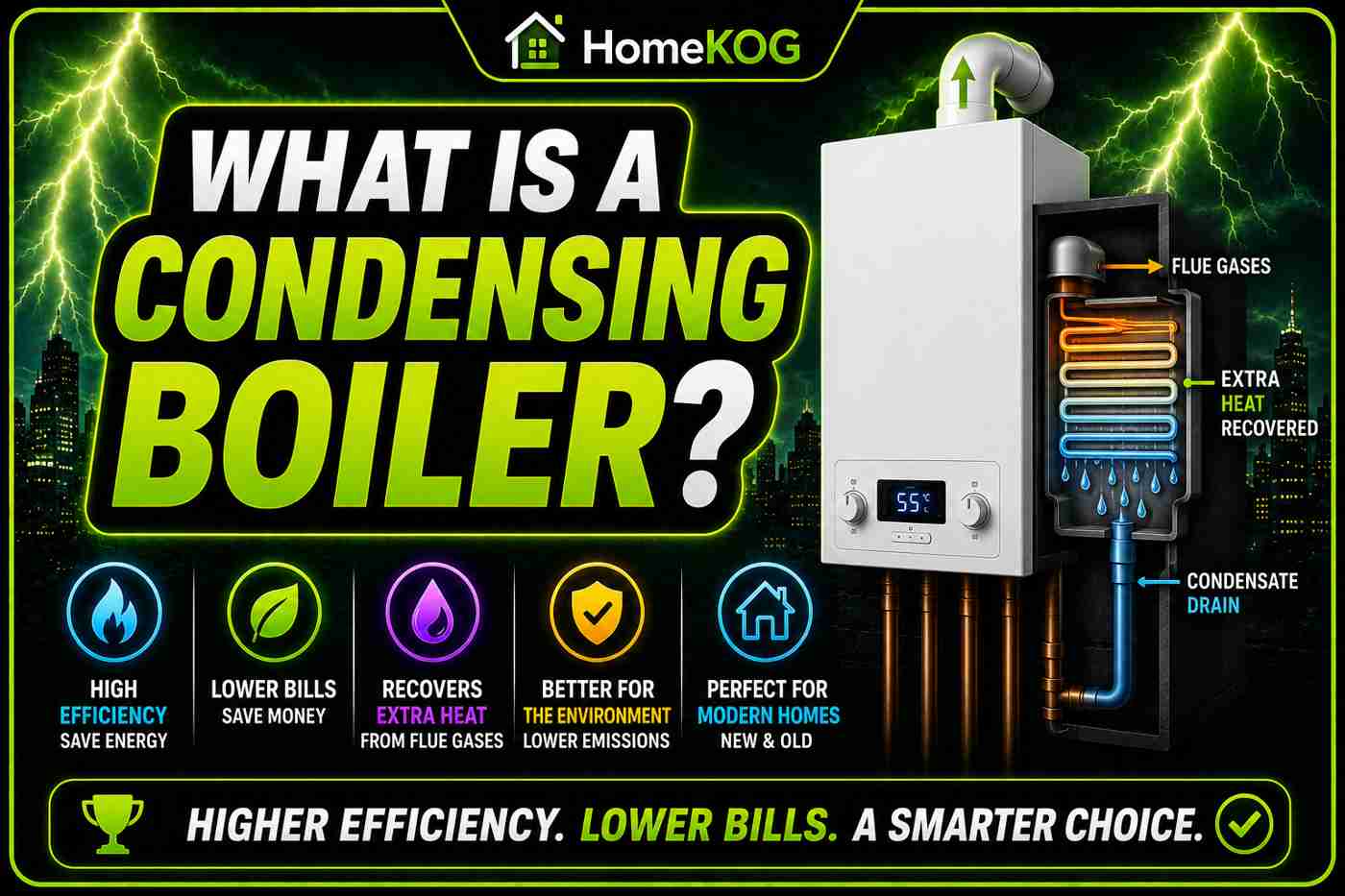
A condensing boiler is a boiler designed to extract as much useful heat as possible from the fuel it burns before releasing waste gases through the flue. It achieves this through a secondary heat exchanger that captures heat from the flue gases — heat that an older non-condensing boiler would simply expel to the atmosphere at around 250°C. By recycling this heat back into the system, a condensing boiler loses only around 55°C of heat through the flue, compared to 250°C for a non-condensing unit.
The efficiency difference is substantial. Non-condensing boilers typically operate at 70 to 80% efficiency — meaning 20 to 30% of the energy consumed is wasted as heat escaping through the flue. Modern condensing boilers achieve A-rated efficiency of over 90%, with premium models reaching up to 98%. The Boiler Plus legislation introduced in April 2018 requires all new gas boilers installed in England to achieve a minimum of 92% efficiency.
The name comes from the condensation process that occurs in the secondary heat exchanger. As cold return water from the heating system passes through the heat exchanger, it cools the flue gases below their dew point — the temperature at which water vapour condenses into liquid. This condensate is acidic and is drained away safely via the condensate pipe to an external drain. The white vapour visible from the flue of a modern condensing boiler in cold weather is this condensation process in action — not smoke.
How Does a Condensing Boiler Work?
Both condensing and non-condensing boilers begin the heating process in the same way. A burner at the bottom of the unit heats fuel — gas or oil — at temperatures of 250 to 350°C. The heat generated passes into the primary heat exchanger, where it transfers into the system water that circulates to the radiators.
The critical difference is what happens to the remaining heat in the flue gases after the primary heat exchanger. In a non-condensing boiler, these gases exit directly to the atmosphere through the flue at around 250°C, taking a significant proportion of the fuel’s energy with them. In a condensing boiler, the hot flue gases are directed upwards into a secondary condensing chamber rather than straight out through the flue.
Inside the condensing chamber, cool return water from the heating system enters at the top rather than the bottom. This cool water — typically around 50 to 60°C after circulating through the radiators — passes through tubes surrounded by the hot flue gases. The flue gases transfer their remaining heat into this cool water, dropping the flue gas exit temperature to around 55°C, before the gases leave through the flue. The return water, now preheated by the condensing chamber, enters the primary heat exchanger already warm and requires less energy to bring to the target flow temperature. This is the efficiency gain — the same amount of fuel produces more useful heat because less of it escapes through the flue.
Older non-condensing boilers use three flat metal baffles in the primary heat exchanger, which allow flue gases to move relatively freely towards the flue. Condensing boilers use zigzag baffles that force hot gases through a longer path, keeping them in contact with the heat exchanger surfaces for longer before directing them into the condensing chamber — further improving heat extraction at the primary stage.
Types of Condensing Boiler
Condensing technology is not a boiler type in itself — it refers to the efficiency design. All three main boiler types are available as condensing units, and since 2005 virtually all new boilers installed in UK homes are condensing by regulation.
Combi Condensing Boilers
The most widely installed boiler type in UK homes. A combi boiler is a fully self-contained unit with no need for a hot water storage cylinder or cold water tank in the loft. It heats water directly from the mains on demand — when a hot tap is opened, the boiler fires and delivers hot water within seconds. The compact size suits smaller homes, flats, and properties where loft or airing cupboard space is limited. what a combi boiler does is provide both heating and hot water in a single unit, making it an efficient choice for modern living. This versatility allows homeowners to benefit from a reliable supply of hot water without the need for additional infrastructure. As a result, many opt for combi boilers to simplify their heating systems while maximizing energy efficiency.
The limitation of a combi boiler is simultaneous demand — when multiple outlets require hot water at the same time, the boiler divides its output between them, reducing flow rate at each. For homes with a single bathroom and up to four occupants, a combi is typically the most practical and cost-effective choice.
System Condensing Boilers
A system boiler works with a separate hot water storage cylinder but has no cold water tank in the loft — the cold feed comes directly from the mains. Most of the system components including the pump and expansion vessel are built into the boiler unit, meaning more components are covered by the manufacturer’s warranty than on a regular boiler installation.
The stored hot water cylinder allows simultaneous high-volume hot water delivery to multiple outlets, making system boilers well suited to larger homes with two or more bathrooms. The limitation is that once the cylinder’s stored hot water is used, a reheating period is required before full supply is restored.
Regular (Conventional) Condensing Boilers
A regular boiler — also called a conventional, traditional, or heat-only boiler — works with both a hot water storage cylinder and a cold water feed tank in the loft. It is the oldest boiler type and operates at lower system pressure than combi or system boilers, making it well suited to older properties with aging pipework and radiators that may not withstand higher pressure systems. understanding pressure release valves is crucial in ensuring the safe operation of any boiler system. These valves help maintain optimal pressure levels, preventing potential hazards caused by excessive buildup. Regular maintenance and inspection of these components can prolong the lifespan of the boiler and enhance overall efficiency.
Regular boilers are the most cost-effective to purchase but only the boiler unit itself is covered by the manufacturer’s warranty — external components including the cylinder, tank, and associated valves are the homeowner’s responsibility. They suit properties where a regular boiler is already installed and the existing cylinder and loft infrastructure is in good condition.
What Size Condensing Boiler Do I Need?
Boiler output is measured in kilowatts (kW) and the correct size depends on the number of bedrooms, bathrooms, and the simultaneous hot water demand of the property.
| Bathrooms | Bedrooms | Recommended Minimum Output |
|---|---|---|
| 1 | 1–4 | 26–29kW |
| 2 | 1–4 | 29–35kW |
| 3 or more | 1–5 | 35kW+ |
Properties where multiple showers, baths, or taps are likely to be used simultaneously — such as a large family home — should lean towards the higher end of the output range for their bathroom count. Oversizing a boiler does not improve performance and reduces efficiency, as an oversized boiler short-cycles — firing and stopping frequently rather than modulating continuously — which increases wear and reduces fuel efficiency.
Are Condensing Boilers Safer Than Non-Condensing Boilers?
Yes. Condensing boilers are safer in two important ways. First, they use a balanced flue that draws combustion air from outside the building rather than from the room the boiler is installed in. Older non-condensing boilers with open flues draw air from the room, creating a risk that combustion gases could be drawn back into the property if the flue is blocked or poorly maintained. A balanced flue eliminates this risk entirely by keeping the combustion air supply and flue gas discharge completely separated from the building’s internal air.
Second, condensing boilers are fully sealed units. There is no risk of poisonous gases leaking from the combustion chamber into the property during normal operation. Additional safety devices that shut down the boiler automatically if the flue is obstructed are standard on all condensing units.
Carbon Monoxide Safety
Despite the improved safety of condensing boilers, carbon monoxide awareness remains essential for all gas appliance installations. Around 60 people die from accidental carbon monoxide poisoning in England and Wales every year, almost all from incorrectly installed, poorly maintained, or faulty appliances. Carbon monoxide is colourless, odourless, and tasteless — it cannot be detected without an alarm, and symptoms of exposure (dizziness, headache, nausea, shortness of breath) are frequently mistaken for flu until serious harm has occurred.
A functioning carbon monoxide alarm is essential in any home with a gas boiler. Alarms should be positioned on the ceiling or on the wall approximately five feet above floor level — carbon monoxide is slightly lighter than air and rises. An alarm on every floor of the property provides the most reliable protection. CO alarms typically last five to seven years depending on the manufacturer and should be replaced before the end of their rated lifespan.
Warning signs that a boiler may be producing carbon monoxide and should be switched off immediately with a Gas Safe engineer called include: a pilot light that burns yellow rather than blue or frequently blows out; gas appliance flames that are predominantly yellow; smoke or heavy condensation building up in rooms; brown or sooty staining around the boiler; or a faint unusual smell from the boiler — while CO is odourless, incomplete combustion of gas can produce detectable odours.
When Should You Replace With a Condensing Boiler?
Any boiler over 15 years old is operating at significantly reduced efficiency compared to current A-rated condensing models and is worth replacing on economic grounds alone. An elderly G-rated boiler operating at 70% efficiency costs substantially more to run annually than a modern condensing boiler at 92% or above — the difference on a typical household gas bill can exceed £300 to £500 per year depending on usage and property size.
Other circumstances where installing a condensing boiler is the appropriate decision include: suspected or confirmed carbon monoxide issues with the existing appliance; adding a bathroom or significantly increasing hot water demand that the current boiler cannot meet; a boiler that has become costly to maintain through repeated repairs; and any scenario where the cost of repairs to an existing non-condensing boiler approaches the cost of replacement.
FAQ
Are all new boilers condensing boilers?
Yes. Since 2005, regulations in the UK require all newly installed gas boilers to be condensing. Non-condensing boilers already in use before that date can continue to operate but cannot be replaced with a new non-condensing unit except in very specific circumstances where a condensing boiler is genuinely not viable — which is rare in modern UK housing.
Why does my condensing boiler produce white vapour from the flue?
The white vapour visible from the flue of a condensing boiler — particularly in cold weather — is water vapour condensing as the cool flue gases meet outdoor air. This is normal and is the visible evidence that the condensing process is working correctly. It is not smoke and is not a sign of any fault. A non-condensing boiler produces much hotter flue gases that typically disperse before becoming visible.
What is the condensate pipe on a condensing boiler?
The condensate pipe carries the acidic liquid water produced during the condensing process from the secondary heat exchanger to an external drain. It is typically a white plastic pipe that exits the boiler and runs to an external drain or soakaway. During freezing weather, the external section of the condensate pipe can freeze and block, causing the boiler to lock out and display a fault code. Thawing the pipe with warm water and resetting the boiler resolves this. Lagging the external section of the pipe prevents recurrence. boiler condensate pipe functions explained include ensuring proper drainage to prevent buildup that could lead to more significant issues. Regular maintenance and inspection of the condensate pipe are essential for the boiler’s efficient operation. Understanding these functions not only aids in troubleshooting but also extends the lifespan of the heating system.
How efficient is a condensing boiler?
Current condensing boilers achieve A-rated efficiency of over 90% under the ErP rating system. The Boiler Plus legislation (2018) requires a minimum of 92% for new installations in England. Premium models including the Viessmann Vitodens 200-W reach up to 98% efficiency. The equivalent rating for older non-condensing boilers is typically between 70 and 80%, meaning 20 to 30% of energy purchased is wasted through flue heat loss.
Do condensing boilers require more maintenance than non-condensing ones?
The annual servicing requirement is the same — a Gas Safe engineer should service every gas boiler once a year regardless of type. Condensing boilers have an additional component — the condensate trap — that requires checking and clearing at service if acidic condensate has caused deposits to accumulate. The condensate pipe also requires monitoring in cold weather for the freezing risk. Neither requires additional maintenance appointments beyond the standard annual service.
Conclusion
Condensing boilers have been the standard for new UK gas boiler installations since 2005 for clear and practical reasons — they are more efficient, safer, and better designed than the non-condensing units they replaced. The secondary heat exchanger that gives them their name and their efficiency advantage captures heat that older boilers waste entirely, reducing fuel consumption and bills for every degree of heating delivered.
For homeowners with a boiler over 15 years old, or any boiler displaying the carbon monoxide warning signs described above, the case for replacement with a modern condensing unit is straightforward. The annual running cost saving from moving from a G-rated non-condensing boiler to an A-rated condensing replacement typically recoups the installation cost within three to five years through reduced gas consumption alone — while providing the additional benefits of a full manufacturer’s warranty, improved reliability, and modern safety design.