
What is a Smart Boiler and What Makes a Boiler Smart? 2026
Quick Answer: A smart boiler is a standard gas boiler connected to a smart thermostat via WiFi, allowing remote control of heating and hot water from a smartphone app from anywhere in the world. Most modern boilers can be made smart by adding a compatible smart thermostat without replacing the boiler itself. Built-in WiFi is now standard on premium models including the Worcester Bosch Greenstar 4000 and Viessmann Vitodens 050-W. Smart thermostats cost from £150 to £300 and can save up to £120 per year on energy bills.
The smart home has moved well beyond smart speakers and connected lighting. Smart heating is now one of the most practical and financially rewarding upgrades available to UK homeowners — allowing heating and hot water to be controlled, scheduled, and monitored from a smartphone whether at home or away, and enabling the boiler to learn from household patterns and adjust its output automatically. This guide explains exactly what makes a boiler smart, how smart thermostats connect and work, which boilers and thermostats lead the market in 2026, and how to decide whether smart heating is right for your home.
What is a Smart Boiler?
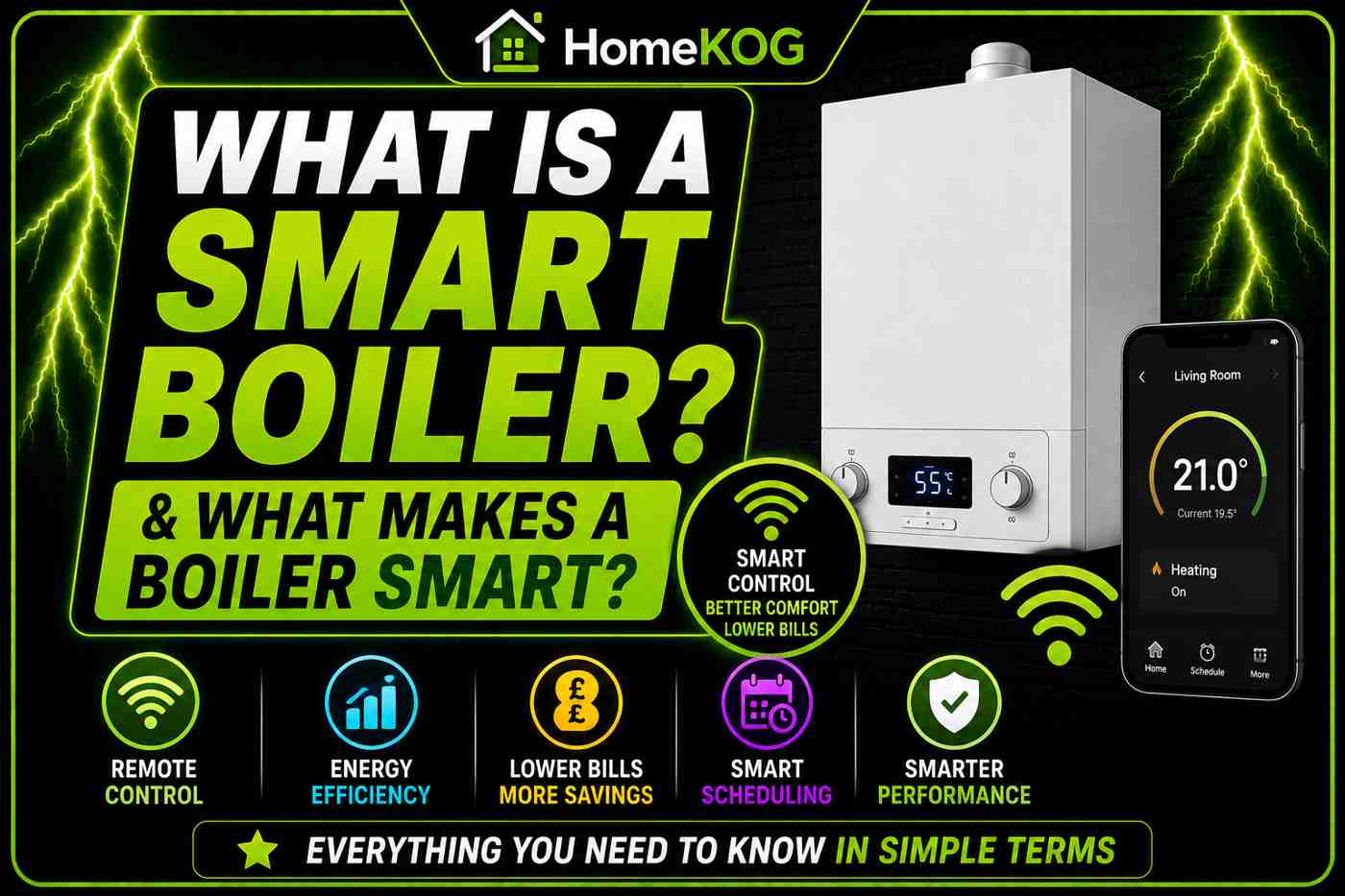
A smart boiler is a gas boiler that has been connected to a smart thermostat and the internet, giving the homeowner remote control of heating and hot water via a smartphone app. The boiler itself does not change — what changes is the level of control and intelligence applied to when and how it operates. Some current boilers include built-in WiFi as standard, allowing direct remote diagnostics and monitoring by the manufacturer or engineer without a call-out. Others can be made smart by adding a compatible smart thermostat to an existing installation. In addition to this advanced connectivity, magnetic filter benefits for boilers can further enhance efficiency and lifespan. By preventing sludge and debris from accumulating within the system, homeowners can expect improved performance and lower maintenance costs. This ensures that the overall heating system operates seamlessly, providing consistent comfort and reliability.
Once connected, a smart heating system can be controlled from anywhere with an internet connection — adjusting temperature, switching heating on or off, setting schedules, monitoring energy usage, and in some cases using voice commands through Amazon Alexa, Google Assistant, or Siri.

How Does a Smart Boiler Work?
A smart boiler system has three connected components working together. The hub plugs into the home’s broadband router and acts as the communication bridge between the internet and the heating system — some hubs connect wirelessly rather than requiring a physical router connection. The receiver is wired to the boiler and connects it to the hub, allowing the smart system to send instructions directly to the boiler. The smart thermostat is the user-facing interface that displays temperature information, allows manual adjustment, and communicates with the app on the homeowner’s smartphone or tablet.
When the homeowner adjusts heating from their phone — whether from the sofa or from a different country — the instruction travels from the app through the internet to the hub, from the hub to the receiver, and from the receiver to the boiler. The system responds within seconds. More advanced learning thermostats go further by monitoring the household’s patterns over time and building a heating schedule automatically, adjusting for occupancy, outdoor temperature, and seasonal changes without requiring any manual programming.
How Do I Make My Boiler Smart?
Making an existing boiler smart requires only the addition of a compatible smart thermostat — the boiler does not need to be replaced. Before purchasing a thermostat, confirm two things. First, that the existing boiler can be controlled by a standard thermostat or programmer — the vast majority of modern gas boilers can. Second, that the smart thermostat chosen is compatible with the specific boiler model — compatibility lists are available on every major thermostat manufacturer’s website.
Installation involves replacing the existing thermostat with the new smart thermostat, connecting the receiver to the boiler, and pairing both devices with the hub and the smartphone app. The process requires confidence with basic wiring. For homeowners who are not comfortable with electrical connections, professional installation is available from most smart thermostat manufacturers and is the recommended route for those with any uncertainty. If a new boiler is being installed, adding a smart thermostat at the point of installation is the most straightforward approach and is usually the most cost-effective.
How Does a Smart Thermostat Connect to a Boiler?
The connection between a smart thermostat and a boiler uses a three-component system. The hub connects to the home’s broadband router either by ethernet cable or wirelessly. The receiver connects physically to the boiler’s existing wiring terminals — typically in the same position as the previous thermostat receiver — and communicates with the hub via a wireless signal. The thermostat itself mounts on a wall, ideally in a hallway away from direct sunlight, draughts, and radiators that could influence the temperature reading. Most manufacturers recommend positioning the receiver close to the boiler but away from large metal objects that could interfere with the wireless signal.
Best Smart Boilers in 2026
Worcester Bosch Greenstar 4000
The Worcester Bosch Greenstar 4000 is one of the best-selling boilers in the UK and one of the most comprehensively smart boilers currently available. Built-in WiFi is standard on the 4000 series, enabling direct remote diagnostics by Worcester Bosch engineers without a call-out visit. The boiler includes a touchscreen LED control panel, a modulating burner for energy-efficient output management, hydrogen-ready credentials for future-proofing, and an optional intelligent filling system for automatic water pressure management. It is compatible with the Worcester Bosch EasyControl smart thermostat and the broader Bosch ecosystem.
Key smart features: Built-in WiFi, touchscreen controls, hydrogen ready, modulating burner, optional intelligent filling system.
Viessmann Vitodens 050-W
The Viessmann Vitodens 050-W is a highly compact A-rated combi boiler with built-in WiFi, touchscreen controls, and a modulating burner. Its ViCare app — rated 4.6 stars on the Apple App Store — enables full remote control and monitoring. While slightly less feature-rich in built-in smart functions than the Worcester Greenstar 4000, the Vitodens 050-W is notably more compact and has an established reputation for reliability. Hydrogen-ready credentials and Viessmann’s stainless steel Inox-Radial heat exchanger add further long-term appeal.
Key smart features: Built-in WiFi, ViCare app, touchscreen controls, hydrogen ready, modulating burner.
Viessmann Vitodens 100-W
The Vitodens 100-W is Viessmann’s flagship combi boiler and a consistent Which? Best Buy. It adds weather compensation capability and a higher maximum efficiency of 94% to the 050-W platform. Full ViCare app compatibility and Vitoconnect smart control module integration make it one of the most capable smart boilers in the mid-to-premium price bracket.
Worcester Bosch Greenstar 8000
The Greenstar 8000 is Worcester Bosch’s premium combi, offering a 12-year maximum warranty and black or white gloss finish options alongside the full Greenstar smart platform. Its EasyControl integration provides the most advanced smart scheduling and energy monitoring available within the Worcester Bosch ecosystem.
Ideal Logic C30
The Ideal Logic C30 is a strong value option for homeowners who want smart capability without the premium price of the Viessmann or Worcester 8000 ranges. Compatible with the Ideal Halo smart thermostat and third-party smart thermostats including Hive and Nest, it delivers A-rated efficiency with straightforward smart integration.
Best Smart Thermostats for UK Boilers in 2026
Google Nest Learning Thermostat
The Nest Learning Thermostat is the most technologically advanced consumer smart thermostat available in the UK. It monitors the household’s heating patterns over the first week of use and builds a personalised schedule automatically, refining it over time as patterns change. Geofencing via the home’s smartphones detects when occupants leave and return, adjusting the heating to avoid warming an empty property. Compatible with combi boilers, system boilers, regular boilers, and air-source heat pumps — though compatibility with individual models should be confirmed before purchase. Widely regarded as the best-designed smart thermostat on the market.
Best for: Households with reasonably consistent routines who want a thermostat that programmes itself.
Hive Active Heating
Hive Active Heating is one of the most widely used smart thermostats in the UK and is compatible with gas, LPG, some electric, and some oil boilers. The Hive app allows full remote control of heating and hot water separately, and the system is compatible with Amazon Alexa, Google Assistant, and Apple Siri for voice control. Centrica claims users can save up to £120 per year through more efficient heating management. British Gas engineers are available to install Hive professionally, though self-installation is supported for confident DIYers.
Best for: Homeowners who want voice control integration and compatibility with an existing smart home ecosystem.
tado° V3+ Smart Thermostat
The tado° system combines geofencing with weather compensation — factoring in the local weather forecast when calculating how much heating the home needs rather than simply responding to indoor temperature. It supports individual room control through smart thermostatic radiator valves and includes open-window detection that identifies when a window has been opened and suspends heating for that room automatically. Smart reporting through the tado° app provides detailed energy usage analysis. Understanding pressure release valve operation principles is essential for optimizing system performance and ensuring safety. These valves play a critical role in maintaining the correct pressure levels within various applications, preventing potential hazards. Proper knowledge and implementation of these principles can lead to increased efficiency and reduced energy consumption in heating systems.
Best for: Households who want room-by-room control and weather-compensated heating for maximum efficiency.
Worcester Bosch EasyControl
The Worcester Bosch EasyControl is designed specifically for Worcester Bosch combi and system boilers including the Greenstar 4000, 8000, Greenstar i, Si Compact, and Highflow CDI. Because it is purpose-built for the Worcester Bosch platform, the integration between thermostat and boiler is tighter than any third-party thermostat can achieve. The app works on both Apple and Android and provides energy monitoring alongside full remote scheduling.
Best for: Worcester Bosch boiler owners who want the tightest possible integration between thermostat and boiler. When considering the best combi boilers for UK homes, it’s essential to assess both efficiency and reliability. Many homeowners prioritize not just performance but also the long-term savings on energy bills. With a variety of options available, selecting the right boiler can significantly enhance comfort throughout the colder months. understanding combi boiler efficiency is crucial when evaluating these systems. High-efficiency models not only reduce energy consumption but also lead to substantial cost savings over time. As technology advances, homeowners have access to more sophisticated options that can further enhance energy efficiency and performance.
Baxi uSense
The Baxi uSense requires a wired connection to the boiler and is compatible with all Baxi combi boilers including the Duo-tec and 600 ranges. It includes a boiler fault diagnosis function and a holiday mode that suspends normal heating schedules during periods away. For Baxi boiler owners, it provides straightforward smart integration at a competitive price.
Best for: Baxi boiler owners seeking a purpose-built, no-fuss smart thermostat with fault diagnosis capability.
EPH CP4i Smart Thermostat
The EPH CP4i is controlled via the EMBER app and includes programmable scheduling, wireless connection, frost protection, weather compensation, and zonal control. It is a strong option for homeowners who want weather compensation capability at a competitive price point without committing to the premium pricing of the Nest or tado° systems.
Best for: Budget-conscious homeowners who want weather compensation and zone control without premium pricing.
How Much Does a Smart Boiler Cost?
The cost of smart heating depends on whether a new boiler is being installed or whether an existing boiler is simply being upgraded with a smart thermostat.
| Option | Typical Cost |
|---|---|
| Smart thermostat only (self-install) | £150 – £300 |
| Smart thermostat with professional installation | £250 – £450 |
| New smart combi boiler (unit only) | £840 – £1,950 |
| New smart combi boiler fully installed | £1,800 – £3,200 |
| Monthly subscription services (some thermostats) | £3 – £5 per month |
Annual savings from smart heating are typically cited at £60 to £120 per year for an average UK home, depending on the household’s previous heating habits and the efficiency of the smart thermostat’s scheduling and geofencing functions. Homes that previously left heating running on fixed schedules regardless of occupancy tend to see the largest savings.
Smart Boilers: Pros and Cons
Smart heating offers genuine benefits for most UK homeowners but is not the right fit for every household. Understanding both sides is the clearest basis for the decision.
Advantages of smart heating include full remote control of heating and hot water from anywhere in the world, automatic adjustment based on occupancy through geofencing, energy usage monitoring and reporting, integration with voice assistants and smart home ecosystems, the ability to heat specific zones or rooms independently, and potential savings of £60 to £120 per year from more efficient heating management.
Disadvantages include the upfront cost of a smart thermostat (£150 to £300 plus potential installation), compatibility limitations with certain older boiler models, the time required for learning thermostats to establish accurate patterns in households with irregular routines, additional maintenance compared to a standard thermostat, and the potential for subscription costs on some platforms.
Is a Smart Boiler Right for Me?
Smart heating delivers the greatest benefit for homeowners who regularly leave the house to find it over-heated or return to a cold home, who want to stop wasting energy heating unoccupied rooms or properties, who already use voice control or smartphone apps for other home devices and would find the same approach to heating natural, or who want to monitor and actively reduce their heating-related carbon footprint.
Smart heating is less immediately impactful for homeowners who already keep close manual control of their heating, who have a very consistent and simple daily routine that a standard programmer can handle, or who are uncomfortable with smartphone apps or WiFi-connected devices. For these households, the financial savings will be more modest and the learning curve may outweigh the benefit.
FAQ
Do I need to replace my boiler to get smart heating?
No. Most modern gas boilers can be connected to a smart thermostat without any changes to the boiler itself. Confirming compatibility between the chosen smart thermostat and the existing boiler model before purchase is the only requirement. If a new boiler is being installed, adding a smart thermostat at installation is the most convenient and often most cost-effective approach.
Can a smart thermostat work with any boiler?
Smart thermostats are compatible with the majority of modern combi, system, and regular gas boilers, but not universally. Some thermostats are designed specifically for individual boiler brands — the Worcester Bosch EasyControl only works with Worcester Bosch models, for example. Third-party thermostats like Nest and Hive work with most boilers but should be checked against the specific model before purchasing. The manufacturer’s compatibility checker is the definitive reference.
How much can I save with a smart boiler?
Savings vary significantly based on how the heating was managed previously. Households that previously used a fixed programmer without any occupancy adjustment typically see the largest savings — up to £120 per year according to Hive’s figures. Households already managing heating carefully may see smaller savings. The geofencing function that prevents heating running in an empty property is the single largest contributor to energy savings in most households.
What is geofencing in a smart thermostat?
Geofencing is a feature that uses the GPS location of the household’s smartphones to determine when occupants have left and are returning home. When the last occupant leaves the property, the thermostat reduces heating to a minimum. When an occupant’s phone shows they are approaching home, the thermostat activates heating to ensure the property is warm on arrival. This prevents the common energy waste of heating running on a fixed schedule in an empty house.
Can I control a smart boiler with my voice?
Yes, provided the smart thermostat is compatible with a voice assistant. Hive is compatible with Amazon Alexa, Google Assistant, and Apple Siri. Nest integrates natively with Google Home. tado° supports both Alexa and Google Home. Worcester Bosch EasyControl and Baxi uSense have more limited voice integration. Confirming voice assistant compatibility before purchasing is straightforward via each manufacturer’s compatibility page.
What is the best smart thermostat for a UK home in 2026?
The Google Nest Learning Thermostat is the most technically advanced option for households with consistent routines who want a thermostat that programmes itself automatically. Hive Active Heating is the most widely compatible and most accessible option for households who want simple setup with strong voice control integration. tado° is the strongest choice for households who want weather compensation and room-by-room control. Worcester Bosch EasyControl is the best choice for Worcester Bosch boiler owners specifically. The right choice depends primarily on the existing boiler model and the household’s smart home ecosystem.
Conclusion
Smart heating is no longer a niche technology — it is a practical and increasingly accessible upgrade that delivers genuine energy savings and convenience for the majority of UK households. The key decision is not whether to go smart, but which combination of boiler and thermostat delivers the best fit for the specific property, routine, and smart home setup already in place.
For homeowners installing a new boiler in 2026, specifying a model with built-in WiFi — such as the Worcester Bosch Greenstar 4000 or Viessmann Vitodens 050-W — and adding a compatible smart thermostat at installation is the most seamless and cost-effective route to full smart heating control. For those making an existing boiler smart, a compatible third-party thermostat such as the Nest, Hive, or tado° provides the same core remote control and scheduling capability at a fraction of the cost of a new boiler installation.