
Biasi Boiler Error Codes: Full Guide to Causes and Fixes 2026
Quick Answer: The most common Biasi boiler error codes are ER 04 (primary circuit fault — low pressure or no flow), ER 01 (ignition failure lockout), ER 02 (safety thermostat lockout), and ER 14 (pump fault or temperature spike). ER 04 can sometimes be resolved by repressurising the system if pressure has dropped below 1.5 bar. All lockout codes and component faults require a Gas Safe registered engineer to diagnose and repair. Understanding ideal boiler error codes explained allows homeowners to take initial steps in troubleshooting their heating system. Familiarity with these codes can help in identifying the specific issues before calling a professional. However, it’s crucial to remember that safety should always come first, and any repairs should be conducted by a qualified technician.
Biasi is an Italian boiler manufacturer whose products have been installed across the UK in significant numbers, particularly in the budget and mid-range categories. Models including the Biasi 24S and Biasi Riva Plus are among the most commonly serviced. Like all manufacturers, Biasi uses a fault code system to identify problems quickly — and understanding what each code means is the fastest way to determine whether a simple fix will restore heating and hot water or whether a Gas Safe engineer is needed.
Biasi Fault Code Structure
Biasi fault codes are displayed in two formats. Codes prefixed with ER indicate error conditions, with a + symbol indicating the boiler remains operational and a + Reset suffix indicating the boiler has entered lockout mode and requires a manual reset before it will restart. The FL and Li codes are status indicators for specific pressure and temperature conditions rather than component faults.

Common Biasi Boiler Error Codes
ER 04 — Primary Circuit Fault (Low Pressure or No Flow)
ER 04 is the most commonly seen Biasi fault code and indicates an error within the primary heating circuit, most often caused by insufficient water pressure or a very weak water flow through the system. It is the Biasi code most likely to be resolved by the homeowner without calling a Gas Safe engineer.
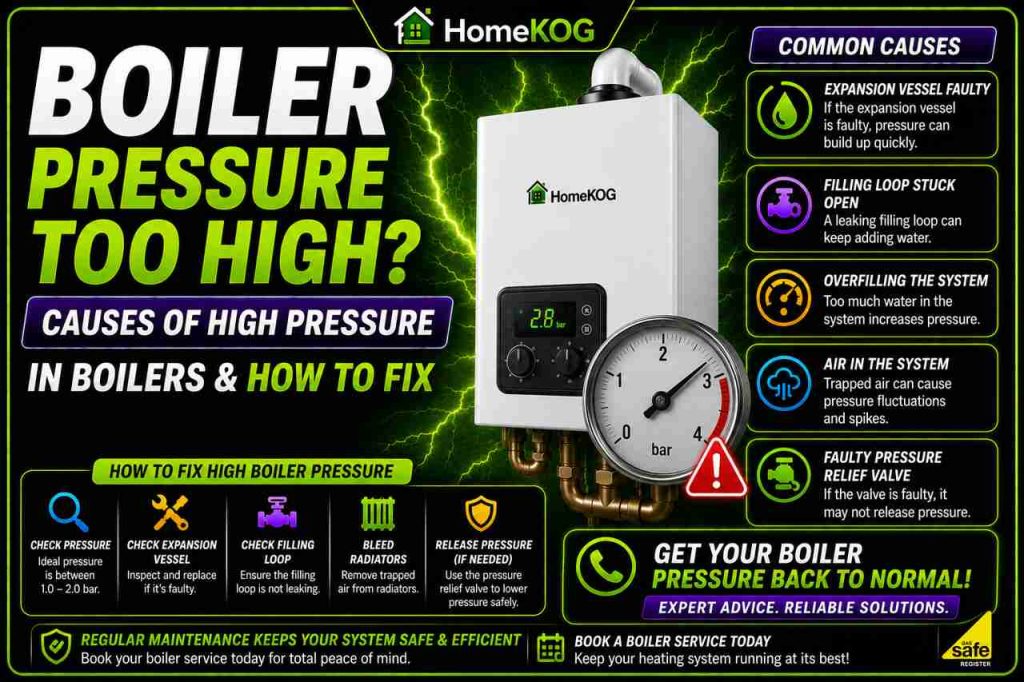
The first check when ER 04 appears is the system pressure gauge. If the pressure reads below 1.5 bar, adding water to the system via the filling loop — following the method described in the Biasi boiler manual for the specific model — will restore pressure and may clear the fault. The target pressure for most Biasi models when cold is between 1 and 1.5 bar. If pressure is within the correct range and ER 04 persists, the problem is more likely with the pump, which requires a Gas Safe engineer to inspect and repair.
If pressure drops again shortly after being restored, a leak in the central heating system is the likely cause and a Gas Safe engineer should locate and repair the source rather than the homeowner continuing to repressurise repeatedly.
Can you fix it yourself? Check pressure first — repressurise if below 1.5 bar. Call a Gas Safe engineer if pressure is correct or drops repeatedly.
ER 01 — Ignition Failure Lockout
ER 01 indicates the boiler has failed to ignite during the start-up sequence and has entered safety lockout mode. The most common causes are a gas supply interruption, blocked burner jets, wiring faults, or a problem with the PCB. Checking that other gas appliances in the property are working normally is the first step — if they are not, a gas supply issue rather than a boiler fault is the likely cause.
If the gas supply is confirmed and a single reset attempt does not restore the flame, a Gas Safe engineer should inspect the burner, ignition electrode, gas valve, and PCB wiring before the boiler is returned to service. Blocked burner jets are a common cause on older Biasi models and can be cleaned by an engineer during a service without requiring component replacement.
Can you fix it yourself? Check gas supply and attempt one reset. Call a Gas Safe engineer if ER 01 persists.
ER 02 — Safety Thermostat Lockout
ER 02 means the boiler’s safety thermostat has tripped and entered lockout mode to prevent overheating damage to internal components. The thermostat activates when the boiler reaches a temperature that could cause harm if operation continued. The most common underlying causes are a pump failure or reduced circulation preventing heat from being distributed effectively, an airlock in the system, or a thermostat that has developed a fault and is tripping at a lower temperature than intended.
Because diagnosing the cause requires removing the boiler casing and inspecting internal components, a Gas Safe engineer must carry out the investigation before the boiler is restarted. Resetting an ER 02 lockout without establishing the underlying cause risks repeated overheating that can permanently damage the heat exchanger.
Can you fix it yourself? No — a Gas Safe engineer must inspect the cause before any reset is attempted.
ER 14 — Pump Fault or Temperature Spike
ER 14 appears in two variants. With a + Reset suffix it indicates the pump is damaged or the primary circuit temperature has risen above 105°C — both serious conditions requiring lockout and immediate engineer inspection. Without the + Reset suffix, the code indicates the temperature gradient in the flow pipe is rising faster than 2K per second, which typically points to a circulation problem rather than a pump failure — though the two are closely related.
In both variants, a Gas Safe engineer should assess the pump, the circulation system, and the heating circuit before the boiler is restarted. Repeated ER 14 faults without resolving the underlying circulation issue can cause progressive and expensive heat exchanger damage.
Can you fix it yourself? No — a Gas Safe engineer is required for both variants.
Full Biasi Boiler Error Code Reference
| Code | Fault | Reset Required? | DIY Fix? |
|---|---|---|---|
| ER 01 | Ignition failure lockout | Yes | Check gas supply, attempt reset — then engineer |
| ER 02 | Safety thermostat lockout | Yes | No — engineer required |
| ER 03 | General lockout | Yes | Attempt reset — engineer if recurring |
| ER 04 | Primary circuit fault — no water or weak flow | No | Check and restore pressure — engineer if pump fault |
| ER 05 | Fan control system fault | No | No — engineer required |
| ER 06 | Central heating NTC temperature probe damaged | No | No — engineer required |
| ER 07 | Domestic hot water NTC temperature probe damaged | No | No — engineer required |
| ER 08 | External NTC temperature probe damaged | No | No — engineer required |
| ER 09 | Flue NTC temperature probe fault | No | No — engineer required |
| ER 10 | Flue probe intervention lockout | Yes | No — engineer required |
| N/A | Flame detection error | — | No — engineer required |
| ER 12 | Central heating NTC temperature probe damaged | No | No — engineer required |
| ER 13 | Delivery to return temperature differential exceeds 40K | No | No — engineer required |
| ER 14 + Reset | Pump damaged or primary temperature exceeded 105°C | Yes | No — engineer required |
| ER 14 | Excessive flow temperature gradient (more than 2K/s) | No | No — engineer required |
| ER 19 | Domestic hot water inlet probe failure | No | No — engineer required |
| ER 25 | Flame detection fault lockout | Yes | No — engineer required |
| ER 69 | Wiring fault lockout | Yes | No — engineer required |
| Li | Primary circuit temperature limit reached during hot water operation | — | No — engineer if recurring |
| FL | System pressure too high | — | Bleed radiator — engineer if recurring |
Fault Code Detail: Key Secondary Codes
ER 03 — General Lockout
ER 03 is a non-specific lockout code that indicates the boiler has shut down without a more precisely identified cause. A single reset attempt is appropriate as a first step. If the boiler restarts and operates normally, the lockout was a temporary event. If ER 03 returns after resetting, a Gas Safe engineer should investigate the boiler to identify the underlying cause rather than the homeowner continuing to reset repeatedly.
ER 05 — Fan Control System Fault
The fan controls combustion air supply and flue gas exhaust — both critical to safe and efficient operation. A fault in the fan control system can prevent the boiler from firing and will cause a lockout if the fan is not running within the correct parameters. Fan motor failure, a wiring fault, or a faulty fan control board are the most common causes. A Gas Safe engineer should inspect and replace the fan or associated components as required.
ER 06, ER 07, ER 08, ER 12 — NTC Temperature Probe Faults
NTC temperature probes are thermistor-based sensors that monitor water temperature at key points in the heating and hot water circuits. ER 06 and ER 12 both relate to central heating circuit probes, ER 07 to the domestic hot water probe, and ER 08 to an external temperature probe used in weather-compensated systems. A damaged probe can cause the boiler to misread water temperature and shut down unnecessarily. Probe replacement is typically an inexpensive repair when the sensor itself has failed, but the engineer should also check wiring to the probe as a disconnection or short circuit can produce the same code as a failed sensor.
ER 09 and ER 10 — Flue Temperature Probe Faults
ER 09 indicates a fault with the flue NTC probe — the sensor that monitors flue gas temperature as a safety measure. ER 10 is the lockout version, indicating the flue probe has detected conditions that triggered a safety shutdown. Both require a Gas Safe engineer to inspect the flue probe and the flue system before the boiler is restarted, as a flue temperature fault can indicate heat exchanger problems or flue blockages that must be confirmed safe before operation resumes.
ER 13 — Excessive Delivery to Return Temperature Differential
ER 13 appears when the difference between the flow and return water temperatures exceeds 40K, which indicates that heat is not being transferred effectively from the water to the radiator circuit. This is most commonly caused by poor circulation — a failing pump, a closed or restricted radiator valve, or an airlock — and occasionally by a heat exchanger that has become fouled with sludge. A Gas Safe engineer should inspect the full heating circuit to identify the cause of the differential.
ER 19 — Domestic Hot Water Inlet Probe Failure
ER 19 indicates a failure of the sensor that monitors the temperature of cold water entering the domestic hot water circuit. A failed inlet probe prevents the boiler from correctly managing the heating of domestic hot water and will cause hot water delivery problems. Probe replacement by a Gas Safe engineer is required.
ER 25 — Flame Detection Fault Lockout
ER 25 is a lockout specifically related to a fault in the flame detection system — distinct from ER 01 which is a broader ignition failure. Where ER 01 covers the full ignition sequence, ER 25 specifically indicates the flame detection electrode or its associated circuit has developed a fault. A Gas Safe engineer should inspect and clean or replace the detection electrode and check the wiring between the electrode and the PCB.
ER 69 — Wiring Fault Lockout
ER 69 indicates a wiring fault serious enough to trigger a safety lockout. Wiring faults can affect multiple components and can be difficult to trace without systematic testing of the boiler’s electrical circuits. A Gas Safe engineer should carry out a full wiring inspection before attempting to reset the boiler, as resetting a boiler with an unidentified wiring fault can mask the problem and risk further electrical damage.
Li — Primary Circuit Temperature Limit Reached
The Li status code appears when the primary circuit temperature reaches its limit during domestic hot water operation — the boiler is prioritising hot water heating and the central heating circuit has reached maximum temperature as a result. This is not necessarily a fault in itself and may clear once hot water demand ends. If Li appears frequently or persists outside of high hot water demand periods, a Gas Safe engineer should assess the system’s circulation and heat distribution.
FL — High System Pressure
The FL code indicates system pressure is too high. Bleeding a radiator to release a small volume of water from the system is the appropriate homeowner action to reduce pressure. If FL appears without the system having recently been overfilled, a faulty expansion vessel or a pressure relief valve that is not opening at the correct pressure is the likely cause, and a Gas Safe engineer should investigate.
Can you fix it yourself? Try bleeding a radiator to reduce pressure. Call an engineer if FL recurs without overfilling.
FAQ
What does the Biasi ER 04 fault code mean?
The Biasi ER 04 fault code indicates an error within the primary heating circuit, most commonly caused by insufficient water pressure or very weak water flow. It is the most common Biasi fault code. Checking the system pressure and repressurising via the filling loop if the pressure is below 1.5 bar will resolve ER 04 in many cases. If pressure is within the correct range when ER 04 appears, the pump is the most likely cause and a Gas Safe engineer should inspect it.
Can I fix Biasi boiler faults myself?
ER 04 can sometimes be resolved by the homeowner by repressurising the system if pressure has dropped below 1.5 bar. The FL high pressure code can be addressed by bleeding a radiator. A single reset attempt is appropriate for ER 01, ER 03, and ER 25 after confirming the gas supply. All other Biasi fault codes — particularly ER 02, ER 14, and ER 69 — require a Gas Safe registered engineer to diagnose and repair safely before any reset is attempted.
What causes the Biasi ER 01 fault code?
The Biasi ER 01 fault code means the boiler has failed to ignite and has entered safety lockout. The most common causes are a gas supply interruption, blocked burner jets, wiring faults between the ignition components, or a PCB problem. Checking that other gas appliances are working confirms the gas supply is active. If the supply is fine, a single reset attempt is appropriate. If ER 01 returns after one reset, a Gas Safe engineer should inspect the burner, ignition electrode, gas valve, and PCB before the boiler is restarted. In addition to the ER 01 fault code, it’s important for homeowners to be aware of other potential issues that could arise with their heating systems. Understanding daikin boiler error code troubleshooting can help identify and resolve problems before they escalate. Regular maintenance and timely inspections will ensure the boiler operates efficiently and reduce the likelihood of further faults.
What does the Biasi ER 02 code mean?
The Biasi ER 02 code means the safety thermostat has tripped and the boiler has entered lockout mode to prevent overheating. The underlying cause is most commonly a pump failure reducing water circulation, an airlock in the system, or a thermostat that has developed a fault and is tripping prematurely. Because diagnosing ER 02 requires removing the boiler casing, a Gas Safe engineer must carry out the inspection. The boiler should not be reset until the underlying cause has been identified, as repeated overheating can permanently damage the heat exchanger.
What is the difference between ER codes with + Reset and those without?
On Biasi boilers, codes displaying + Reset alongside the error code indicate the boiler has entered full lockout mode and the fault condition must be resolved before a manual reset can be performed. These are the more serious faults where the boiler has determined it cannot safely continue operation. Codes displaying + without Reset indicate the boiler has detected a fault but has not entered full lockout — it may continue to attempt operation while displaying the code, though the underlying fault should still be addressed promptly.
How do I prevent Biasi boiler fault codes?
Annual servicing by a Gas Safe registered engineer is the most effective way to prevent Biasi fault codes. During a service the engineer cleans the burner jets — one of the most common causes of ER 01 on Biasi boilers — checks gas pressure and combustion quality, inspects all NTC temperature probes and their wiring, tests the pump and circulation system, and identifies any components approaching the end of their service life. Keeping the system pressure between 1 and 1.5 bar with the boiler cold also prevents ER 04 from triggering and reduces the risk of secondary circulation faults that can lead to ER 02 and ER 14 lockouts.
When should I replace a Biasi boiler rather than repair it?
A Biasi boiler under 10 years old with a single straightforward fault is almost always worth repairing. For older Biasi models where the PCB has failed, multiple NTC probes require replacement, or the pump needs replacing for the second time, the economics of continued repair versus a new A-rated boiler installation are worth reviewing honestly with a Gas Safe engineer. PCB replacement in particular can be expensive — often £200 to £500 including parts and labour — and on a boiler that is already 10 or more years old, that investment may be better directed towards a new boiler with a fresh manufacturer’s warranty.
Conclusion
Biasi’s fault code system covers a comprehensive range of faults across the 24S, Riva Plus, and other models in the range. Of all the codes in this guide, ER 04 is the most likely to be resolved by the homeowner — by repressurising the system to between 1 and 1.5 bar when pressure has dropped. Bleeding a radiator to address FL high pressure is also within the homeowner’s scope. A single reset is appropriate for ER 01 and ER 03 after the gas supply is confirmed. For all other codes — and particularly the lockout codes ER 02, ER 14, and ER 69 — a Gas Safe registered engineer should carry out a full inspection before any reset is attempted.
Annual servicing remains the most effective prevention strategy, keeping the burner clean, the sensors calibrated, and the pump and circulation system operating within correct parameters throughout the boiler’s expected 10 to 15-year operational lifespan. understanding system boiler operation is crucial for both efficiency and safety. Regular checks can identify potential issues before they escalate, ensuring reliable heating performance. By familiarizing oneself with the key components and their functions, users can make informed decisions about maintenance and service needs.