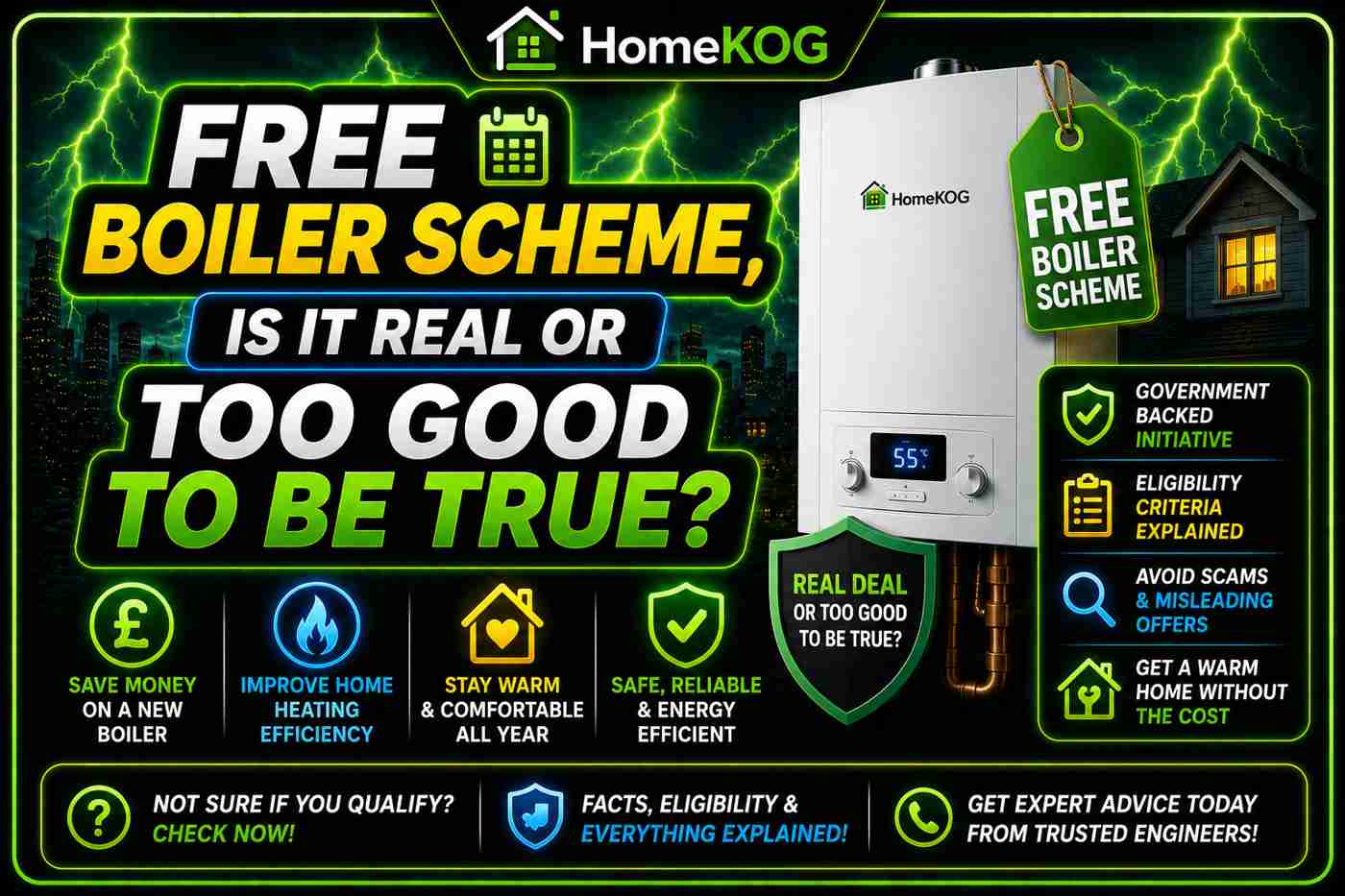

Free Boiler Scheme: Is It Real or Too Good to Be True?
Quick Answer
Yes, the “free boiler scheme” is real, but the phrase is a simplification. In 2026, support usually comes through schemes such as ECO, local authority-led Warm Homes funding, or low-carbon heating grants. A completely free replacement is possible for some households, but eligibility, property type, and the heating measure offered all matter. (GOV.UK)
If you have heard the words “free boiler” and assumed it sounded too good to be true, the honest answer is this: it is real for some households, but it is not a universal offer and it is not always a like-for-like free gas boiler replacement. In 2026, the rules are more nuanced than many adverts suggest. (GOV.UK)
The main thing to understand is that government-backed help exists, but it sits under formal schemes with specific eligibility rules. Some people may qualify for a fully funded heating upgrade, while others may only qualify for partial help, insulation, or a heat pump grant rather than a free boiler. (GOV.UK)
Free Boiler Scheme Entity Relationships
- Free boiler scheme → usually refers to → government-backed home energy support.
- ECO → targets → lower-income and eligible households.
- Warm Homes: Local Grant → supports → eligible households in England.
- Boiler Upgrade Scheme → funds → heat pumps and some biomass boilers.
- Homeowner eligibility → depends on → income, benefits, and property efficiency.
- Private tenants → need → landlord permission for works.
- EPC rating → affects → scheme eligibility.
- Local authorities → can use → ECO Flex referrals for some households.
- Energy suppliers → may deliver → ECO-funded measures.
- Free installation claims → do not always mean → every applicant gets a free gas boiler.
- Low-carbon heating grants → often replace → fossil fuel systems with heat pumps.
- Reputable installer → should hold → the correct certifications and approvals.

What Does “Free Boiler Scheme” Actually Mean in 2026?
In practice, “free boiler scheme” is a marketing phrase, not the official name of one single nationwide boiler giveaway. In 2026, help is mainly delivered through broader energy-efficiency schemes, especially the Energy Company Obligation, known as ECO, plus some local authority schemes and low-carbon heating grants. (Ofgem)
That means the offer you receive may not always be a free gas combi boiler. Depending on your circumstances, you might instead be offered insulation, first-time central heating, a renewable heating upgrade, or other energy-saving improvements that better fit the scheme rules. (Ofgem)
Is the Free Boiler Scheme Real?
Yes, the underlying support is real. GOV.UK confirms that people may be able to get help from their energy supplier through the Energy Company Obligation, and Warm Homes: Local Grant is also live in England for eligible homes. The Boiler Upgrade Scheme is separate and offers grants toward heat pumps and, in limited cases, biomass boilers rather than free gas boiler swaps. (GOV.UK)
The catch is that not everyone qualifies, and not every property will receive the same type of upgrade. So the phrase is real in principle, but the promise of a free replacement boiler for everyone is not. (GOV.UK)
Which Schemes Matter in 2026?
ECO and ECO Flex
ECO is the main Great Britain-wide energy efficiency scheme aimed at cutting fuel poverty and reducing carbon emissions. GOV.UK says homeowners may qualify if they own a property with an EPC of D, E, F or G, while private renters may qualify if the property is rated E, F or G and the landlord gives permission. Eligibility is often tied to certain benefits, and local authorities can also refer some low-income households through ECO Flex. (GOV.UK)
There is an important 2026 detail here: Ofgem says ECO4 runs until 31 March 2026, and the scheme has also been amended, so current delivery depends on the latest rules and transitional arrangements. That means people should always check live eligibility rather than relying on an old article or advert. (Ofgem)
Warm Homes: Local Grant
Warm Homes: Local Grant is available in England and is aimed at low-income households, certain benefit recipients, or people living in specific postcode areas. GOV.UK says it can fund free energy-saving improvements, and official guidance says it covers energy performance upgrades and low-carbon heating for privately owned homes in England with EPC ratings between D and G. (GOV.UK)
This is one of the clearest reasons why the “free boiler” message can be misleading. In some cases, the funded improvement may be heating-related, but the wider goal is improving the home’s energy performance, not simply handing out boilers. (GOV.UK)
Boiler Upgrade Scheme
The Boiler Upgrade Scheme is real too, but it is not a free boiler scheme in the usual sense. GOV.UK says it offers grants in England and Wales for replacing fossil fuel systems with an air source heat pump or ground source heat pump, with grants of up to £7,500, and £5,000 for biomass boilers in limited circumstances. It is scheduled to run until 31 December 2027. (GOV.UK)
So if you are hoping for help in 2026, the support may be available, but it may point you toward low-carbon heating instead of another gas boiler. (GOV.UK)
Who Can Benefit From a Free or Subsidised Boiler Upgrade?
The households most likely to qualify are those on lower incomes, those receiving certain benefits, and those living in inefficient homes. GOV.UK lists benefits such as Universal Credit, Pension Guarantee Credit, Pension Savings Credit, Income Support, income-based JSA, income-related ESA, Child Benefit, and Housing Benefit under the ECO route. (GOV.UK)
Private tenants can also qualify in some cases, but they usually need the landlord’s permission. Local authority referral routes may help some households that are not on listed benefits but are still on a low income or vulnerable to living in a cold home. (GOV.UK)
Typical eligibility checkpoints
| Eligibility factor | What usually matters |
|---|---|
| Income or benefits | Certain means-tested or qualifying benefits may help under ECO. |
| Property EPC | Lower EPC bands are usually more likely to qualify. |
| Tenure | Homeowners and some private tenants may be eligible. |
| Landlord consent | Usually required for rented private homes. |
| Location | Some schemes depend on council area or postcode. |
| Existing heating | The system you have now can affect the support offered. |
These are broad rules, but the exact decision is always scheme-specific and property-specific. (GOV.UK)
What Happens When You Apply?
The exact process depends on the scheme. In general, you will either check eligibility through a GOV.UK route, your local authority, or an approved installer or supplier working under the scheme. From there, the property usually needs some form of assessment before any work is approved. (GOV.UK)
That assessment is there for a reason. The scheme provider needs to know what heating you have now, what your home’s efficiency is like, and which upgrade gives the best result under the funding rules. That is why not every successful applicant receives the same measure. (GOV.UK)
Basic application process
- Check which live scheme applies to your home and region.
- Confirm whether your income, benefits, and EPC rating fit the rules.
- Arrange an assessment if the provider confirms likely eligibility.
- Review the measure offered, which may be a boiler, insulation, first-time heating, or low-carbon heating.
- Proceed only with an approved, properly certified installer.
How To Avoid Scams
The fact that the schemes are real does not mean every cold-call or ad is trustworthy. Be careful with any company that guarantees a free boiler before checking your property, pressures you for immediate decisions, or is vague about which government scheme they are using.
A genuine route should be able to explain the scheme clearly, set out your eligibility, and show the installer credentials needed for the work. If it is a gas boiler, the installer must be Gas Safe registered. If it is a heat pump, scheme-specific certification requirements may apply. (Ofgem)
Free Boiler Scheme vs Heat Pump Grant
A lot of confusion comes from mixing these up. One is usually about fuel-poverty and energy-efficiency support, while the other is about low-carbon heat.
Comparison table
| Scheme | What it is mainly for | What you may get | Where |
|---|---|---|---|
| ECO / ECO Flex | Energy efficiency and fuel poverty support | Measures can include heating and efficiency upgrades | Great Britain |
| Warm Homes: Local Grant | Low-income household upgrades | Free energy improvements and low-carbon heating | England |
| Boiler Upgrade Scheme | Decarbonising heating | £7,500 toward heat pumps, £5,000 biomass in limited cases | England and Wales |
This is why two households can both say they got help with heating, while one got a free upgrade package and the other got a grant toward a heat pump. (GOV.UK)
Is It Worth Applying?
Yes, if you think you may qualify, it is worth checking. The worst outcome is usually that you find out you are not eligible. The best outcome is that you receive a funded or heavily subsidised upgrade that improves comfort, lowers bills, and reduces emissions.
The key is to go into the process with realistic expectations. In 2026, genuine support exists, but it is targeted, conditional, and increasingly tied to wider home energy improvements rather than a simple blanket promise of a free gas boiler. (GOV.UK)
Is the Free Boiler Scheme a Viable Option to Save on Boiler Replacement Costs in 2026?
The Free Boiler Scheme presents a practical solution for homeowners looking to mitigate their expenses in 2026. By leveraging government incentives, participants can achieve significant boiler installation cost savings. This initiative not only reduces financial burdens but also promotes energy efficiency, making it an attractive option for many. Additionally, homeowners should consider the cost benefits of boiler servicing, which can extend the life of their heating systems and prevent costly breakdowns. Regular maintenance ensures optimal performance, leading to further energy savings. By investing in servicing now, residents can enjoy long-term financial gains while contributing to a more sustainable living environment.
FAQs
Is the free boiler scheme real in 2026?
Yes, the support behind the phrase is real in 2026, but it usually comes through formal schemes such as ECO, Warm Homes: Local Grant, or other home energy programmes. The phrase “free boiler scheme” is informal and can be misleading because not every eligible household gets a free gas boiler. Some may get insulation, a first-time heating system, or a low-carbon heating upgrade instead. (GOV.UK)
Who qualifies for a free boiler replacement?
Eligibility usually depends on a mix of household income, qualifying benefits, property EPC rating, and whether you own or privately rent the home. GOV.UK says qualifying benefits under ECO can include Universal Credit, Pension Guarantee Credit, Housing Benefit, Income Support, and others. Local authority referral routes can also include some low-income households not receiving those benefits. (GOV.UK)
Can private tenants get a free boiler?
Sometimes, yes. GOV.UK says private renters may be eligible under ECO if the property has the required EPC rating and the landlord gives permission. The exact outcome depends on the scheme rules and the condition of the property, so a tenant should expect an assessment rather than an automatic approval. (GOV.UK)
Is ECO4 still running in 2026?
Ofgem says ECO4 runs until 31 March 2026, and the scheme has also been amended, so 2026 applications depend on the live timetable and the latest delivery arrangements. That means some support may still be available during 2026, but applicants should check current rules rather than assuming old eligibility still applies unchanged. (Ofgem)
Does the Boiler Upgrade Scheme give you a free boiler?
No, not in the usual gas boiler sense. The Boiler Upgrade Scheme gives upfront grants toward heat pumps and, in limited cases, biomass boilers. GOV.UK says it offers up to £7,500 toward air source and ground source heat pumps, and £5,000 for eligible biomass systems. It is a grant scheme, not a universal free boiler replacement scheme. (GOV.UK)
What is Warm Homes: Local Grant?
Warm Homes: Local Grant is an England-only scheme that can provide free energy-saving improvements to eligible households on a low income, on certain benefits, or in some postcode areas. Official guidance says it covers energy performance upgrades and low-carbon heating, especially for privately owned homes with EPC ratings from D to G. (GOV.UK)
How do I apply for a free boiler scheme?
The route depends on the scheme. You may need to apply through a GOV.UK service, your local authority, your energy supplier, or an approved installer working under the programme. In most cases, there is an eligibility check first, followed by a home assessment to decide which measure the funding will support. (GOV.UK)
How can I avoid free boiler scams?
Use official GOV.UK or Ofgem information first, and be cautious with cold calls or guaranteed promises. A genuine provider should explain which scheme is funding the work, what the eligibility rules are, and which installer certifications apply. If a company cannot clearly explain the process or pressures you to act immediately, that is a warning sign. (Ofgem)
Conclusion
The free boiler scheme is not a myth, but it is also not as simple as many adverts make it sound. In 2026, real help exists through government-backed energy schemes, yet what you can get depends on your home, your income, your region, and the exact scheme rules in force at the time. (GOV.UK)
So no, it is not too good to be true. It is just more conditional than the headline suggests. If you think you may qualify, the best next step is to check the live eligibility rules through official channels and make sure any installer you speak to is properly approved for the work being offered.