
What Should I Know About Viessmann Fault Codes in Relation to Each Other?
Understanding Viessmann fault codes is essential for efficient boiler maintenance. Each code indicates specific issues that can vary in complexity. For those facing similar problems, utilizing viessmann f4 fault code troubleshooting tips can streamline the diagnostic process and enhance resolution speed, ensuring your heating system operates smoothly. When confronted with errors, the viessmann f5 fault code solutions can provide valuable insights into resolving the underlying issues. It’s important to follow manufacturer guidelines for troubleshooting to prevent further complications. By effectively addressing these fault codes, homeowners can ensure their heating systems maintain optimal performance throughout the winter months.
Viessmann Boiler F1 Fault Code: Meaning, Causes & How to Fix It in 2026
Quick Answer: The Viessmann F1 fault code means the flue gas temperature sensor has detected a temperature above the safe operating threshold — described by Viessmann as “maximum flue gas temperature exceeded.” The most common causes are low boiler pressure, a faulty pump, air in the system, or a defective flue gas temperature sensor. Low pressure is the one cause homeowners can address themselves by repressurising the boiler. All other causes require a Gas Safe registered engineer.
The Viessmann F1 fault code is a safety-triggered lockout that prevents the boiler from continuing to operate when the flue gas temperature exceeds its safe limit. In most cases it points to a circulation or pressure issue rather than a problem with the flue itself, and catching it early prevents the overheating damage that would follow if the boiler continued to run.
This guide covers exactly what the F1 fault means, what triggers it, what you can check yourself, and what a Gas Safe engineer will need to do to resolve it.
Get a new boiler quote online here >
Key Facts: Viessmann F1 Fault Code Relationships
- The Viessmann F1 fault code indicates that the flue gas temperature sensor has detected a temperature exceeding the safe operating limit, causing the PCB to trigger a boiler lockout.
- A flue gas temperature sensor is a thermistor that monitors the temperature of gases leaving the boiler through the flue, and a faulty or worn sensor can produce false high-temperature readings that trigger the F1 fault without any actual overheating.
- A PCB (printed circuit board) is the control hub of the Viessmann boiler that validates each stage of the heating process and triggers the F1 lockout when the flue gas temperature reading exceeds the permitted threshold.
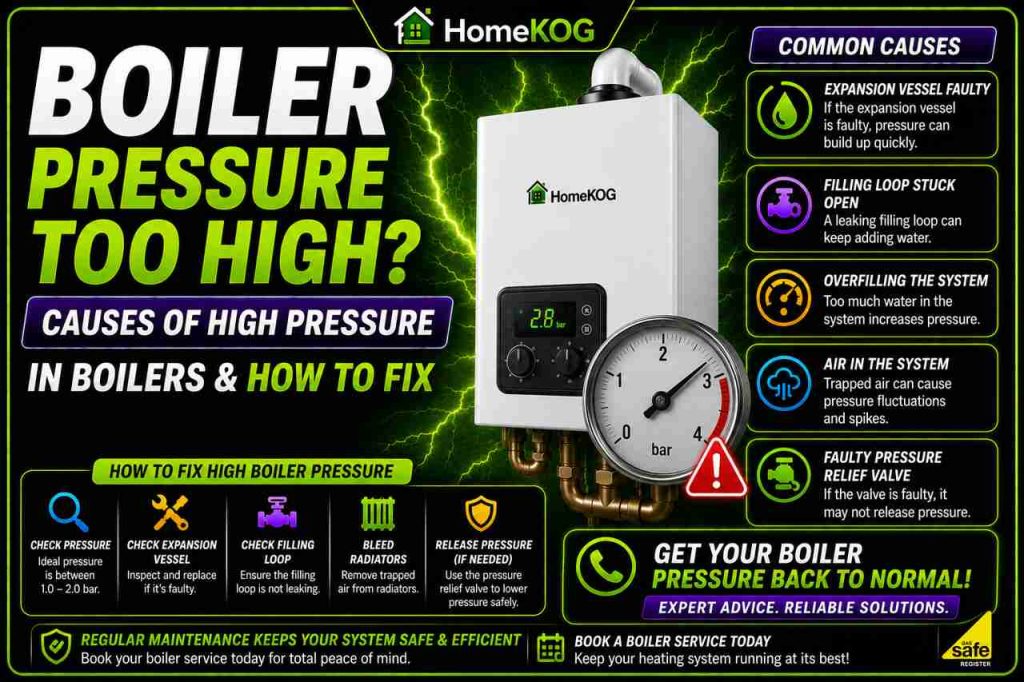
- Boiler pressure on a Viessmann boiler should sit between 0.5 and 1 bar when cold and between 1 and 1.5 bar when hot, and pressure below 1 bar can reduce water flow through the heat exchanger sufficiently to cause overheating and the F1 fault.
- A central heating pump is the component responsible for circulating hot water away from the boiler and through the radiators, and a faulty or incorrectly installed pump can trap hot water in the boiler, causing overheating and the F1 fault.
- An airlock is a pocket of trapped air in the pipework or pump that blocks water flow, reduces circulation, and can trigger the F1 fault by allowing heat to build up in the boiler.
- A NTC thermistor is the specific type of temperature sensor used to measure flue gas temperature in the Viessmann boiler, and its electrical resistance changes in proportion to temperature — wear over time can cause inaccurate readings.
- A power flush is a system cleaning procedure that can occasionally dislodge corroded debris from pipework and cause leaks, which may manifest as recurring F1 faults in the period following the flush.
- Low boiler pressure is the most common and most easily resolved cause of the F1 fault and can be addressed by the homeowner using the filling loop to repressurise the system.
- A Gas Safe registered engineer is the only professional legally permitted to diagnose and repair internal boiler components including the pump, PCB, and flue gas sensor on a Viessmann boiler.
- Pump replacement on a Viessmann boiler typically costs between £200 and £300 including parts and labour.
- A flue gas temperature sensor replacement costs between £30 and £120 depending on the specific model.

What Does the Viessmann F1 Fault Code Mean?
Viessmann defines the F1 fault code as “maximum flue gas temperature exceeded.” The flue gas temperature sensor mounted in the flue pipe has detected a temperature above what the boiler considers safe for normal operation, and the PCB has responded by shutting the boiler down.
In most cases this overheating condition is not caused by a problem with the flue itself but by a reduction in water circulation through the heat exchanger. When water cannot flow through the boiler at the correct rate, heat that should be transferred to the water instead builds up in the boiler and escapes through the flue at abnormally high temperatures. The sensor detects this and triggers the lockout before internal components are damaged.
The three things Viessmann recommends checking when the F1 code appears are the fill level of the heating system, the operation of the circulation pump, and whether there is air trapped in the system. These three checks cover the most common causes of the fault and provide a logical starting point for diagnosis.
What Causes the Viessmann F1 Fault Code?
Low Boiler Pressure
Low system pressure is the most frequently identified cause of the F1 fault and the one most likely to be resolvable by the homeowner without a Gas Safe engineer. Viessmann boilers operate within a pressure range of 0.5 to 1 bar when cold and 1 to 1.5 bar when running — slightly lower than the ranges specified for many other brands.
When pressure falls below 1 bar, less water is available to flow through the heat exchanger. The heat produced by the burner cannot be transferred efficiently to the reduced volume of water, causing temperatures to rise in the boiler and flue above safe limits.
A single pressure drop in a year is not unusual and does not necessarily indicate a leak. Two or more drops, or a rapid fall to very low levels, suggests an underlying leak in the system that a Gas Safe engineer should investigate.
To repressurise a Viessmann boiler, switch it off and allow it to cool fully. Locate the filling loop beneath the unit — two taps connected by a short section of pipe. Turn both tap handles until they run parallel with the pipe to open them, watch the pressure gauge rise, and close both taps when the reading reaches the desired level. Restart the boiler. If the F1 code clears and pressure holds, low pressure was the cause. If pressure drops again shortly afterwards, a leak is present and an engineer’s inspection is needed.
Faulty or Incorrectly Installed Pump
The central heating pump is responsible for moving hot water away from the boiler and around the heating circuit. If the pump fails, is running at the wrong speed, or has been installed at an incorrect angle, water cannot leave the boiler at the required rate. The heat that should travel to the radiators instead stays in the boiler, raising flue gas temperatures and triggering the F1 fault.
Pump faults in newer installations are sometimes caused by incorrect orientation during fitting rather than component failure. In these cases the pump simply needs to be reinstalled correctly without requiring a replacement. In older boilers, pump failure due to worn bearings, a seized shaft, or electrical failure is more common and replacement is typically the most cost-effective solution.
Pump replacement on a Viessmann boiler costs between £200 and £300 including parts and labour.
Air in the System
Air can enter the central heating system gradually over time or in larger volumes when maintenance work such as bleeding radiators is carried out. When air accumulates in pipework or within the pump housing, it creates a blockage that prevents water from flowing freely — a condition known as an airlock. Reduced water circulation causes the boiler to overheat and produces the F1 fault.
An airlock in the pump is resolved by a Gas Safe engineer using the bleed screw to release trapped air until water begins to flow steadily. Air elsewhere in the pipework can be removed by systematically bleeding the central heating circuit. Once the airlock is cleared and circulation is restored, the boiler can be reset and the F1 code should clear.
Faulty Flue Gas Temperature Sensor
If the boiler’s pressure and circulation are both confirmed to be normal and the F1 fault persists, the flue gas temperature sensor itself may be at fault. The sensor is an NTC thermistor — a small electrical component whose resistance changes in proportion to temperature. As it ages, the thermistor can produce inaccurate readings that cause the PCB to record a high temperature and trigger the F1 lockout even when the actual flue gas temperature is within safe limits.
A Gas Safe engineer will test the sensor’s electrical resistance using a multi-meter and cross-reference the readings against the manufacturer’s acceptable range. A sensor that is providing readings outside the expected range will need to be replaced. Flue gas temperature sensors are relatively affordable components, costing between £30 and £120 depending on the Viessmann model. If the engineer finds evidence that the sensor failure was caused by moisture or a leak, the source of that moisture will need to be identified and repaired alongside the sensor replacement.
Can a Power Flush Cause an F1 Fault?
Yes, in some circumstances. A power flush can dislodge corrosion and debris that has been trapped in pipework for years. If the underlying pipework is significantly corroded, the cleaning process can cause small leaks to develop that were not present before the flush. These leaks cause pressure loss that can manifest as a recurring F1 fault. If the F1 code has appeared shortly after a power flush, this should be raised with the engineer who carried out the work.
What Can You Fix Yourself?
Repressurising the boiler when the pressure gauge reads below 1 bar is the one F1-related action homeowners can carry out safely without a Gas Safe engineer. The steps for doing this are described in the low boiler pressure section above.
All other causes of the F1 fault — pump faults, airlocks, sensor replacement, and leak investigation — involve internal boiler components and must only be worked on by a Gas Safe registered engineer. Opening the boiler casing or working on any gas component without Gas Safe registration is illegal in the UK and potentially dangerous.
Viessmann F1 Fault Code Repair Costs in 2026
| Cause | Typical Repair Cost (2026) |
|---|---|
| Low pressure — repressurisation | No cost — DIY fix |
| Pump replacement | £200–£300 including parts and labour |
| Airlock clearance | Call-out and labour charge |
| Flue gas sensor replacement | £30–£120 for part, plus labour |
| Leak investigation and repair | Varies depending on location and extent |
| New Viessmann boiler installation | £1,500–£3,000 |
When to Consider Replacing a Viessmann Boiler
Viessmann boilers are among the most reliable available in the UK market and can be expected to provide between 10 and 15 years of service with proper maintenance. For boilers within this range that are regularly serviced, the F1 fault is typically a manageable repair that restores full function at reasonable cost. Viessmann boiler efficiency ratings explained highlight the importance of selecting the right model for your heating needs. Understanding these ratings can help homeowners make informed decisions that maximize both comfort and energy savings. By comparing the efficiency levels, you can choose a boiler that not only meets your requirements but also contributes to lower energy bills over time.
For boilers that are older, outside warranty, and have generated repeated fault codes — particularly where multiple components are showing wear simultaneously — the cumulative cost of ongoing repairs can approach the cost of a new installation. A new Viessmann boiler from the Vitodens range brings a full manufacturer warranty, improved efficiency, and a significantly lower risk of recurring faults over the coming decade. If the engineer’s inspection reveals deterioration beyond the component directly implicated in the F1 fault, a new boiler quote should be obtained alongside the repair quote before a decision is made.
Frequently Asked Questions
What does the Viessmann F1 fault code mean?
The Viessmann F1 fault code means the boiler’s flue gas temperature sensor has detected a temperature above the safe operating limit, defined by Viessmann as “maximum flue gas temperature exceeded.” The PCB has triggered a lockout to prevent the boiler from continuing to operate in an overheating condition. The most common causes are low system pressure, a faulty pump, air trapped in the system, or a defective flue gas temperature sensor producing a false reading.
Can I fix the Viessmann F1 fault myself?
If the boiler pressure gauge reads below 1 bar, repressurising the system using the filling loop is something homeowners can carry out safely. This resolves the F1 fault in cases where low pressure is the cause. All other F1 causes — pump faults, airlocks, sensor failures, and leak investigations — involve internal boiler components and must only be handled by a Gas Safe registered engineer. Attempting to open the boiler casing or work on gas components without the correct registration is illegal and dangerous.
What is the correct boiler pressure for a Viessmann boiler?
Viessmann boilers operate at a slightly lower pressure range than many other brands. The recommended range is 0.5 to 1 bar when the system is cold and 1 to 1.5 bar when the heating is running. If the gauge reads below 1 bar when the system is cold, repressurising the boiler is the appropriate first step. If pressure drops repeatedly after repressurising, a leak somewhere in the system is the most likely cause and a Gas Safe engineer should investigate.
How much does it cost to fix a Viessmann F1 fault in 2026?
Repressurising the boiler to resolve low pressure costs nothing. A pump replacement costs between £200 and £300 including parts and labour. A flue gas temperature sensor costs between £30 and £120 for the part, plus the engineer’s labour for testing and fitting. If a leak is identified as the underlying cause, repair costs will depend on the location and extent of the leak. For older boilers requiring multiple repairs, comparing these costs against a new boiler quote is worthwhile before proceeding.
Can a faulty sensor cause the F1 fault without actual overheating?
Yes. The NTC thermistor that measures flue gas temperature can produce inaccurate readings as it ages, causing the PCB to record an apparent overheating condition even when the actual flue gas temperature is within normal limits. A Gas Safe engineer will test the sensor’s electrical resistance with a multi-meter to determine whether it is providing accurate readings. If the sensor is found to be faulty, replacement is required. Flue gas sensors are relatively affordable and do not represent a major repair cost on their own.
Can a power flush cause an F1 fault code to appear?
Yes, in some cases. A power flush dislodges debris and corrosion from inside pipework. If the pipework is significantly corroded, the cleaning process can open small leaks that were not present before the flush. These leaks cause pressure loss that can manifest as a recurring F1 fault. If the fault has appeared in the period following a power flush, this should be raised with the engineer who carried out the work, who can inspect the system for new leak points.
When should I replace my Viessmann boiler instead of repairing the F1 fault?
If the boiler is more than ten years old, outside its manufacturer warranty, and has required repeated engineer call-outs in recent years, replacement may offer better long-term value than continued repair. The F1 fault is typically a manageable fix on a well-maintained Viessmann boiler, but if the engineer identifies deterioration in multiple components during the investigation, the combined cost of bringing the boiler back to reliable operation may approach the cost of a new installation. A new Viessmann Vitodens boiler brings full warranty coverage, improved efficiency, and significantly lower running costs over the next decade. For those considering an upgrade, the Viessmann Vitodens 222F performance review highlights its impressive efficiency ratings and reliable operation. Users have reported notable reductions in energy bills, making it a smart investment for homeowners looking to enhance their heating systems. Additionally, its advanced technology ensures quieter performance, adding to the overall comfort of the living environment.
Conclusion
The Viessmann F1 fault code is a safety shutdown that responds to a detected overheating condition in the flue gas circuit. In the majority of cases it is caused by a reduction in water circulation — through low pressure, a pump fault, or an airlock — rather than a fault with the flue itself.
Low system pressure is the one cause homeowners can address independently by repressurising via the filling loop. For all other causes, a Gas Safe engineer is the appropriate first call. The F1 fault is typically resolved at manageable cost on a well-maintained Viessmann boiler, though for older units with a history of recurring faults, the economics of repair versus replacement deserve careful consideration before further work is authorised.
Annual boiler servicing remains the most reliable way to prevent the F1 fault from developing — keeping the pump clean, the system pressure stable, and the flue sensor in accurate working order before the heating season begins.