
What Are the Similarities Between Viessmann F4 Fault Code and Worcester C6 Fault Code Regarding Flame Detection Issues?
Both the Viessmann F4 fault code and the Worcester C6 fault code reflect common issues in flame detection systems. Each indicates that the appliance is unable to sense a flame properly, triggering safety shutdowns. Addressing these problems may involve similar adjustments, leading to effective worcester c6 fault code solutions.
Viessmann Boiler F4 Fault Code: Meaning, Causes & How to Fix It in 2026
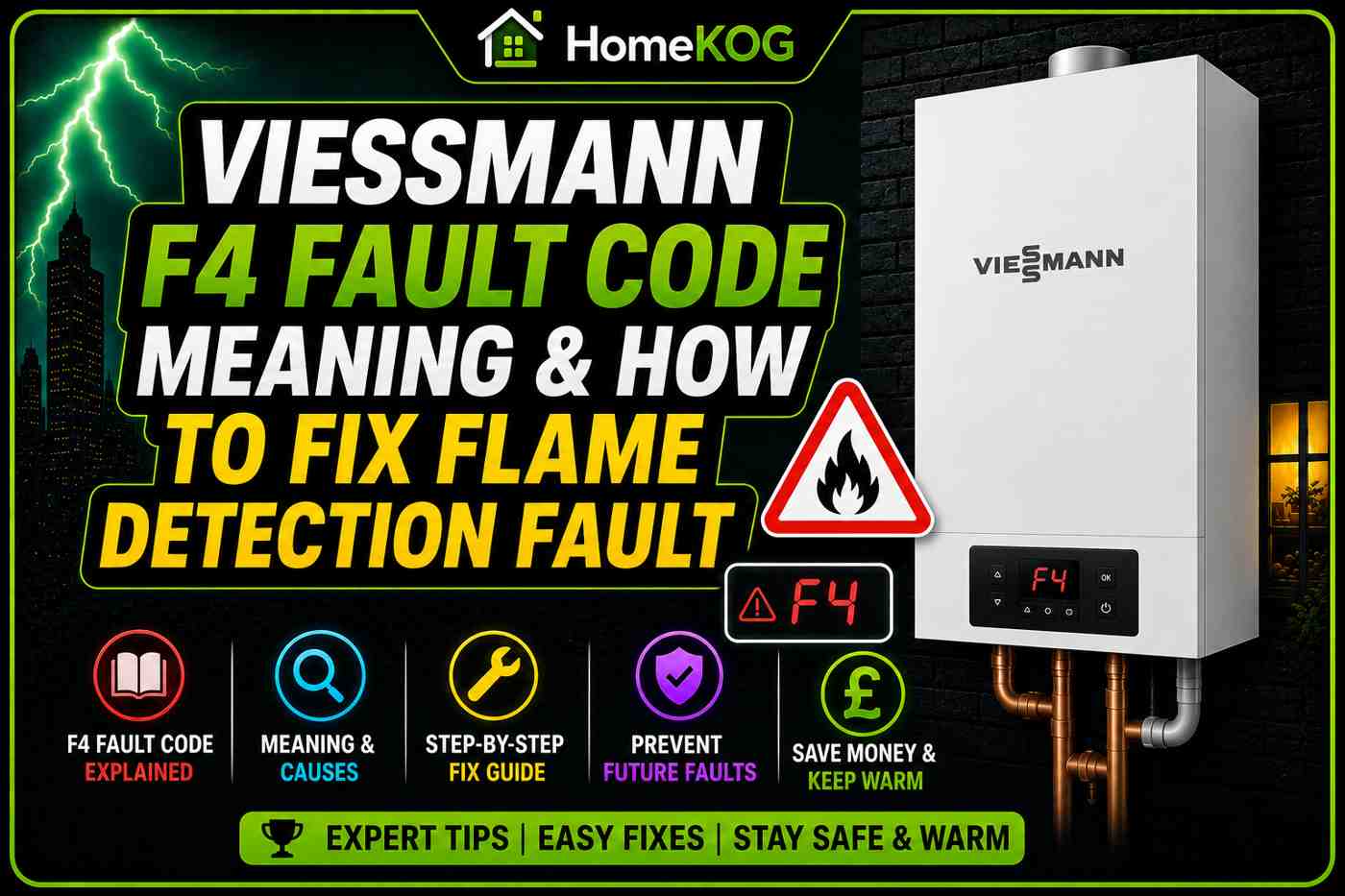
Quick Answer: The Viessmann F4 fault code indicates that the boiler’s PCB has not detected a flame signal during the ignition sequence and has shut down as a safety precaution. Common causes include a faulty or dirty flame sensor, a stuck gas valve, a blocked burner jet, a failed ignition lead, or a PCB fault. All F4 repairs must be carried out by a Gas Safe registered engineer — do not attempt to reset the boiler repeatedly without the fault being diagnosed first.
Seeing the F4 fault code on a Viessmann boiler means the unit cannot confirm that its burner flame has established correctly and has entered lockout to prevent further operation. It is a fault that needs professional attention, but understanding what causes it and what the engineer will check puts you in a much better position when arranging a repair.
This guide covers everything UK homeowners need to know about the Viessmann F4 fault code in 2026.
Get a new boiler quote online here >
Key Facts: Viessmann F4 Fault Code Relationships
- The Viessmann F4 fault code indicates a loss of or failure to detect a flame signal, meaning the boiler has been unable to confirm that the burner has lit correctly during an ignition attempt.
- A PCB (printed circuit board) is the electronic control centre of the Viessmann boiler that monitors all component signals and triggers the F4 lockout when no flame signal is received from the flame sensor.
- A flame sensor is the component responsible for detecting whether the burner flame is present and transmitting this confirmation to the PCB, and a dirty or failed sensor is one of the most common causes of the F4 fault.
- A boiler lockout is the safety shutdown triggered by the Viessmann boiler when the PCB detects the F4 fault, preventing the unit from continuing to operate and risking gas accumulation or component damage.
- A gas valve is a mechanical component that opens to allow gas into the burner when heat is demanded, and a valve stuck in the closed or partially closed position will prevent gas from reaching the burner and cause the F4 fault.
- An ignition lead is the electrical component that carries the high-voltage spark signal to the ignition electrode, and a faulty or moisture-damaged lead will prevent a spark from being produced.
- A spark generator is the component that produces the electrical spark required to ignite the gas entering the burner, and failure of this component will result in no flame and the F4 fault code.
- A burner jet is the small orifice through which gas passes into the burner before ignition, and partial blockage with carbon or debris will restrict gas flow and prevent a reliable flame from forming.
- A wiring harness is the cable assembly connecting the boiler’s electrical components to the PCB, and loose or damaged connections can cause intermittent signals that trigger the F4 fault.
- Water damage from an internal leak is the most common cause of electrical component failure in Viessmann boilers and can affect the flame sensor, ignition lead, spark generator, and PCB simultaneously.
- A gas valve replacement on a Viessmann boiler costs approximately £275 including parts and labour in 2026.
- A PCB replacement on a Viessmann boiler costs approximately £450 including parts and labour in 2026.

What Does the Viessmann F4 Fault Code Mean?
The F4 fault code on a Viessmann boiler signals that the PCB has not received confirmation from the flame sensor that the burner flame has established during the ignition sequence. Without this confirmation, the boiler will not continue to operate — it enters lockout and shuts down to prevent unburned gas from accumulating inside the combustion chamber.
When a call for heat or hot water is made, the boiler runs through a specific sequence: the fan starts to create a draught through the flue, the gas valve opens to allow fuel into the burner, the ignition system creates a spark to light the gas, and the flame sensor confirms to the PCB that the flame is present. If any part of this sequence fails — or if the flame sensor does not transmit a valid signal — the PCB displays the F4 code and shuts the boiler down.
The lockout is a safety feature designed to protect both the boiler and the occupants of the property. It should be respected rather than repeatedly overridden with the reset button, which is not a repair and will not resolve the underlying fault.
Common Causes of the Viessmann F4 Fault Code
Faulty or Dirty Flame Sensor
The flame sensor is one of the most frequently implicated components in an F4 fault. It is a sensitive electrical component that sits within the combustion chamber and monitors whether the burner flame is present. Over time, carbon and combustion byproducts can build up on its surface, insulating it from the heat of the flame and preventing it from generating the signal the PCB is waiting for.
In some cases the sensor can be cleaned and reinstated without replacement. In others — particularly where the porcelain insulation around the sensor has cracked or where the component has been damaged by moisture — full replacement is required. A Gas Safe engineer will test the sensor’s electrical output with a multi-meter to determine which course of action is appropriate.
If the ignition sequence is running correctly but the boiler starts and then stops within seconds, a dirty or faulty flame sensor is the most likely cause, as the boiler establishes a flame briefly but the sensor fails to confirm it to the PCB in time.
Stuck or Faulty Gas Valve
The gas valve controls the flow of fuel into the boiler and is a mechanical component subject to wear over time. If the valve becomes stuck in a fully or partially closed position, insufficient gas reaches the burner jet and no flame can be established, regardless of whether the ignition system is working correctly.
An F4 fault caused by a stuck gas valve typically means the ignition attempt goes through its sequence without producing any visible flame — the spark occurs but there is nothing to ignite. The engineer will inspect the valve’s electronics and attempt to free it. If the valve is worn beyond reliable operation, replacement is the appropriate course of action.
A gas valve replacement on a Viessmann boiler costs approximately £275 including parts and labour.
Blocked Burner Jet
The burner jet is the small orifice through which gas passes before it enters the burner and is ignited. Because the openings are very small, even minor accumulations of carbon particles or debris from the combustion process can partially block them, restricting the gas flow to a level insufficient for a stable flame to form.
The jet itself does not usually need replacing — in most cases the engineer will remove it, clean it thoroughly, and refit it. Once the blockage has been cleared and the gas supply is confirmed, the boiler can typically be restarted with the F4 code cleared.
Ignition Lead and Spark Generator Faults
The ignition lead carries the electrical signal from the spark generator to the ignition electrode, which produces the spark that lights the gas. If either of these components has failed or is damaged, no spark will be produced and the flame cannot establish — resulting in the F4 fault regardless of the condition of the gas supply or burner.
Water damage is the most common cause of failure in these components. Even a small amount of moisture from an internal boiler leak can cause the ignition lead or spark generator to fail. The engineer will check both components visually for signs of moisture and test them electrically to confirm whether they are functioning correctly.
Wiring and Connection Faults
All electrical components in the boiler communicate with the PCB through a wiring harness. Over time, vibration from the boiler’s operation can cause connections to work loose, and general wear can cause wiring to degrade. Loose or damaged connections produce intermittent signals that can cause the PCB to record an F4 fault even when the underlying components are otherwise functional.
A Gas Safe engineer will carry out a visual inspection of the wiring harness and connections as a standard part of diagnosing the F4 fault, paying particular attention to the connections between the flame sensor, ignition system, and PCB. In some cases, securing a loose connection is all that is required to clear the fault. Understanding the gas safe register overview is crucial for ensuring that engineers adhere to safety standards and regulations. This register not only provides essential information about qualified professionals but also helps homeowners make informed decisions regarding their gas appliances. Regular checks and adherence to the gas safe register can prevent potential hazards and ensure optimal performance.
Faulty PCB
If all other components test correctly and the F4 fault persists, the PCB itself may be at fault. A damaged PCB can fail to interpret signals correctly, meaning the flame sensor may be transmitting a valid signal that the PCB is unable to process — leading to a false F4 fault code.
Additional signs that the PCB may be involved include the boiler cycling on and off very rapidly, other fault codes appearing alongside F4, or the boiler behaving erratically in other ways. PCB failure is often caused by moisture damage from an internal leak, electrical failure, or age-related component degradation.
A PCB replacement on a Viessmann boiler costs approximately £450 including parts and labour. If both the PCB and another major component such as the gas valve need replacing on an older boiler, it is worth comparing the combined repair cost against the price of a new boiler installation before committing to the work. when considering the viessmann boiler advantages over vaillant, one must also evaluate the overall efficiency and longevity of the system. Viessmann boilers are often noted for their robust design and advanced technology, leading to lower energy costs over time. It’s essential to factor in these aspects when making a decision on the best boiler for your home. Understanding the system boiler functioning principles is crucial for identifying potential issues before they become costly repairs. Additionally, familiarizing oneself with these principles can help homeowners make informed choices about maintenance and upgrades. By recognizing how different components work together, such as the heat exchanger and pump, one can optimize the performance and efficiency of their boiler system.
What Will a Gas Safe Engineer Check?
When a Gas Safe engineer attends to investigate the Viessmann F4 fault code, they will work through the ignition system systematically to identify the specific cause.
The inspection will include the ignition lead and spark generator, the burner and burner jet, the flame sensor, the gas valve and its electronics, all wiring connections to the PCB, and the PCB itself. A multi-meter will be used to test the electrical output and resistance of each component against the manufacturer’s acceptable specifications, allowing the engineer to pinpoint which element has failed rather than replacing components speculatively.
Visual inspection will also look for any signs of internal moisture or leaking, as water damage is one of the most common routes to electrical component failure in Viessmann boilers.
Can the Heat Exchanger Cause an F4 Fault?
A faulty heat exchanger does not directly cause an F4 fault, but a heat exchanger that has developed a leak can cause water to reach electrical components — including the flame sensor, ignition leads, and PCB — leading to the kind of electrical failures that produce the F4 code.
Persistent low boiler pressure alongside the F4 fault can be an indication of a heat exchanger leak. A Gas Safe engineer will check for this during the investigation. Heat exchanger replacement is one of the more expensive boiler repairs, and for older boilers outside warranty it is worth discussing the economics of repair versus replacement with the engineer before proceeding.
Viessmann F4 Fault Code Repair Costs in 2026
| Component | Typical Repair Cost (2026) |
|---|---|
| Flame sensor cleaning or replacement | £100–£200 |
| Burner jet cleaning | Included in engineer call-out |
| Ignition lead replacement | £100–£200 |
| Gas valve replacement | Around £275 |
| PCB replacement | Around £450 |
| New Viessmann boiler installation | £1,500–£3,000 |
Should You Repair or Replace the Boiler?
For Viessmann boilers within warranty and in otherwise good condition, repairing the F4 fault is the clear course of action. Viessmann is a premium brand with a strong reliability record, and the vast majority of F4 faults are resolved with a single component repair at a manageable cost.
For boilers more than ten years old that are outside warranty, the calculation requires more care. If the F4 fault is caused by PCB failure, or if the engineer identifies additional wear across multiple components during the investigation, the combined cost of repairs may approach the cost of a new installation. A new Viessmann boiler brings improved efficiency, lower running costs, and a full manufacturer warranty from the date of installation.
Viessmann was founded in 1917 and has grown into one of the most recognised heating brands globally. The Vitodens range — including the 050-W, 100-W, and 111-W — consistently ranks among the most efficient and reliable boilers available in the UK market, making a new installation a genuinely strong long-term investment where replacement is the recommended course. The Viessmann Vitodens 222F specifications reveal exceptional energy efficiency ratings and advanced technology features. Its compact design makes it an ideal choice for homes with limited installation space, while its user-friendly interface ensures ease of operation. Homeowners can expect significant savings on their energy bills, further enhancing the appeal of this innovative boiler model.
Frequently Asked Questions
What does the Viessmann F4 fault code mean?
The Viessmann F4 fault code means the boiler’s PCB has not received a valid flame signal during the ignition sequence and has shut the boiler down as a safety precaution. The boiler cannot produce heating or hot water while this fault is active. Common causes include a dirty or failed flame sensor, a stuck gas valve, a blocked burner jet, a faulty ignition lead or spark generator, wiring faults, or a failed PCB. All repairs require a Gas Safe registered engineer. Understanding the viessmann f5 fault code explained can help identify issues that arise when the boiler encounters a different set of ignition problems. Similar to the F4 code, the F5 fault indicates a failure in the ignition system, often related to the air intake or venting issues. It’s crucial to address these faults quickly to ensure the safe and efficient operation of your heating system.
Can I fix the Viessmann F4 fault code myself?
No. The F4 fault involves gas and electrical components inside the boiler that must only be accessed and repaired by a Gas Safe registered engineer. Attempting to open the boiler casing or work on internal components without Gas Safe registration is illegal in the UK and potentially dangerous. The boiler reset function is not a repair — it is designed to be used after the fault has been identified and resolved, not as a way of clearing an active fault repeatedly.
What is the most common cause of the Viessmann F4 fault?
The most frequently identified causes are a dirty or faulty flame sensor, a stuck or partially closed gas valve, and a blocked burner jet. Of these, a flame sensor that has accumulated carbon deposits on its surface is the most common, as it prevents the sensor from detecting the flame even when the ignition sequence has produced one. In many cases the sensor can be cleaned rather than replaced, resolving the fault at relatively low cost.
How much does it cost to fix a Viessmann F4 fault in 2026?
The repair cost depends on which component has failed. Flame sensor cleaning or replacement and ignition lead repairs typically cost between £100 and £200. A gas valve replacement costs approximately £275. PCB replacement costs approximately £450. If the engineer can resolve the fault by cleaning the burner jet or securing a loose wiring connection, the cost may be limited to the call-out and labour charge.
Should I reset my Viessmann boiler when the F4 code appears?
A single reset attempt is acceptable to see whether the fault was a temporary occurrence. If the boiler restarts and runs normally without the F4 code reappearing, monitor it over the following hours to confirm it is operating correctly. If the F4 fault returns after the reset, do not continue resetting the boiler. Call a Gas Safe engineer to diagnose and repair the fault before using the reset again, as repeated resetting without resolving the cause risks gas accumulation and component damage.
Can a heat exchanger problem cause the F4 fault code?
Not directly, but a leaking heat exchanger can cause water to reach electrical components including the flame sensor and ignition leads, leading to the electrical failures that produce the F4 code. Persistent low boiler pressure alongside the F4 fault is a sign that a heat exchanger leak may be involved. A Gas Safe engineer will check for this during the investigation. Heat exchanger replacement is expensive and on an older boiler the economics of repair versus full replacement should be discussed with the engineer before the work is authorised.
When should I replace my Viessmann boiler instead of repairing the F4 fault?
For boilers under ten years old and within warranty, repair is almost always the right choice. For older boilers outside warranty where the F4 fault is caused by PCB failure or multiple worn components, the combined repair cost can approach or exceed the price of a new installation. A new Viessmann boiler provides full warranty coverage, improved efficiency, and lower monthly running costs. If the engineer’s inspection reveals that several components are showing significant wear alongside the F4 fault, obtaining a new boiler quote alongside the repair quote is a sensible approach before committing.
Conclusion
The Viessmann F4 fault code is a clear and specific signal that the boiler’s ignition sequence has not completed successfully and the unit has shut itself down for safety. It is a fault that ranges from a relatively inexpensive sensor clean to a more significant PCB or gas valve replacement, and identifying the specific cause requires a Gas Safe engineer to work through the ignition system systematically. In addition to the Viessmann F1 fault code explained, users should also be aware that different models may present unique error codes that require specific attention. Knowing how to interpret these codes can help in troubleshooting and avoiding unnecessary service calls. Regular maintenance is crucial to minimize the likelihood of encountering these faults in the first place.
For most Viessmann boilers in good overall condition, the F4 fault is a manageable repair that restores full function quickly. For older boilers with multiple worn components or where major parts like the PCB require replacement, reviewing the case for a new installation alongside the repair quote ensures the most cost-effective decision is made for the longer term.
Annual servicing remains the most effective way to prevent the F4 fault from developing in the first place, keeping the flame sensor clean, the burner jet clear, and the ignition system in reliable working order before the heating season begins.