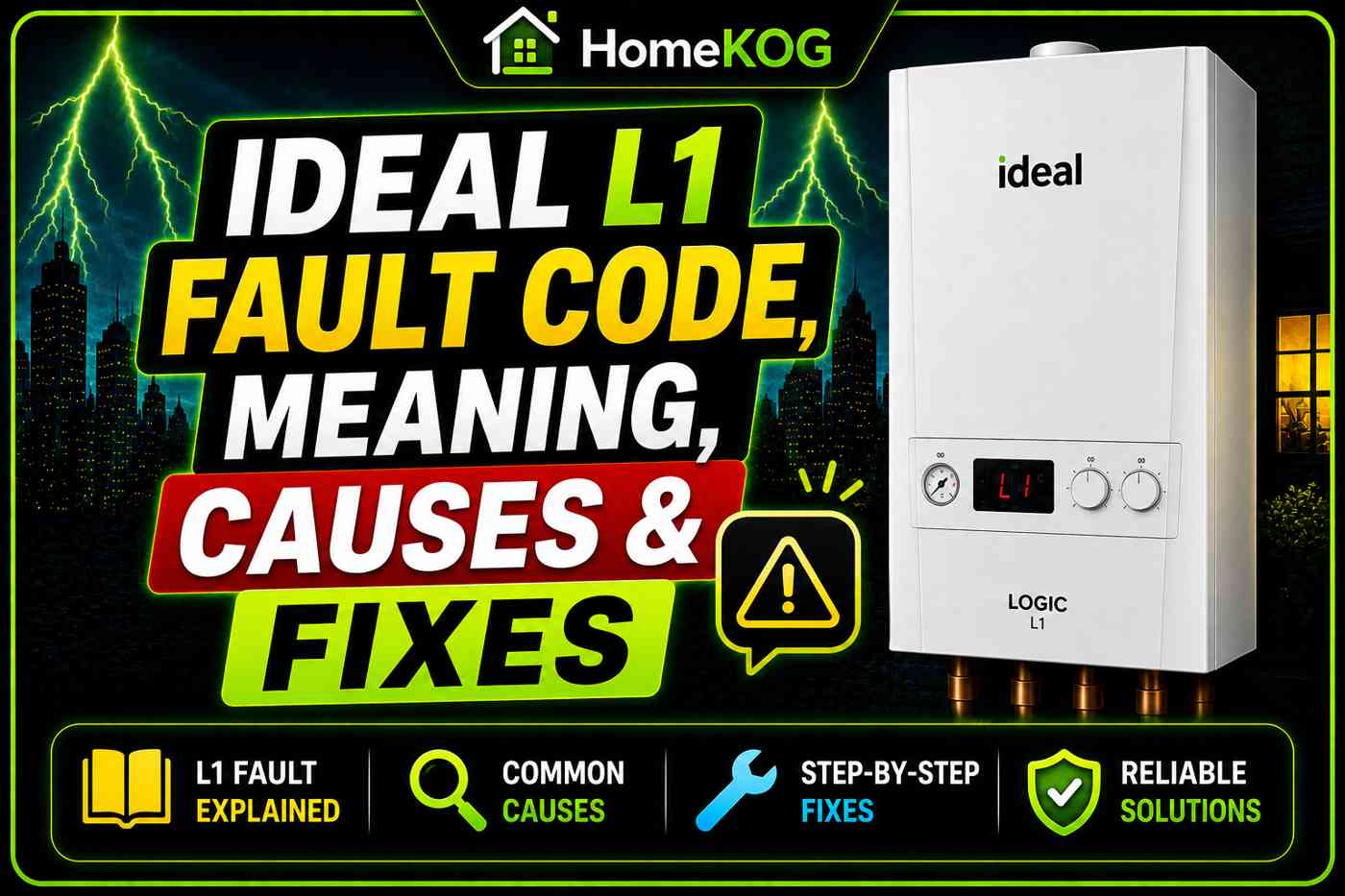

Ideal L1 Fault Code: Meaning, Causes & How to Fix It
Quick Answer: The Ideal Logic L1 fault code indicates the boiler has detected an incorrect flow water temperature — either too high or too low — and has locked out as a safety precaution. Common causes include a faulty flow thermistor, limescale build-up in the flow pipe, a failed circulation pump, or a PCB fault. Attempting a reset is the first step, but persistent L1 faults require a Gas Safe registered engineer.
The L1 code is one of the Ideal Logic boiler’s temperature protection responses, designed to stop the appliance from operating when the water flowing through the heating circuit is outside the safe range the PCB expects to see. Like most Ideal fault codes, it is doing exactly what it should — protecting components from damage by halting operation until the underlying cause is identified and resolved. The challenge for homeowners is that the causes range from a straightforward thermistor repair to more significant pump or PCB work, making professional diagnosis the most reliable path forward.
Ideal L1 Fault Code: Key Entity Relationships
- The Ideal Logic L1 fault code is a flow temperature error displayed when the boiler detects that the hot water flow temperature reading falls outside the acceptable operating range, triggering a safety lockout that prevents the appliance from continuing to run.
- The boiler flow pipe is the pipe through which heated water leaves the Ideal Logic boiler to circulate through the central heating system, with the flow thermistor mounted at this point to monitor the temperature of water as it exits the heat exchanger.
- A flow thermistor is a temperature-sensing resistor mounted at the flow pipe of the Ideal Logic boiler that measures water temperature by resistance and transmits that data to the PCB, with a faulty or incorrectly reading thermistor producing the inaccurate temperature data that triggers the L1 fault code.
- Limescale build-up within the flow pipe is a cause of the Ideal L1 fault in hard water areas where calcium carbonate deposits accumulate near the flow thermistor, causing the sensor to register a higher temperature than is actually present in the broader heating circuit.
- A central heating pump is the circulation component responsible for moving water through the heating system, with pump failure or seizure preventing adequate water flow and causing the boiler to overheat and trigger the L1 fault code due to insufficient circulation.
- The printed circuit board is the control component of the Ideal Logic boiler that receives and interprets resistance readings from the flow thermistor and initiates the L1 lockout when those readings indicate a temperature outside the boiler’s safe operating range.
- A thermistor wiring fault is a cause of intermittent Ideal L1 fault code appearances when vibration from the boiler’s moving parts progressively loosens the connections between the flow thermistor and the PCB, causing inconsistent or corrupted temperature readings.
- Central heating inhibitor is a liquid chemical treatment added to the heating system annually that reduces corrosion and sludge formation, protecting the flow pipe, thermistor, and pump from the debris accumulation that contributes to L1 fault conditions.
- A magnetic boiler filter is a device fitted to the heating system that captures iron oxide and metallic debris circulating in the water before it reaches the pump and heat exchanger, reducing the rate of sludge accumulation that can block circulation and trigger the L1 fault.
- A Gas Safe registered engineer is the legally required professional for all Ideal Logic L1 fault diagnosis and repair work, including thermistor testing and replacement, pump inspection and cleaning, PCB assessment, and limescale treatment.
- Heating sludge is the mixture of rust particles, dirt, and debris that builds up in central heating pipework and can block the pump or restrict circulation, causing the water to heat unevenly and producing the flow temperature readings that trigger the L1 fault code.
- Annual Ideal boiler servicing by a Gas Safe registered engineer reduces the likelihood of L1 fault appearances by identifying early-stage thermistor degradation, developing pump issues, and limescale accumulation before they cause a temperature reading fault severe enough to trigger a lockout.

What Does the Ideal Logic L1 Fault Code Mean?
The L1 fault code on an Ideal Logic boiler means the PCB has detected a flow water temperature reading that is either significantly higher or lower than the expected operating range. The flow pipe is where heated water exits the boiler to circulate through the radiator circuit, and the thermistor mounted at this point monitors that temperature continuously. When the reading moves outside the parameters the PCB recognises as safe, the boiler locks out.
The lockout is the correct response. A flow temperature that is genuinely too high indicates the water is overheating — a condition that can cause component damage, expansion vessel problems, and in serious cases structural damage to pipework. A reading that is too low may indicate the thermistor is sending incorrect data or that heat transfer is not occurring as it should.
The important distinction with L1 is that the fault code reflects what the PCB is reading from the thermistor — not necessarily what the actual water temperature is. If the thermistor itself is faulty, or if limescale near the sensor is causing a localised temperature elevation, the PCB will lock out the boiler based on an inaccurate reading. This is why an engineer’s diagnostic process involves testing the thermistor’s resistance values directly rather than simply assuming the temperature reading is accurate.
Can a Reset Fix the Ideal L1 Fault?
A boiler reset is a reasonable first step when the L1 code appears. Press and hold the reset button beneath the display screen for three seconds on newer Ideal Logic models, or rotate the mode dial to the reset position on older variants. If the boiler fires normally following the reset and the L1 code does not return, the fault may have been caused by a transient temperature spike rather than a persistent component issue.
If the L1 code returns shortly after the reset, or if the boiler fails to reignite at all, the underlying cause requires professional diagnosis. Resetting repeatedly without identifying the root cause risks additional wear on components and, in cases where the high temperature reading reflects a genuine overheating condition, potential damage to the heat exchanger and surrounding parts.
Common Causes of the Ideal Logic L1 Fault Code
Faulty Flow Thermistor
A faulty flow thermistor is the most common cause of the Ideal L1 fault code and also the least expensive to repair. The thermistor measures temperature by resistance — at a given temperature it should produce a predictable resistance reading in Ohms. If the thermistor has drifted out of calibration, developed a fault through age, or has wiring connections that have loosened due to boiler vibration, it will transmit an incorrect resistance value to the PCB. The board interprets this as an abnormal flow temperature and locks out the boiler.
Thermistor wiring issues are particularly associated with intermittent L1 faults — the code appears, the boiler resets and runs normally for a period, then the code appears again. This pattern suggests a connection that is making and breaking contact due to vibration rather than a thermistor that has failed completely.
A Gas Safe engineer will test the thermistor’s resistance with a multimeter and compare the reading against the expected value for the current water temperature. Where the thermistor is found to be faulty, replacement costs approximately £40 to £60 for the part, with total repair costs including diagnostic time and labour typically between £110 and £140. This makes a thermistor fault one of the more straightforward and affordable L1 resolutions.
Limescale Build-Up in the Flow Pipe
Limescale accumulation in the flow pipe is a cause of L1 that is more common in hard water areas and on boilers that have not received consistent annual servicing or inhibitor treatment. When calcium carbonate deposits settle on or near the flow thermistor, the localised temperature at the sensor can become elevated relative to the broader flow water temperature. The thermistor reads this elevated local temperature accurately, but the reading does not reflect the actual temperature of the water circulating through the heating system as a whole.
The PCB, receiving a temperature reading that appears too high, locks out the boiler — even though the actual system water temperature is within safe parameters. This is one of the scenarios where the L1 fault code reflects a genuine sensor reading rather than a faulty sensor, making limescale identification an important part of the diagnostic process.
A Gas Safe engineer will assess the flow pipe for limescale deposits and recommend an appropriate treatment. Products from manufacturers such as Sentinel or Fernox can break down existing deposits and allow them to be flushed from the system. Where deposits are heavily entrenched, replacing the affected section of pipework or the thermistor itself may be the most practical solution. Fitting a magnetic filter and adding a limescale inhibitor to the heating system after treatment reduces the rate of future accumulation.
Broken or Blocked Central Heating Pump
A pump that has failed, seized, or is operating at an incorrect speed setting cannot maintain adequate water flow through the heating circuit. Without sufficient circulation, the water heated by the heat exchanger has nowhere to go and the flow temperature rises rapidly — producing the high flow temperature reading that triggers the L1 lockout.
A pump operating at too low a speed for the size of the property produces a similar effect. Grundfos and other pump manufacturers offer models with multiple speed settings, and a pump set to a lower speed than the number of radiators in the system requires will circulate water too slowly to maintain safe flow temperatures.
A Gas Safe engineer will first check the pump speed setting and adjust it if necessary. Where the pump is blocked by sludge or has developed an airlock, cleaning the pump body and bleeding the airlock are the next steps. If the shaft and bearings are worn but the rest of the pump is serviceable, replacing those components may extend the pump’s working life without requiring a full replacement. Where the pump has failed beyond practical repair, a replacement unit is required — a repair that restores full circulation and, with it, normal flow temperature readings.
PCB Fault
Where thermistor testing, limescale assessment, and pump inspection all return normal results, a PCB fault is the remaining explanation for a persistent L1 code. The PCB may be misinterpreting the thermistor’s resistance readings due to an electrical fault in the temperature monitoring circuit, producing a lockout based on data that is being processed incorrectly rather than data that is genuinely abnormal.
A Gas Safe engineer will carry out a visual inspection of the PCB first, looking for signs of burnt connections, water damage, or loose wiring. Where the visual inspection is inconclusive, a multimeter test of the PCB’s signal processing confirms whether the board is functioning correctly. PCB replacement is the most expensive outcome of an L1 diagnosis, typically costing between £450 and £550 depending on the Ideal boiler model. On an older boiler, this cost should be weighed directly against the installed price of a new appliance.
How to Prevent the Ideal L1 Fault From Recurring
Annual servicing by a Gas Safe registered engineer is the most effective preventive measure. A service covers thermistor condition and wiring connections, pump operation and speed settings, heat exchanger limescale assessment, and PCB function — the full set of components implicated in L1 faults. Catching thermistor wear and limescale development early removes the most common causes of L1 before they reach the point of triggering a lockout.
Filling the system with a central heating inhibitor each year, adding a limescale inhibitor if hard water is a concern, and fitting a magnetic filter to capture metallic debris before it reaches the pump and heat exchanger are the three most practical supplementary measures available between service visits. Together with annual professional servicing, they address each of the primary causes of L1 recurrence systematically.
FAQ: Ideal Logic L1 Fault Code
What does the Ideal Logic L1 fault code mean?
The Ideal Logic L1 fault code indicates the boiler has detected a flow water temperature reading that falls outside its safe operating range — either significantly too high or too low. The PCB receives this data from the flow thermistor mounted at the flow pipe and locks the boiler out as a precaution when the reading is abnormal. The fault can reflect a genuine temperature problem or an inaccurate reading from a faulty thermistor or limescale-affected sensor. A Gas Safe registered engineer must diagnose the specific cause before the boiler is returned to service.
Can I fix the Ideal L1 fault code myself?
The only homeowner action appropriate for the L1 fault is a single reset attempt. Press and hold the reset button beneath the display for three seconds and allow the boiler to attempt a fresh start. If the code clears and the boiler operates normally, monitor the situation over the following hours. If the L1 code returns, or if the boiler does not restart after the reset, a Gas Safe registered engineer should be contacted. All further diagnosis and repair — thermistor testing, pump inspection, limescale treatment, and PCB assessment — requires professional qualifications and equipment.
What is the flow thermistor and how does it cause L1?
The flow thermistor is a temperature-sensing resistor mounted at the flow pipe of the Ideal Logic boiler that measures the temperature of water as it leaves the heat exchanger. It communicates with the PCB by producing a resistance reading in Ohms that varies with temperature. A thermistor that has drifted out of calibration, developed a fault, or has a loose wiring connection sends an inaccurate resistance reading to the PCB. The board interprets this as an abnormal flow temperature and locks out the boiler with the L1 code, even if the actual water temperature is within a safe range.
Can limescale cause the Ideal L1 fault code?
Yes. In hard water areas, calcium carbonate deposits can accumulate on or near the flow thermistor in the flow pipe. The localised temperature at the sensor becomes elevated relative to the broader circuit temperature, causing the thermistor to report a higher reading than accurately reflects the system water temperature. The PCB locks out the boiler based on this elevated reading. Treatment with a limescale remover such as a Sentinel or Fernox product can break down existing deposits, and fitting a limescale inhibitor and magnetic filter afterwards reduces the rate of future accumulation.
How much does it cost to repair an Ideal L1 fault?
Repair costs depend on the cause identified. A thermistor replacement is one of the least expensive outcomes, with parts costing £40 to £60 and total repair costs including labour and diagnostic time typically between £110 and £140. Pump repairs vary depending on whether adjustment, cleaning, or full replacement is required. PCB replacement is the most expensive outcome, typically costing between £450 and £550 depending on the boiler model. A Gas Safe engineer will provide a specific repair estimate following the diagnostic visit.
How does a pump fault cause the Ideal L1 fault code?
A failed, seized, or incorrectly set circulation pump cannot maintain adequate water flow through the heating circuit. Without sufficient circulation, the water heated by the heat exchanger cannot be distributed to the radiators and accumulates near the boiler, causing the flow temperature to rise rapidly. The flow thermistor detects this elevated temperature and reports it to the PCB, which interprets it as a high flow temperature fault and locks out the boiler with the L1 code. An engineer will check the pump speed setting, inspect for airlocks or sludge blockages, and confirm whether the pump requires cleaning, adjustment, or replacement.
How can I prevent the Ideal L1 fault from recurring?
Annual servicing by a Gas Safe registered engineer is the most effective measure, covering thermistor testing, pump operation checks, limescale assessment, and PCB condition review. Using central heating inhibitor annually slows the corrosion and sludge formation that can block the pump and affect circulation. Adding a limescale inhibitor is advisable in hard water areas. Fitting a magnetic filter to capture metallic debris before it reaches the pump and heat exchanger addresses the sludge accumulation that contributes to circulation-related L1 faults between service visits.
Does the Ideal L1 fault mean I need a new boiler?
Not usually. The majority of L1 faults are caused by a thermistor or pump issue that is cost-effective to repair on boilers of most ages. Replacement becomes a more serious consideration when the fault involves PCB failure on a boiler over 10 years old, or when the boiler is developing multiple fault codes that collectively indicate widespread component deterioration. A Gas Safe engineer who has diagnosed the specific cause of the L1 fault is the right person to advise honestly on whether repair or replacement represents the better long-term investment for your situation.
Conclusion
The Ideal Logic L1 fault code is a precise diagnostic indicator that the boiler’s flow temperature monitoring system has detected an abnormal reading. Whether that reflects a genuine temperature problem or an inaccurate reading from a faulty thermistor or limescale-affected sensor makes a significant difference to the repair required — and distinguishing between the two is exactly what a Gas Safe engineer’s diagnostic process is designed to do. In scenarios where the ideal f2 fault code explained reveals issues within the system, further investigation can help pinpoint whether sensors or other components are to blame. Understanding this fault code can aid in determining the best course of action for a proper and efficient repair. Additionally, it highlights the importance of regular maintenance to prevent potential errors in the future.
A thermistor fault is one of the more affordable boiler repairs available, and in many L1 cases it is the only component that needs attention. The more significant costs — pump replacement, PCB replacement — arise in a smaller proportion of cases, and even then the age and overall condition of the boiler determines whether repair or replacement is the more rational choice.
Annual servicing, consistent inhibitor treatment, and a magnetic filter give an Ideal Logic boiler the best practical protection against the conditions that lead to L1 faults. An engineer who inspects the flow thermistor, pump, and heat exchanger once a year will identify deterioration before it causes a lockout — keeping the heating running reliably through the months when it matters most. One popular option among homeowners is the Worcester 4000 boiler features overview, highlighting its energy efficiency and compact design. This boiler is engineered to deliver high performance while minimizing energy costs, making it an attractive choice for modern living. Furthermore, its user-friendly controls ensure that customers can easily adjust settings for optimal comfort year-round.