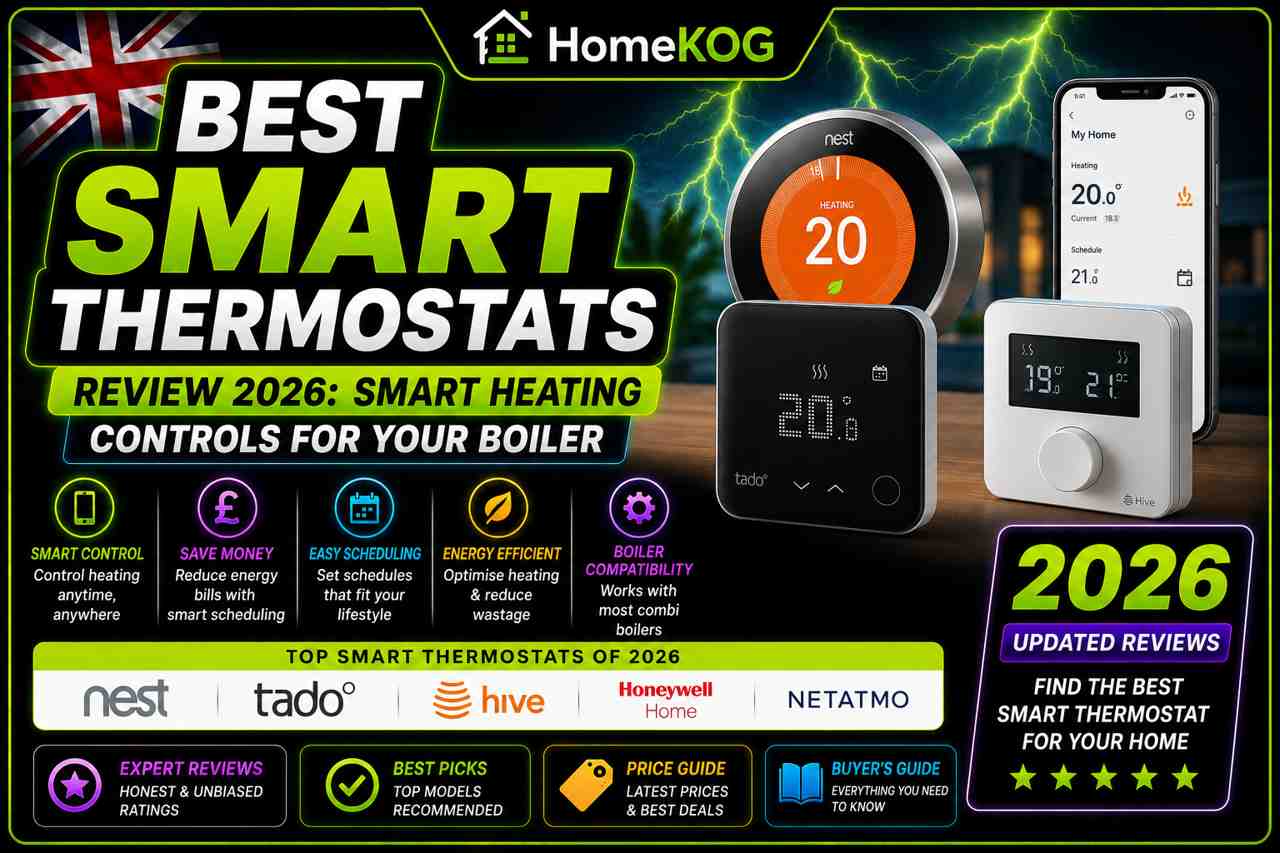

Best Smart Thermostats UK 2026: Top Heating Controls for Your Boiler
Quick Answer: The best smart thermostats for UK homes in 2026 are the Drayton Wiser (best overall), Google Nest Learning Thermostat (best for energy bill savings), Hive Smart Thermostat (best premium option), and Honeywell Evohome (best for zonal temperature control). All four work with most modern boilers and can reduce heating bills by up to 23% through smarter scheduling and occupancy-based control.
Smart thermostats have moved well beyond the simple programmable timers that older heating systems relied on. Today’s best models learn your daily routine, track your location, respond to voice commands, and allow you to adjust the heating room by room from anywhere in the world using a smartphone app. For UK homeowners looking to reduce energy bills and gain genuine control over their central heating, choosing the right smart thermostat is one of the most cost-effective upgrades available — often delivering meaningful savings without touching the boiler itself.
Smart Thermostats: Key Entity Relationships
- A smart thermostat is a Wi-Fi-enabled heating control device that replaces a conventional programmable thermostat, allowing homeowners to manage central heating remotely via a smartphone app, voice assistant, or automated schedule.
- The Drayton Wiser smart thermostat is a zonal heating control system that combines an internet-connected hub with individual smart radiator valves, enabling room-by-room temperature management at a lower price point than most premium competitors.
- The Google Nest Learning Thermostat is a self-programming smart thermostat that uses machine learning to observe household routines and adjust the heating schedule automatically, reducing average heating bills by approximately 13.5% over a full year of use.
- The Hive Smart Thermostat is a connected heating control produced by Hive, a subsidiary of British Gas, that manages whole-home heating via a geolocation-enabled app and supports optional smart thermostatic radiator valves for room-level control.
- The Honeywell Evohome is a modular zonal smart thermostat system that requires a dedicated controller unit and individual thermostatic heads fitted to each radiator, providing precise room-by-room temperature scheduling across the entire heating system.
- Geofencing is a location-based feature used by the Google Nest and Hive thermostats that detects when the homeowner’s smartphone leaves or approaches the property and automatically adjusts the heating to avoid warming an empty home.
- Zonal heating control is a heating management approach that divides a property into independently controlled temperature zones, typically achieved through smart radiator valves paired with a central hub, reducing energy consumption in unoccupied rooms.
- A C-wire — also known as a common wire — is a low-voltage electrical cable that provides continuous power to a smart thermostat for features such as Wi-Fi connectivity and backlit displays, and its absence in older heating systems may require an adapter or professional installation.
- The Boiler Plus regulations introduced in April 2018 require all new combi boiler installations in England to include an advanced heating control such as a smart thermostat, load compensator, or weather compensation kit as a condition of the installation.
- Amazon Alexa and Google Assistant are voice control platforms compatible with the Drayton Wiser and Hive smart thermostats, enabling homeowners to adjust heating settings using spoken commands through smart speakers or displays.
- Weather compensation is an advanced heating control feature that adjusts a boiler’s flow temperature in response to outdoor temperature changes, improving condensing boiler efficiency and reducing fuel consumption across the heating season.
- Boiler brand smart thermostats — including the Worcester Bosch EasyControl, Viessmann ViCare, Ideal Halo, Baxi uSense, Vaillant vSmart, and Glow-Worm MiGo — are manufacturer-specific controls designed to communicate directly with their respective boiler ranges, often providing deeper integration than universal third-party models.

Why Upgrade to a Smart Thermostat in 2026?
The case for fitting a smart thermostat has strengthened considerably as energy prices in the UK have remained elevated. A thermostat that responds to occupancy, learns your schedule, and prevents the heating from running in an empty house does not just add convenience — it addresses one of the most common sources of wasted energy in a typical British home.
Under the Boiler Plus regulations, all new combi boiler installations in England must already include an advanced heating control. But for the many millions of existing installations running on basic programmers, upgrading to a smart thermostat is one of the simplest and most affordable steps available to reduce annual energy costs without any changes to the boiler itself.
The best models on the market in 2026 go considerably further than scheduling. They track location, respond to voice commands, integrate with wider smart home ecosystems, and — in the case of zonal systems — allow individual rooms to be heated independently so that energy is not wasted warming spaces that are not being used.
Best Smart Thermostats Overview
| Model | Best For | Zonal Control | Voice Assistant | Geofencing |
|---|---|---|---|---|
| Drayton Wiser | Best overall | Yes (with smart valves) | Alexa, Google | No |
| Google Nest Learning | Energy bill savings | No | Google, Alexa | Yes |
| Hive Smart Thermostat | Premium features | Optional (add-on valves) | Alexa, Google, Siri | Yes |
| Honeywell Evohome | Zonal temperature control | Yes (per radiator) | Limited | No |
Best Overall Smart Thermostat: Drayton Wiser
The Drayton Wiser earns its recommendation as the best overall smart thermostat for UK homes by combining internet-connected heating control with genuine room-by-room zonal management at a price that undercuts most of its direct competitors. It is the option that delivers the broadest set of practical features for the widest range of households without requiring a significant upfront investment.
The system centres on a central heating hub that connects to the home’s Wi-Fi and communicates with individual smart thermostatic radiator valves fitted throughout the property. Through the Wiser app, each room can be scheduled independently, with boost intervals available from 30 minutes to three hours for occasions when a single room needs heating outside the normal schedule.
Over time the Wiser learns the household’s routine and begins to anticipate heating requirements, adjusting room temperatures automatically to match typical occupancy patterns. Both Amazon Alexa and Google Assistant are supported, so voice commands through a compatible smart speaker can control the heating without reaching for a phone.
Drayton Wiser: Design and Usability
The physical design of the Wiser hub and thermostat is functional rather than striking — plain white plastic with rounded corners and simple LED indicators. It will not draw attention on a wall the way the Nest or Hive units might, which suits homeowners who prioritise performance over aesthetics. The app experience is intuitive, and the system is genuinely accessible for households without a strong interest in smart home technology.
The main limitation is the absence of a motion sensor or geofencing capability, which means the system relies entirely on scheduled programming and manual app control rather than adapting automatically to unexpected changes in occupancy. For households with consistent routines, this is rarely a practical issue.
Best for Energy Bill Savings: Google Nest Learning Thermostat
The Google Nest Learning Thermostat is the most technically sophisticated self-programming thermostat available to UK homeowners. Its core proposition is simple: within a week of installation it begins observing when the heating is adjusted and by how much, and within a few weeks it has built a schedule that reflects the household’s actual routine without any manual programming required.
The learning capability alone is valuable, but the location-based features add a further layer of efficiency. Geofencing uses the homeowner’s smartphone location to detect when the property is empty and automatically reduces the heating, then brings the temperature back up as they approach home. Across a full year of use, Nest users report an average reduction in heating bills of around 13.5% — a meaningful saving on a typical UK gas bill.
Google Nest Learning Thermostat: Design and Usability
The Nest’s design is one of the most recognisable in the smart thermostat category. The circular body with its brushed metal finish and glass face draws clear inspiration from the Apple iPod click wheel and sits comfortably alongside premium interior design. The display is clear and readable, and the Nest app is among the most polished and user-friendly available.
The primary limitation is the absence of zonal control. The Nest manages the whole-home heating as a single zone, so individual radiators cannot be controlled independently without supplementary equipment. For households where the main priority is reducing overall energy consumption rather than managing room-by-room temperatures, this is unlikely to be a deciding factor.
Correct placement matters more with the Nest than with some competitors. Because the thermostat’s built-in sensor uses the temperature and occupancy of the room it is installed in to make decisions, placing it in a hallway or spare room that is not representative of the home’s typical occupied temperature will reduce the accuracy of its learning.
Best Premium Smart Thermostat: Hive Smart Thermostat
The Hive Smart Thermostat is the natural choice for homeowners who want a premium-feeling connected heating control that integrates into a broader smart home ecosystem. Produced by a subsidiary of British Gas, Hive benefits from strong brand recognition, wide installer availability, and compatibility with Amazon Alexa, Google Assistant, and Apple HomeKit — the broadest range of voice assistant support of any model in this comparison.
The thermostat’s circular dial design is one of the most visually attractive in the category, featuring a clean interface that displays the current and target temperatures clearly. Setup is managed entirely through the Hive app, which handles scheduling, geolocation, and remote control in a single well-designed interface.
Geofencing allows the system to detect when the homeowner is approaching home and begin heating the property to the desired temperature before they arrive, and a holiday mode keeps the thermostat dormant to avoid unnecessary energy use during extended absences.
Hive Smart Thermostat: Zonal Control and Limitations
Whole-home heating is controlled as a single zone as standard. Room-by-room zonal control requires the addition of Hive’s smart thermostatic radiator valves, available separately at approximately £54 per valve — a cost that adds up in larger properties but provides genuine flexibility for households where heating demand varies significantly between rooms.
The Hive thermostat does not include a motion sensor, meaning occupancy detection relies entirely on the geolocation function rather than any in-home presence detection. This makes accurate smartphone location essential to the system’s occupancy-based features functioning as intended. The Hive app also requires a subscription for full monitoring functionality, which is worth factoring into the total cost of ownership.
Best for Zonal Temperature Control: Honeywell Evohome
Honeywell’s Evohome is the most comprehensive zonal heating control system available at the consumer level in the UK. Where other smart thermostats treat zonal control as an add-on feature, the Evohome is built around it from the ground up — each radiator in the property receives its own individual thermostatic head that communicates with a central touchscreen controller.
This architecture allows each room to be scheduled independently with precise temperature control throughout the day, and the system calculates the time required to bring each room up to its target temperature, adjusting when it begins heating to ensure rooms are at the right temperature when occupancy is expected rather than after it.
Honeywell Evohome: Design, Interface, and Limitations
The central controller features a backlit resistive touchscreen with a colour-coded temperature display that makes the status of each zone immediately readable. The interface is clear and functional, though the overall design of both the controller and the radiator heads has a more utilitarian appearance than the Nest or Hive units.
The modular nature of the system is its greatest practical advantage and its primary cost consideration. Equipping an entire property with individual radiator heads represents a meaningful upfront investment, and the per-room cost increases significantly in larger homes. Discounted packs are available and should be explored when pricing a full installation.
The Evohome offers less in terms of smart home integration and machine learning than the Nest or Hive. It is best understood as a highly accurate and capable zonal control system rather than a self-learning smart thermostat, and homeowners who prioritise room-by-room precision over app polish and voice assistant integration will find it the most capable option available.
Boiler Brand Smart Thermostats
Beyond the universal smart thermostat market, most major boiler manufacturers offer their own proprietary smart controls designed to communicate directly with their boiler ranges. These brand-specific thermostats often provide deeper integration with the boiler’s modulation and efficiency features than a universal third-party control can deliver.
The main consideration when evaluating a boiler brand thermostat is the quality of the accompanying smartphone app, which varies considerably between manufacturers and can significantly affect the day-to-day usability of the system. The thermostats themselves are generally well engineered, and the price is typically lower than equivalent universal models — but the app experience is worth researching before committing.
The principal brand smart thermostats currently available for UK boilers are as follows. The Worcester Bosch EasyControl is designed for the Greenstar range and provides full app-based scheduling and remote control. The Viessmann ViCare integrates with Vitodens boilers and supports weather compensation. The Ideal Halo works with the Logic and Vogue ranges. The Baxi uSense is compatible with the Baxi combi and system boiler range. The Vaillant vSmart connects to ecoTEC boilers. The Glow-Worm MiGo pairs with the Flexicom and Betacom ranges. The EPH CP4i is a versatile wired control compatible with a broad range of boiler types.
All of these controls use app-based management and offer remote access to scheduling and temperature settings, making them a legitimate alternative to universal smart thermostats for homeowners who prioritise boiler-native integration over ecosystem breadth.
Smart Thermostat Buyer’s Guide
Smart vs Programmable Thermostats
The decision between a smart and a non-connected programmable thermostat comes down to how much flexibility and automation is genuinely useful in your household. A programmable thermostat handles fixed daily schedules reliably and costs significantly less — for households with very consistent routines and no interest in remote control or voice integration, it remains a perfectly adequate choice.
A smart thermostat adds meaningful value where occupancy varies, where remote control is useful, or where the energy-saving potential of learning and geofencing features justifies the higher upfront cost. Over a full heating season, the potential to reduce bills by 13 to 23% makes the financial case for smart thermostats straightforward for most UK homeowners.
Checking Your Wiring Before You Buy
Before purchasing any smart thermostat, it is worth checking whether your current heating system has a C-wire — the common wire that provides continuous low-voltage power to the thermostat for Wi-Fi connectivity and display functions. Older UK heating systems frequently operated on two-wire configurations that do not include a C-wire, which can complicate smart thermostat installation.
If a C-wire is not present, options include fitting an add-a-wire adapter, selecting a model such as the Google Nest that includes an internal battery for power, or having a heating engineer install a C-wire as part of the thermostat fitting. Discussing the wiring situation with your installer before purchase avoids unexpected complications on the day of installation.
Zonal Heating and Energy Efficiency
Zonal heating control — dividing the property into independently managed temperature zones — is one of the most effective ways to reduce energy waste in a multi-room home. Heating bedrooms to the same temperature as living spaces throughout the day, or maintaining a consistent temperature in rooms that are rarely used, represents a straightforward and avoidable energy cost.
The Drayton Wiser and Honeywell Evohome both deliver genuine room-by-room control. The Hive system supports zonal management with the addition of smart radiator valves. The Google Nest manages whole-home heating as a single zone and relies on its learning capability to reduce consumption rather than zonal separation.
Underfloor heating systems are also compatible with most smart thermostat platforms and provide an effective low-temperature heat distribution method that works particularly well in a zonal control arrangement.
FAQ: Best Smart Thermostats
What is the best smart thermostat for a UK home in 2026?
The Drayton Wiser is our top recommendation for most UK homes in 2026. It combines genuine room-by-room zonal control through smart radiator valves with internet-connected scheduling, Amazon Alexa and Google Assistant compatibility, and an accessible price point. For homeowners focused primarily on minimising energy bills through automation, the Google Nest Learning Thermostat’s self-programming capability and geofencing features make it the strongest alternative. The best choice ultimately depends on whether whole-home efficiency or room-level control is the higher priority.
Will a smart thermostat save me money on my heating bills?
Yes, in most cases. Studies and user data consistently show that smart thermostats reduce heating bills through more accurate scheduling, occupancy-based control, and the elimination of heating empty homes. Google Nest users report average savings of around 13.5% on heating costs, while smart thermostat users more broadly report reductions of up to 23% compared to basic programmable controls. Actual savings depend on how the thermostat is configured, the size and insulation level of the property, and how much heating was previously wasted on unoccupied spaces.
Do I need a smart thermostat under Boiler Plus regulations?
If you are having a new combi boiler installed in England, yes. The Boiler Plus regulations introduced in April 2018 require all new combi boiler installations to include an advanced heating control — which includes smart thermostats, load compensators, and weather compensation kits. For existing installations, there is no legal requirement to upgrade, but the energy bill savings available make it a worthwhile investment for most homeowners regardless of regulatory obligation.
What is geofencing on a smart thermostat?
Geofencing is a location-based feature that uses the GPS signal from the homeowner’s smartphone to detect when they leave or approach the property. When the phone moves beyond a set boundary, the thermostat reduces the heating to avoid warming an empty home. As the phone returns within range, the system brings the heating back up so the property is comfortable by the time the homeowner arrives. Google Nest and Hive both use geofencing as a core occupancy detection method.
Can a smart thermostat control individual rooms?
Some smart thermostats can manage room-by-room temperatures through zonal control, but not all. The Drayton Wiser and Honeywell Evohome both offer full room-level control — the Wiser through smart radiator valves added to each radiator, and the Evohome through individual thermostatic heads fitted to every radiator in the property. The Hive thermostat supports room-level control with optional smart radiator valves available as add-ons. The Google Nest Learning Thermostat controls whole-home heating as a single zone and does not support individual room management without additional equipment.
What is a C-wire and do I need one for a smart thermostat?
A C-wire — the common wire — is a low-voltage cable that provides continuous electrical power to a smart thermostat for features such as Wi-Fi connectivity, display backlighting, and app communication. Many older UK heating systems were wired with only two cables and do not include a C-wire. If your current thermostat wiring lacks a C-wire, options include fitting a third-party add-a-wire adapter, choosing a model with an internal battery such as the Google Nest, or having a heating engineer install a C-wire as part of the smart thermostat fitting.
Are boiler brand smart thermostats worth considering?
Yes, particularly if you want deeper integration between the thermostat and your specific boiler model. Manufacturer thermostats such as the Worcester Bosch EasyControl, Viessmann ViCare, Ideal Halo, and Vaillant vSmart are designed to communicate directly with their respective boiler ranges, enabling more precise modulation and efficiency features than a universal thermostat may achieve. They are also typically priced lower than premium universal models. The main variable to research before purchasing is the quality of the manufacturer’s smartphone app, which varies significantly and affects the practical usability of the system day to day.
How do I choose between a smart thermostat and a weather compensation control?
The two are not mutually exclusive — many boiler-compatible smart thermostats include weather compensation as a feature, and some manufacturer-specific controls such as the Viessmann ViCare support both functions simultaneously. A weather compensation control adjusts the boiler’s flow temperature in response to outdoor conditions, which directly improves condensing boiler efficiency regardless of occupancy. A smart thermostat primarily manages when the heating runs and at what temperature. For maximum energy efficiency, the ideal setup combines a correctly commissioned condensing boiler with both smart scheduling and weather compensation — a combination available through several of the boiler brand controls listed above.
Conclusion
Smart thermostats represent one of the most accessible and cost-effective upgrades available to UK homeowners in 2026. The right choice depends on the priorities that matter most in your household — whether that is the self-programming efficiency of the Google Nest, the comprehensive zonal control of the Drayton Wiser or Honeywell Evohome, or the premium ecosystem integration of the Hive.
All four models deliver meaningful energy bill savings and a level of heating control that a conventional programmer simply cannot match. For homes where individual room temperatures matter, the Drayton Wiser offers the strongest combination of capability and value. For households focused on set-and-forget automation, the Google Nest’s learning capability remains the benchmark.
Whichever model you choose, pairing it with a correctly sized and properly commissioned condensing boiler — and ensuring the thermostat communicates with the boiler in the way it was designed to — is what turns a smart heating control into a genuinely smart investment.