
Ideal Isar Boiler Problems: Fault Codes, Causes & How to Fix Them
Quick Answer: The most common Ideal Isar boiler problems include flame loss (F2 fault code), low water pressure (F1), no hot water, kettling noises, and ignition failure. Some faults — such as low pressure and a frozen condensate pipe — can be resolved at home. Others, including flame loss, leaks, and ignition lockout, always require a Gas Safe registered engineer.
The Ideal Isar is a combi boiler range that has been widely installed across UK homes, but like any boiler, it develops faults over time. Knowing what each fault code means and whether the problem needs professional attention can save you both time and money.
This guide covers every common Ideal Isar boiler problem, what is causing it, and the clearest route to getting it resolved in 2026. In addition to troubleshooting, it’s important to stay informed about ideal boilers pricing details for 2026, as this can help homeowners budget effectively for repairs or replacements. As the market evolves, comparisons to competitors will also provide insight into whether investing in an Ideal Boiler is the best decision. Thorough research can ensure that customers are making an informed choice for their heating needs. In addition to the factors influencing your choice, conducting a system boiler cost analysis is essential to understanding overall expenditure. This analysis not only considers installation fees but also ongoing maintenance and energy consumption costs that can significantly impact your budget. Homeowners should look for updated comparisons that include system boiler options from various brands to make the most informed decision.
Key Facts: Ideal Isar Boiler Problem Relationships
- The Ideal Isar is a combi boiler manufactured by Ideal Heating, a UK brand with over 100 years of experience in central heating solutions.
- The F2 fault code on an Ideal Isar boiler indicates flame loss and is associated with causes including low gas pressure, a faulty fan, PCB failure, or an interrupted gas supply.
- The F1 fault code on an Ideal Isar boiler indicates low water pressure, which can result from a system leak, recently bled radiators, or a faulty pressure relief valve.
- The L2 fault code on an Ideal Isar boiler is associated with multiple faults including gurgling noise, ignition failure, flame loss, and no hot water supply.
- A boiler lockout is a safety mechanism triggered by the PCB when the Ideal Isar detects a persistent fault, resulting in shutdown and an orange warning light on the display.
- A frozen condensate pipe is a fault that displays as a warning notification on the Ideal Isar and can be resolved by the homeowner without professional assistance.
- Kettling noise on an Ideal Isar boiler is caused by limescale or sludge build-up on the heat exchanger and always requires a Gas Safe engineer to resolve.
- A PCB is the printed circuit board that controls all electronic functions of the Ideal Isar boiler and its failure can cause multiple simultaneous fault symptoms.
- A thermocouple is a safety component on an Ideal Isar boiler that monitors the pilot light and shuts off the gas supply if the flame goes out, preventing gas leaks.
- A zone valve is a motorised valve that controls the flow of heated water to different circuits within the heating system and can cause no hot water symptoms when it fails.
- A filling loop is a metal hose with valves at each end that is used to add water to the central heating system and restore boiler pressure after a drop.
- A Gas Safe registered engineer is the only qualified professional legally permitted to carry out repairs on gas boiler components in the UK.

Ideal Isar Boiler Fault Codes at a Glance
Understanding the fault code displayed on your Ideal Isar boiler is the fastest way to identify what has gone wrong. The boiler uses a combination of letter and number codes to indicate specific faults.
| Fault Code | Problem Indicated | Engineer Required? |
|---|---|---|
| F2, FL, L2, FN, LN | Flame loss | Yes |
| F1 | Low water pressure | Only if caused by a leak |
| F1, F2, L2 | No hot water | Depends on cause |
| L2 | Gurgling noise | Yes |
| L2 | Loud ignition noise | Yes |
| L2 | Ignition failure / lockout | Yes |
| No code | Blank display | Yes |
| No code | Frozen condensate pipe | No |
Common Ideal Isar Boiler Problems and How to Fix Them
Flame Loss — F2, FL, L2, FN or LN Fault Code
Flame loss is one of the more complex faults the Ideal Isar can develop because several different underlying causes can produce the same fault code. The boiler is losing its flame during operation — or failing to establish one at all — and shutting down as a result.
Possible causes include low gas pressure at the meter, an insufficient or completely interrupted gas supply, a faulty fan that is not expelling combustion gases correctly, or a failure in an electronic component such as the PCB or pump.
If your home uses a prepayment meter, the first step is to check whether the meter has sufficient credit. If the credit has run out, topping up the meter and resetting the boiler may resolve the fault immediately.
If the gas supply is confirmed to be active and the fault code persists, this is not a repair to attempt yourself. The F2 and associated fault codes on the Ideal Isar always require a Gas Safe registered engineer to identify and replace the faulty component safely.
Low Water Pressure — F1 Fault Code
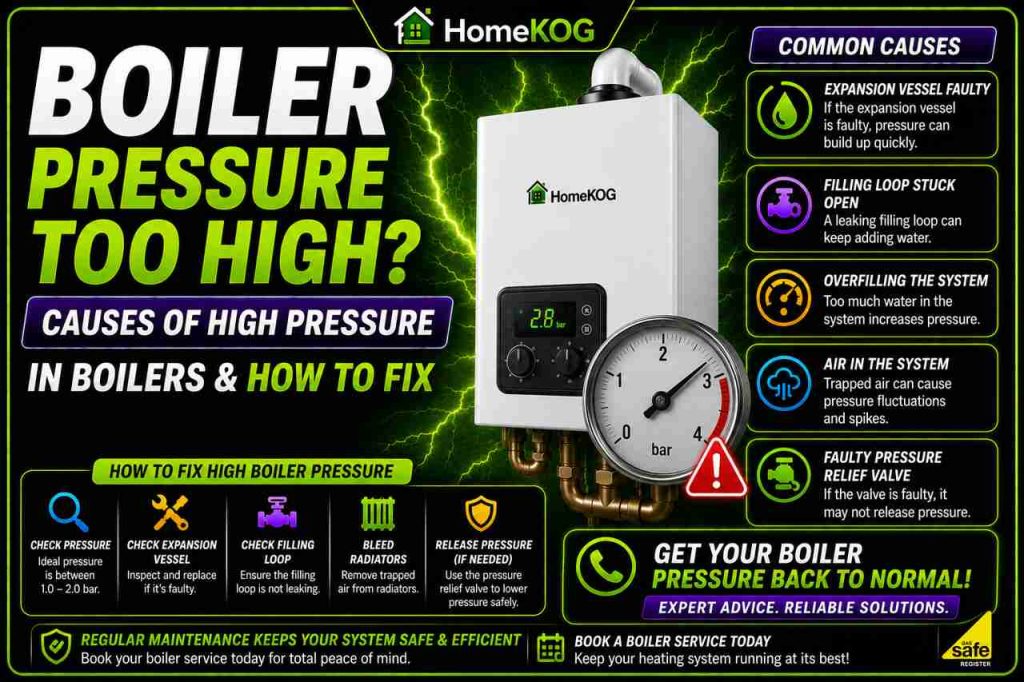
The Ideal Isar boiler operates at an optimal pressure of around 1.5 bar, which is displayed on the built-in pressure gauge on the front of the unit. Some gradual pressure loss over time is normal as the system ages, but a sudden and significant drop in pressure points to a specific cause that needs addressing.
A sudden pressure drop is most commonly caused by a leak somewhere in the system, a pressure relief valve that is no longer sealing correctly, or recently bled radiators that have released water alongside the trapped air.
If the pressure has dropped after a radiator bleed or for no obvious reason and there is no visible leak, you can repressurise the system yourself using the filling loop. Switch the boiler off and allow it to cool fully before starting. Locate the filling loop — a short metal hose connecting the mains water supply to the central heating system — and open the valves on each end to allow water to flow into the system. Watch the pressure gauge and close the valves as soon as the reading reaches one bar. Switch the boiler back on and check that the pressure holds.
If pressure continues to drop, or if you can see water leaking from any part of the system, a Gas Safe engineer will need to identify and repair the source of the loss.
No Hot Water — F1, F2 or L2 Fault Code
A loss of hot water on the Ideal Isar can have several causes, which is why it shares fault codes with both flame loss and pressure faults. Before assuming the problem is internal, there are two checks worth making first.
Check that the temperature dial on the front of the boiler is turned up to an appropriate level. It is easy to inadvertently knock the dial down, and this alone can be the reason for a loss of hot water. Next, locate the isolation valve under the boiler and confirm that it is fully open. A partially closed valve restricts the water supply to the boiler and can prevent hot water from being produced.
If both of these checks come back clear, the fault is likely internal. A failing zone valve — the motorised valve that directs water between the heating and hot water circuits — is one of the more common causes. A Gas Safe engineer will need to investigate and replace the affected component.
Gurgling Noise — L2 Fault Code
A gurgling noise on the Ideal Isar is typically caused by a blockage in the condensate trap — the component that collects acidic condensate water produced during the boiler’s condensing process before it is expelled through the condensate pipe.
To clear this blockage, the condensate trap needs to be removed and cleaned. This will release some water, so placing a bowl or towel underneath the boiler before starting is advisable. Once the trap is cleared and refitted, the gurgling should stop.
If the noise persists after clearing the trap, or if you are not confident carrying out this step yourself, a Gas Safe engineer can complete the task quickly and check for any other contributing factors.
Loud Noise When Igniting — L2 Fault Code
A loud bang or boom when the Ideal Isar attempts to ignite is a fault that should not be ignored. This sound indicates that an excess of unburned gas has accumulated inside the ignition chamber before the burner fires, causing a small but sudden combustion event when ignition finally occurs.
This fault always requires a Gas Safe engineer. The causes are varied — a partially blocked burner, a faulty ignition electrode, or a gas valve that is not opening and closing correctly — and the repair involves working directly with the gas components of the boiler.
Do not continue to use the boiler if it is making a loud noise on ignition. Switch it off and call a registered engineer.
Blank Display
If the display on the Ideal Isar shows nothing at all, the most straightforward explanation is that the boiler has lost its power supply. Check that the boiler is switched on at the isolator switch and that the relevant circuit breaker in your consumer unit has not tripped. Restoring power may be all that is needed.
If the boiler is confirmed to be receiving power but the display remains blank, a component inside the boiler has failed — most likely the PCB or the display unit itself. This requires a Gas Safe engineer to diagnose and replace the faulty component.
Ignition Failure and Lockout — L2 Fault Code
When the Ideal Isar attempts to ignite and fails on three consecutive occasions, it enters a lockout. Lockout is a safety response — the boiler shuts itself down to prevent unburned gas from accumulating — and is indicated by an orange warning light on the display panel.
In some cases, a lockout can be cleared by pressing the reset button on the boiler and waiting for it to attempt ignition again. If the boiler restarts and runs normally, the fault may have been a temporary interruption to the gas supply or a brief electronic glitch.
If the boiler locks out again after resetting, the underlying cause needs to be identified. Common causes include a faulty ignition electrode, a problem with the gas valve, or a PCB fault. All of these require a Gas Safe engineer.
Other Common Ideal Isar Boiler Problems
Boiler Keeps Turning Itself Off
An Ideal Isar that repeatedly switches itself off is usually responding to a fault it has detected internally. The most common causes are low water pressure, a closed isolation valve restricting water flow, a faulty thermostat sending incorrect temperature readings, or a circulating pump that is not moving water around the system effectively.
This fault always requires a Gas Safe engineer to diagnose properly. The boiler is shutting down as a safety precaution, and identifying which component is triggering that response requires professional diagnostic equipment.
Radiators Not Heating Up
Cold or unevenly heated radiators on an Ideal Isar system are most commonly caused by air or sludge accumulating in the central heating circuit. Air prevents water from circulating fully, and sludge restricts flow through the narrowest sections of the system including the radiators themselves.
Bleeding the radiators is the recommended first step and is something most homeowners can carry out at home using a radiator bleed key. Start with the radiator furthest from the boiler and work back towards it. After bleeding, check and restore the system pressure if it has dropped.
If bleeding the radiators does not restore even heat distribution across the system, sludge is the more likely cause and a power flush carried out by a Gas Safe engineer will be needed.
Kettling Noise
Kettling on the Ideal Isar — the rumbling or whistling noise that resembles a boiling kettle — is caused by limescale or sludge build-up on the heat exchanger. Restricted water flow through the heat exchanger causes localised overheating, steam production, and the characteristic noise.
This fault always requires a Gas Safe engineer. A power flush is typically the recommended course of action, followed by the addition of a central heating inhibitor and potentially the fitting of a magnetic system filter to prevent recurrence.
Thermostat Problems
If the Ideal Isar is not reaching the desired temperature or is cycling on and off erratically, the thermostat settings are the first thing to check. Confirm that the thermostat is set to the correct temperature and that it has not been accidentally switched off or had its schedule altered.
If adjusting the settings does not resolve the issue, the thermostat itself may need to be replaced. A smart thermostat replacement is a straightforward job for a heating engineer and can also improve the efficiency of the system as a whole.
Frozen Condensate Pipe
In cold weather, the condensate pipe on the Ideal Isar can freeze solid. This pipe carries wastewater from the boiler’s condensing process to an external drain, and because part of it typically runs outside or through an unheated space, it is vulnerable to freezing when temperatures drop below zero.
The Ideal Isar will usually display a warning notification when this occurs. To resolve it, pour warm — not boiling — water over the frozen section of pipe until the blockage clears. Once the pipe is thawed, reset the boiler using the reset button on the front panel. The boiler should return to normal operation within a few minutes.
This is one of the few Ideal Isar faults that does not require a Gas Safe engineer to resolve.
Pressure Loss
Gradual pressure loss on the Ideal Isar is normal and can be restored by repressurising the system using the filling loop as described earlier in this guide. The process takes only a few minutes and is safe for homeowners to carry out themselves.
If pressure is dropping rapidly and repeatedly, the cause is almost certainly a leak within the system. A faulty pressure relief valve is another possibility. In either case, a Gas Safe engineer will need to locate and repair the source of the loss.
Pilot Light Going Out
If the pilot light on the Ideal Isar goes out and will not stay lit, the most likely cause is a failed thermocouple. The thermocouple is a safety device that detects whether the pilot flame is present. When it fails, it incorrectly signals that the flame is out and cuts the gas supply as a precaution, even when the boiler is otherwise functioning normally.
Replacing a thermocouple always requires a Gas Safe engineer, as it involves working directly with the gas components of the boiler.
Dripping and Leaking
A visible water leak from the Ideal Isar indicates that an internal component has failed — most commonly a seal, valve, or the pressure relief valve. The location and severity of the leak will determine which part is responsible, but in all cases a Gas Safe engineer is needed.
Do not ignore a boiler leak. Water dripping onto electrical components inside the boiler can cause secondary faults that are more expensive to repair, and a persistent leak can lower system pressure to the point where the boiler shuts down entirely.
Frequently Asked Questions
What does the F2 fault code mean on an Ideal Isar boiler?
The F2 fault code on an Ideal Isar boiler indicates flame loss — the boiler is failing to establish or maintain its burner flame during operation. Possible causes include low gas pressure, an insufficient gas supply, a faulty fan, or a failed electronic component such as the PCB. If your home has a prepayment meter, check the credit first. In all other cases, a Gas Safe registered engineer is required to diagnose and repair the fault.
What does the F1 fault code mean on an Ideal Isar boiler?
The F1 fault code on an Ideal Isar boiler indicates that water pressure has dropped below the minimum operating level. The boiler requires a pressure of around 1.5 bar to function correctly. If the pressure has dropped after bleeding radiators or for no obvious reason, you can repressurise the system yourself using the filling loop. If the pressure drop is sudden or recurring, a Gas Safe engineer should investigate for a system leak or a faulty pressure relief valve.
Can I fix Ideal Isar boiler problems myself?
Some faults can be resolved at home without professional help. Low water pressure caused by normal system use can be corrected by repressurising via the filling loop. A frozen condensate pipe can be thawed with warm water and the boiler reset. Cold radiators caused by trapped air can often be resolved by bleeding. For all other faults — including flame loss, ignition failure, leaks, kettling, and blank displays — a Gas Safe registered engineer must be called.
Why does my Ideal Isar boiler keep locking out?
An Ideal Isar boiler locks out after three consecutive failed ignition attempts as a safety measure to prevent unburned gas from accumulating. If the boiler resets and runs normally after one lockout, the cause may have been a brief interruption to the gas supply. Repeated lockouts indicate a persistent underlying fault such as a faulty ignition electrode, gas valve problem, or PCB failure. A Gas Safe engineer will need to identify and repair the specific cause.
Why is my Ideal Isar boiler making a loud noise when it ignites?
A loud bang on ignition from an Ideal Isar boiler means that unburned gas has built up in the ignition chamber before the burner fires. This is sometimes called a delayed ignition fault and can be caused by a partially blocked burner, a failing ignition electrode, or a gas valve that is not opening at the correct point in the ignition sequence. This fault always requires a Gas Safe engineer and the boiler should be switched off until the repair has been carried out.
How do I repressurise my Ideal Isar boiler?
Switch the boiler off and allow it to cool completely before starting. Locate the filling loop — a short metal hose connecting the mains supply to the central heating circuit, typically found beneath the boiler. Open the valves at each end of the loop to allow water to flow into the system, watching the pressure gauge on the boiler front panel. Close both valves as soon as the gauge reads one bar. Switch the boiler back on. If the pressure drops again within a short period, a leak is likely and a Gas Safe engineer should be contacted.
What should I do if my Ideal Isar boiler display is blank?
Start by checking that the boiler isolator switch is turned on and that the circuit breaker for the boiler has not tripped in your consumer unit. If restoring the power supply does not bring the display back to life, an internal component has failed — most likely the PCB or display unit. A Gas Safe engineer will need to diagnose which component is at fault and carry out the replacement. Do not attempt to open the boiler casing to investigate yourself.
Is it worth repairing an Ideal Isar boiler or should I replace it?
For Ideal Isar boilers that are less than ten years old and have developed a single fault, repair is usually the more cost-effective option. For older models that have experienced multiple faults or where the cost of repair approaches £500 or more, replacement becomes increasingly sensible. A new boiler will be more energy efficient, will carry a full manufacturer warranty, and is far less likely to develop further faults in the near term. A Gas Safe engineer can give you an honest assessment of whether the repair is worthwhile given the age and condition of the boiler.
Conclusion
The Ideal Isar is a capable combi boiler, but it does develop recognisable faults as it ages. Understanding what each fault code means and knowing which problems you can address at home puts you in a much stronger position when something goes wrong. When assessing boiler reliability, conducting a Worcester 4000 boiler performance analysis can provide valuable insights into its operational efficiency. Regular maintenance checks can help identify potential issues before they escalate, ensuring optimal performance over time. By familiarizing yourself with the specific metrics highlighted in the analysis, you can make informed decisions about repairs and upgrades as needed. Creating an ideal boiler service checklist is essential for proactive maintenance. This checklist should include regular inspections of key components, ensuring any wear and tear is addressed promptly. By keeping thorough records of your boiler’s performance and maintenance history, you can further enhance its longevity and reliability.
Low pressure and a frozen condensate pipe are the two faults most homeowners can resolve without professional help. For everything else — flame loss, ignition failure, kettling, leaks, and component failures — a Gas Safe registered engineer is the only safe and legal route to a proper repair.
Keeping the boiler serviced annually remains the most reliable way to reduce the frequency of faults, extend the working life of the boiler, and catch developing problems before they become expensive ones. If the Ideal Isar has started generating repeated fault codes and the repair costs are mounting, it may be time to start comparing the cost of a new installation against continuing to maintain an ageing unit.