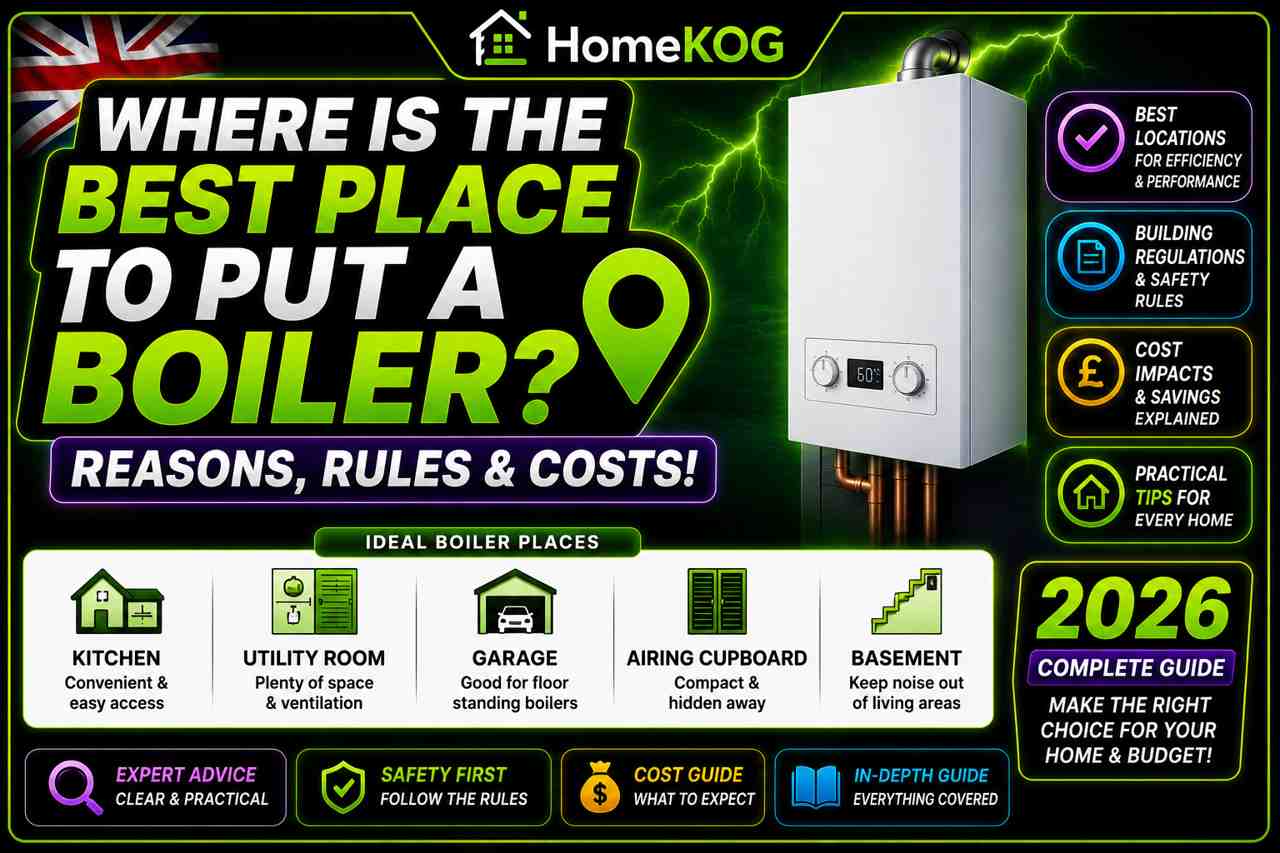

Where is the Best Place to Put a Boiler? Reasons, Rules and Costs 2026
Quick Answer: The best place to put a boiler in most UK homes is inside a kitchen cupboard — it is hidden, easily accessible for servicing, close to the main water-using appliances, and most modern combi boilers are specifically designed to fit standard kitchen cupboard dimensions. The utility room is the second-best option, followed by the airing cupboard where existing pipework is already in place. Bathrooms are viable but require compliance with specific IEE Wiring Regulations on electrical spur placement. Moving an existing boiler to a different room costs £300 to £800 in addition to the boiler cost. All installation must be carried out by a Gas Safe registered engineer.
Choosing where to install a new boiler is a decision that affects convenience, running costs, maintenance access, and noise levels for the next 10 to 15 years. Most homeowners have more flexibility than they realise — while the most popular locations are the kitchen and utility room, a boiler can be safely installed in almost any room in the house provided the relevant regulations are followed. This guide covers every possible boiler location in detail, the regulations that apply to each, and what it costs to relocate a boiler.
What Makes a Good Boiler Location?
The ideal boiler location balances four factors: proximity to the main water-using appliances to minimise hot water pipework runs, accessibility for annual servicing and any repairs, compliance with building regulations for flue routing and clearances, and practicality in terms of available space, wall strength, and ventilation.
Proximity to water-using appliances matters because longer hot water pipe runs mean more cold water to clear before hot water arrives at the tap — wasteful of both water and the homeowner’s time. A boiler installed in the kitchen or ground-floor bathroom is typically closer to the main usage points than one installed in a loft or garage. For combi boilers specifically, which heat water on demand rather than storing it, minimising the distance between the boiler and the main tap is a genuine practical benefit.
Flue access is the most restrictive factor for many installations — the boiler’s flue must pass to the outside of the building, either through a wall or through the roof, with specific minimum clearance distances from windows, doors, and other buildings as specified in the manufacturer’s installation manual. The availability of a suitable flue route frequently determines which rooms are genuinely viable rather than theoretically possible.

Best Places to Install a Boiler
1. Kitchen — Best Overall Location
The kitchen is the most popular boiler location in UK homes and the default recommendation for most combi boiler installations. The vast majority of modern combi boilers are specifically designed with kitchen installation in mind — their compact dimensions match the internal dimensions of a standard kitchen base or wall cupboard, and the clean white or grey aesthetics blend into kitchen cabinetry without visual intrusion.
The kitchen’s proximity to the main water-using appliances — dishwasher, kitchen tap, and typically close to the bathroom on the floor above — minimises hot water pipework runs. Access for annual servicing is straightforward with the cupboard door open. The flue typically has a short, direct route to an external wall. The noise from a modern condensing boiler in a closed cupboard is minimal — typically 34 to 45dB depending on the model, well below the level that would be noticeable in an adjoining room.
Where kitchen space is limited, manufacturers publish specific cupboard dimension requirements for each model — measuring the available space before selecting the boiler avoids the frustration of a model that does not fit. Most modern combi boilers fit a 600mm-wide standard kitchen base or wall unit with adequate clearance.
2. Utility Room — Excellent Alternative
A utility room is an excellent boiler location for any home that has one. It keeps the boiler completely out of the main living and kitchen space, it typically has water connections already in place for a washing machine, and the engineer has unobstructed access without needing to open kitchen cupboards. It is generally less aesthetically important than the kitchen, meaning the boiler can be mounted on an open wall rather than concealed if preferred.
The utility room is particularly well suited to system and regular boiler installations where the hot water cylinder can also be housed in the same room, keeping all the heating infrastructure in a single dedicated space.
3. Airing Cupboard — Best for Replacing a Conventional Boiler
For homes replacing an older conventional boiler that had its hot water cylinder in an airing cupboard, moving a combi or system boiler into the same airing cupboard retains the advantage of existing cold and hot water supply pipework already running to that location. The infrastructure is already in place, reducing the additional pipework required and therefore the installation cost.
The airing cupboard must be adequately sized — the engineer will confirm minimum clearance requirements on all sides of the boiler casing — and a flue route to the outside of the building must be achievable. In many properties, the airing cupboard is on an internal wall, which may require a longer flue run to reach the exterior.
4. Bathroom — Viable with Correct Electrical Regulations
The bathroom is a viable boiler location on the grounds that it is closest to the highest hot water demand point in the home. Having the boiler adjacent to or within the main bathroom means the hot water pipework run is minimised and the condensate drainage can connect easily to the bathroom’s existing waste.
The critical requirement for a bathroom installation is compliance with the IEE Wiring Regulations and Building Regulations zones for electrical installations in bathrooms. The boiler’s electrical spur must be located outside the bathroom — or in an approved zone within it — where water cannot reach the electrical connection. The most practical approach is to house the boiler within a dedicated airing cupboard adjacent to the bathroom rather than on an open bathroom wall, keeping the boiler accessible but separated from the wet zone.
A Gas Safe engineer will confirm the correct zoning requirements for the specific bathroom layout before installation.
5. Bedroom — Possible but Noise Requires Consideration
A bedroom installation is less common but entirely possible in terms of regulation compliance. The primary practical consideration is noise — a boiler that fires during the night when the heating is on a timer or when domestic hot water is demanded will be more noticeable in a bedroom than in a kitchen or utility room.
Modern boilers have dramatically lower noise levels than older models — the Viessmann Vitodens range operates at 34dB and the Worcester Bosch Greenstar 4000 at 42dB, both below the level that would disturb light sleep. Housing the boiler in a purpose-built cupboard or wardrobe within the bedroom reduces noise further and conceals the unit aesthetically.
For anyone considering a bedroom installation, confirming the specific model’s noise rating in dB before purchasing is worthwhile — quieter models are significantly less likely to cause sleep disruption.
Alternative Locations
Garage
A garage installation keeps the boiler completely out of the living space and is viable where the garage is attached to the main property. The primary disadvantages are the increased pipework run to deliver hot water to the house, energy losses through the longer pipe runs in an unheated space, and the risk of condensate pipe freezing during cold weather. Comprehensive pipe insulation and frost protection controls are essential for any garage boiler installation. A detached garage creates additional complications with the connection between the outbuilding and the main house, including gas supply routing and extended pipework.
Loft or Attic
Loft installation was common for older conventional boilers where the cold water feed tank was also in the loft. For modern combi and system boilers, the loft is a less preferred location — remote from the main usage points, requiring a dedicated access ladder, lighting, and flooring for servicing access, and exposed to colder temperatures that risk condensate pipe freezing. If the loft is the only available location, pipe insulation, frost protection, and good access provision are essential.
Under the Stairs
The understairs cupboard can work as a boiler location provided it is adjacent to an external wall for the flue and is spacious enough for the boiler unit with the required clearances for access during servicing. It must not be used for storage of flammable materials once the boiler is installed.
Regulations for Boiler Installation Location
All boiler installations regardless of location must comply with the following core requirements. The installation must be carried out by a Gas Safe registered engineer. The boiler must be installed inside a building on a wall strong enough to support its weight when filled with water. LPG boilers must not be installed below ground level such as in a basement. The flue must pass to the exterior of the building through an external wall or the roof, with the flue terminal at the minimum clearance distances from windows, doors, air bricks, and neighbouring buildings as specified in the manufacturer’s installation manual.
The Boiler Plus requirements (2018) apply regardless of location — a combi boiler installation must include at least one of: time and temperature zone control, load compensation, weather compensation, or a smart thermostat with automation and optimisation functions.
For bathroom installations specifically, the boiler and its electrical spur must comply with the zone requirements of the IEE Wiring Regulations — the engineer will design the installation to ensure electrical components are positioned in approved zones only.
Cost of Moving a Boiler to a Different Room
| Move Type | Typical Cost |
|---|---|
| Moving boiler within the same room | £150–£300 |
| Moving boiler to an adjacent room | £300–£500 |
| Moving boiler to a different floor or distant room | £500–£800 |
| Moving boiler from loft to kitchen | £500–£1,000 |
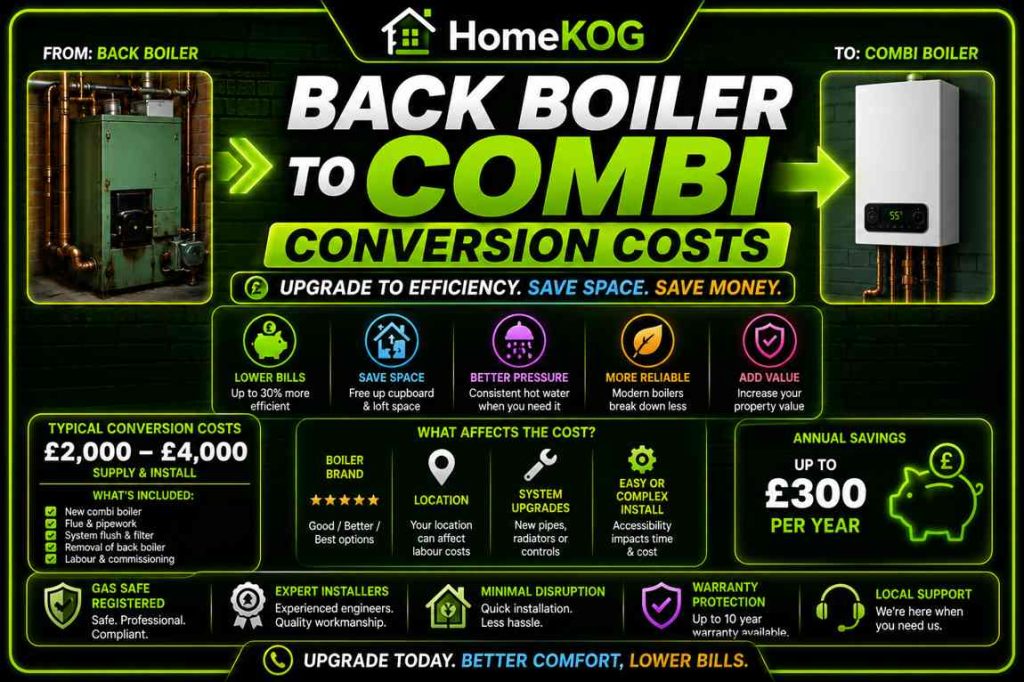
These costs cover the additional pipework, flue extension, and labour involved in the relocation. They are in addition to the boiler replacement cost if a new boiler is being installed simultaneously. Moving a boiler to a distant location from the existing water and gas supply connections requires rerouting those connections — which may involve lifting floorboards, routing through walls, or running external pipe boxing — and this is where costs rise most significantly.
Where a boiler relocation is planned as part of a broader kitchen renovation or extension project, coordinating the boiler move with the building work typically reduces the additional cost as floorboard lifting and wall routing can be done while the building work is already underway.
FAQ
What is the best place to put a boiler?
For most UK homes, a kitchen cupboard is the best boiler location — it is close to the main water-using appliances, hidden, easily accessible for servicing, and most modern combi boilers are specifically designed for kitchen cupboard installation. The utility room is the best alternative for homes that have one, keeping all mechanical infrastructure separate from the main living and cooking areas.
Can a boiler be installed in a bathroom?
Yes, but the installation must comply with the zone requirements of the IEE Wiring Regulations regarding electrical spur placement. The boiler’s electrical connection must be positioned outside the bathroom or in an approved zone — not within reach of water splashing. The most practical bathroom boiler installation typically uses an airing cupboard adjacent to the bathroom rather than mounting the boiler on an open bathroom wall.
How much does it cost to move a boiler?
Moving an existing boiler to a different room costs £300 to £800 depending on the distance of the move and the complexity of rerouting pipework and the flue. This cost is additional to any new boiler cost if replacement is also being carried out simultaneously. A like-for-like replacement in the same location costs significantly less than a relocation.
Can a boiler be installed in a bedroom?
Yes. There are no regulations that prohibit a boiler installation in a bedroom. The practical consideration is noise — a boiler that fires at night during heating cycles can be audible in a bedroom. Selecting a quiet model (below 40dB) and housing it in a purpose-built cupboard within the bedroom minimises noise impact.
Does a boiler need ventilation?
Modern balanced-flue condensing boilers draw combustion air from outside through the flue rather than from the room — they do not require a room ventilation opening. This is one of the reasons they can be installed in sealed kitchen cupboards without the ventilation requirements that applied to older open-flue boiler installations.
Conclusion
The best place to put a boiler is wherever it can be installed safely, accessed easily for servicing, and integrated with the property’s existing pipework at minimum additional cost — and for most UK homes, this means a kitchen cupboard. The utility room and airing cupboard are excellent alternatives depending on the property’s layout and existing infrastructure.
All boiler location decisions should be made in consultation with the Gas Safe registered engineer carrying out the installation — they will assess the specific property, confirm flue routing options, check electrical compliance requirements for the chosen location, and recommend the approach that minimises installation complexity and cost while meeting all applicable regulations. The location question is always secondary to the more fundamental requirement of a correct installation by a qualified professional.