
What is the ErP Directive? Energy-Related Products Guide for Boilers 2026
Quick Answer: The ErP Directive (Energy-related Products Directive) is a European Union regulation adopted in 2010 that sets minimum energy efficiency standards for products that consume energy or affect energy consumption. For boilers, the ErP rating runs from A to G, with A-rated boilers achieving a minimum of 92% efficiency. All new gas boilers sold in the UK must be A-rated condensing models under the Boiler Plus legislation (2018). The ErP label allows homeowners to compare the energy efficiency of boilers and other appliances directly, with A-rated (green) products being the most efficient and G-rated (red) products the least.
When comparing boilers, smart thermostats, hot water cylinders, and heating controls, the ErP label is the standardised efficiency reference that allows direct comparison between products from different manufacturers. Understanding what the label means — and why the rating matters for real-world running costs — helps homeowners make informed purchasing decisions rather than relying on manufacturer claims alone. This guide explains the ErP Directive, how boiler ratings are determined, and what the labels mean in practical terms.
What is the ErP Directive?
The Energy-related Products (ErP) Directive is a regulation introduced by the European Union in 2009 and brought into effect in 2010. It replaced the earlier Energy-using Products (EuP) Directive and significantly expanded the scope of energy efficiency regulation.
The critical difference between the old EuP and the new ErP frameworks is scope. The EuP Directive only covered products that consumed energy directly — boilers, computers, washing machines, air conditioners. The ErP Directive extends regulation to all products that affect energy consumption, including those that do not themselves use energy but influence how much energy other products consume.
Examples of energy-related products newly covered under the broader ErP scope include water-saving showerheads and taps (which reduce the volume of hot water heated by the boiler), energy-saving windows and building insulation (which reduce the heat demand on the boiler), and heating controls and thermostats (which affect how efficiently the boiler’s output is managed).
This holistic view of energy efficiency recognises that the total energy consumed by a home’s heating system is determined not just by the boiler’s efficiency but by the entire system within which it operates — a highly efficient boiler in a poorly insulated property with no controls will still consume far more energy than a moderately efficient boiler in a well-insulated, well-controlled property. To ensure optimal performance, it is essential to follow boiler maintenance best practices regularly. This includes checking for leaks, ensuring proper ventilation, and scheduling professional inspections. By maintaining the system properly, homeowners can maximize energy efficiency and extend the lifespan of their heating equipment.

Why the ErP Directive Matters to Homeowners
The ErP Directive has two practical implications for homeowners. First, it establishes minimum performance standards that manufacturers must meet before their products can be sold in the UK and EU — products that do not meet the minimum standard for their category cannot be placed on the market. This floor standard means that even the least expensive boiler available in a UK retailer meets a minimum efficiency threshold.
Second, the ErP label provides a standardised efficiency comparison that allows homeowners to compare products from different manufacturers on a consistent basis. Without the ErP label, comparing efficiency between brands would require interpreting different manufacturers’ proprietary efficiency claims — which are not always directly comparable. The ErP label provides a single standardised scale that applies consistently across all products in a category.
Before products covered by the ErP Directive can be sold in the UK, they must meet specific safety, health, and environmental protection standards confirmed through testing. Products that pass the test carry a CE mark confirming regulatory compliance. The CE mark is a declaration of compliance rather than a quality indicator, but its absence would indicate a product has not been through the required testing process.
What is the ErP Label?
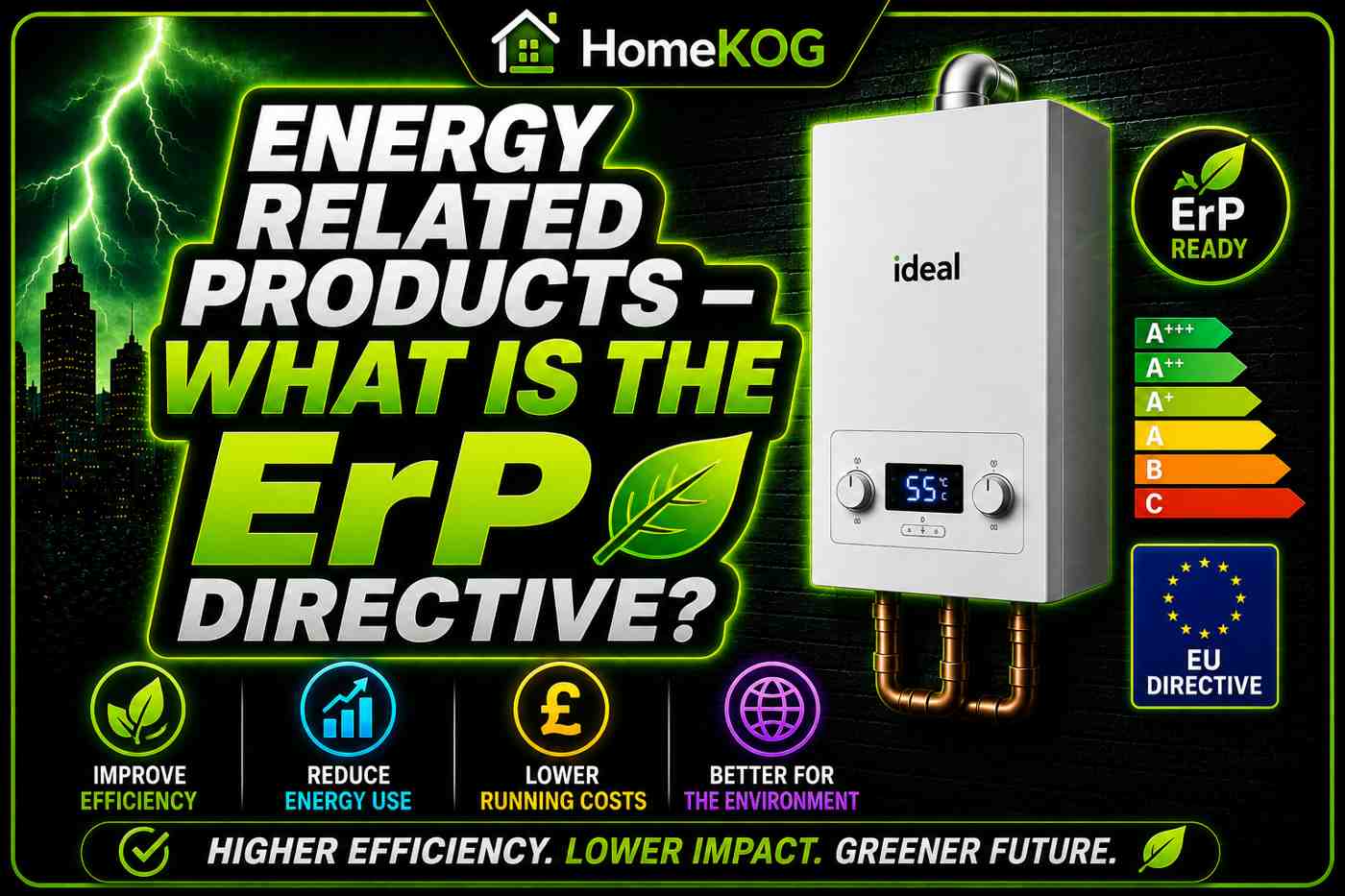
The ErP label is an energy efficiency rating displayed on heating and hot water products. For boilers, the rating scale runs from A++ at the most efficient end to G at the least efficient. For water heaters, the scale runs from A+ to F.
The rating represents the product’s seasonal space heating energy efficiency — how efficiently it converts fuel to useful heat across a full heating season, taking into account the variation in demand and operating conditions that occur throughout the year. This seasonal figure is more representative of real-world performance than a single-point peak efficiency figure, which is why ErP ratings are sometimes slightly lower than a manufacturer’s headline efficiency percentage — the headline figure may be measured at the optimum operating point while the ErP rating reflects average performance across varying conditions.
| ErP Rating | Efficiency Range | Colour Code |
|---|---|---|
| A++ | 130%+ | Dark green (heat pumps only) |
| A+ | 110–129% | Green (heat pumps) |
| A | 92–109% | Green |
| B | 86–91% | Yellow-green |
| C | 82–85% | Yellow |
| D | 78–81% | Amber |
| E | 74–77% | Light orange |
| F | 70–73% | Orange |
| G | Below 70% | Red |
Modern condensing gas boilers achieve A-rated efficiency of 92% or above. Heat pumps, which produce more heat energy than the electrical energy they consume (COP of 3 to 4), achieve A+ or A++ ratings. Older non-condensing boilers typically fall in the D to G range — which is precisely why the government mandated A-rated condensing boilers for all new installations through the Boiler Plus legislation in 2018.
ErP Labels and Boilers: What the Law Requires
Under the ErP Directive, all boilers up to 70kW and all storage tanks and water heaters up to 500 litres must carry an ErP energy efficiency label. This covers the full range of domestic and light commercial gas, oil, LPG, and electric boilers sold in the UK.
The Boiler Plus legislation introduced in England in April 2018 went further than the ErP Directive’s labelling requirement — it mandated that all new gas boilers installed in England must achieve a minimum ErP A-rating of 92% efficiency. This means that any gas boiler legally installed in an English home from April 2018 onwards must achieve at least the A-rated threshold on the ErP scale.
All new boilers from the major manufacturers — Worcester Bosch, Viessmann, Ideal, Vaillant, Alpha, Baxi — achieve A-rated ErP efficiency as standard. Premium models achieve higher efficiencies within the A-band, with the Viessmann Vitodens 200-W reaching 98% at its peak operating efficiency.
How to Read an ErP Label on a Boiler
The ErP label displays the product’s seasonal heating energy efficiency as both a letter rating (A++ to G) and a percentage figure. The label also shows the rated heating output in kW, the sound power level in dB (for outdoor units), and for combination appliances or packaged systems, the contribution of additional components such as solar panels or thermostats to the overall package rating.
When comparing boilers, focus on the letter rating and percentage figure as the primary comparison points. An A-rated boiler at 94% efficiency uses 6% of every unit of gas purchased as waste heat in the flue. At a typical UK gas bill of £1,400 per year, this represents £84 per year wasted. The same bill on an older G-rated 70% efficient boiler wastes £420 per year — the difference of £336 per year in wasted fuel is the direct financial benefit of the efficiency improvement.
ErP Ratings and Smart Heating Controls
The ErP Directive introduced a Ecodesign regulation that requires new heating systems to include efficiency-improving controls alongside the boiler itself. The Boiler Plus legislation in England implements this by requiring at least one of the following to be fitted alongside any new gas combi boiler: time and temperature zone control, load compensation, weather compensation, or a smart thermostat with automation and optimisation functions.
This regulatory requirement means that every new combi boiler installation in England since 2018 includes at least one of these efficiency-enhancing controls — further improving real-world energy efficiency beyond the boiler’s standalone ErP rating.
FAQ
What does ErP A-rated mean for a boiler?
An A-rated ErP boiler achieves a seasonal space heating energy efficiency of 92% or above — meaning at least 92p of every £1 of gas purchased is converted to useful heat, with a maximum of 8p lost as waste heat through the flue. All new gas boilers installed in England since April 2018 must achieve this minimum A-rating under Boiler Plus legislation. Most current models exceed this minimum, with premium units achieving 94 to 98%.
What is the difference between ErP efficiency and SEDBUK efficiency?
SEDBUK (Seasonal Efficiency of Domestic Boilers in the UK) was the older UK efficiency measurement system. ErP replaced SEDBUK as the standard efficiency metric for boilers sold in the UK and EU. Both are seasonal efficiency figures, but they use different calculation methodologies — ErP typically produces a slightly lower figure than SEDBUK for the same boiler because it accounts for a broader range of operating conditions. The ErP A-rating threshold of 92% corresponds approximately to a SEDBUK rating of 90%.
Do all boilers have to be A-rated in the UK?
All new gas boilers installed in English properties must be A-rated under the Boiler Plus legislation (2018). This requirement applies to England specifically — Scotland, Wales, and Northern Ireland have their own building regulations that similarly require condensing boilers but with slightly different detail. In practice, all major manufacturers’ current ranges are A-rated as standard, so compliance is automatic for any boiler from a reputable brand. gas safety certificate requirements explained are essential for ensuring the safe operation of your heating system. Homeowners should be aware that these certificates are mandatory for rental properties and are a reflection of adherence to safety regulations. Regular checks and maintenance can help prevent potential hazards, providing peace of mind for both landlords and tenants alike.
Does the ErP rating affect my energy bills?
Yes, directly. A boiler with a higher ErP efficiency percentage converts a greater proportion of fuel to useful heat, leaving less wasted through the flue. The financial impact depends on the total gas bill — a higher-consuming property saves more from a given efficiency improvement than a lower-consuming one. Replacing a G-rated 70% efficient boiler with an A-rated 94% efficient model saves approximately 25% of the annual gas bill through efficiency improvement alone, before any savings from improved controls or insulation are included.
Where can I find the ErP rating for a specific boiler?
The ErP rating is printed on the boiler’s product label and is published in the manufacturer’s product specification sheets and on the boiler’s page on the manufacturer’s website. The ErP rating for boilers installed in the UK must also be registered on the Product Characteristics Database (PCDB) maintained by BRE, which is used for building energy assessments and EPC calculations.
Conclusion
The ErP Directive and its associated labelling system provide the standardised framework that allows homeowners to compare boilers, thermostats, and other heating products on a consistent energy efficiency basis. For boilers specifically, the A-rating threshold of 92% efficiency — now a legal minimum for new installations in England — represents the baseline above which all products sold must perform, with the best current models achieving up to 98%.
Understanding the ErP label removes ambiguity from boiler comparisons — the letter rating and percentage figure provide an objective, regulated efficiency measurement that applies consistently across all brands and models. For any homeowner replacing a boiler, selecting an A-rated model is both a regulatory requirement and a straightforward financial decision — the running cost saving over the boiler’s 10 to 15-year operational life consistently exceeds the price premium of an efficient condensing boiler over older, lower-rated alternatives.