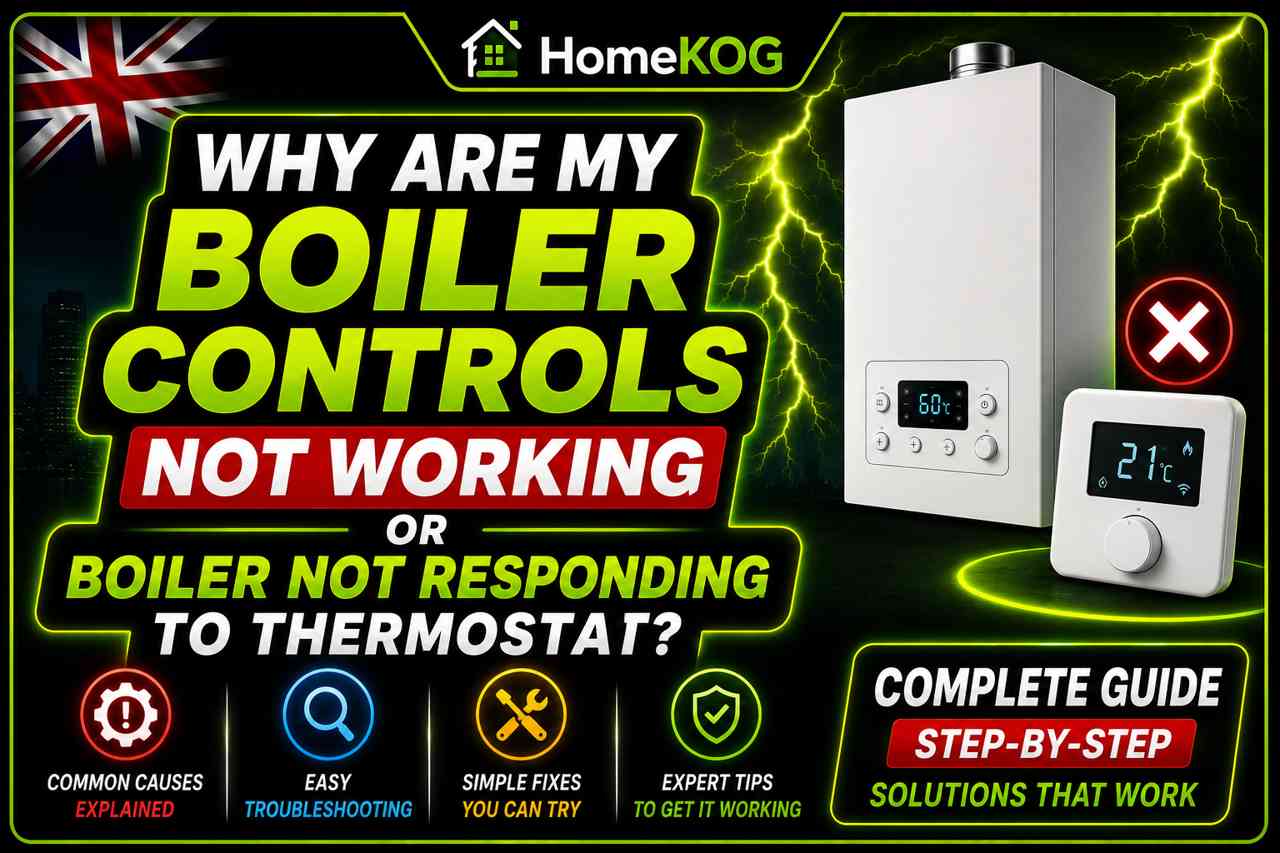

Why Are My Boiler Controls Not Working? Boiler Not Responding to Thermostat 2026
Quick Answer: The most common reasons a boiler does not respond to the thermostat are flat or dead batteries in a wireless thermostat, the room temperature already being at or above the thermostat’s set point, a lost connection between the thermostat and the boiler receiver, or the thermostat being positioned near a heat source that causes inaccurate temperature readings. Most of these can be resolved in minutes without an engineer. Check the boiler is switched on at the mains, replace the thermostat batteries, confirm the set temperature is above the current room temperature, and re-pair the thermostat to its receiver if the wireless connection has been lost.
A boiler that will not respond to the thermostat is one of the most frustrating heating system problems — particularly because it is rarely the boiler itself that is at fault. In most cases where the boiler appears unresponsive to thermostat commands, the issue lies with the thermostat: dead batteries, incorrect settings, a lost wireless connection, or an inaccurate temperature reading caused by poor thermostat placement. This guide works through every cause systematically, starting with the simplest checks and progressing to more complex faults that require professional attention.
Check 1 — Confirm the Boiler is Switched On
The most straightforward explanation is always worth eliminating first. A boiler that has lost power — whether through a power cut, a tripped circuit breaker, or someone switching it off unknowingly — will not respond to any thermostat signal regardless of the thermostat’s condition.
Check that the boiler’s power switch is on — this may be a dedicated fused spur on the wall adjacent to the boiler or a switch at the consumer unit. Check the consumer unit for any tripped circuit breakers on the boiler circuit and reset them if found tripped. If the power was interrupted — during a power cut or after a circuit trip — the boiler may need to be manually reset before it will fire. Some boilers default to off rather than resuming their previous state after a power interruption.
If the boiler has power and its display is active but is showing a fault code, look up the code in the boiler manual — the fault code identifies the specific issue and provides a more direct route to resolution than working through the thermostat system.

Check 2 — Confirm Thermostat Settings are Correct
A boiler will not fire for central heating if the thermostat does not call for heat — meaning the set temperature must be higher than the current measured room temperature for a demand signal to be sent to the boiler.
Check the thermostat’s set point and compare it to the current room temperature displayed. If the room is already at 20°C and the thermostat is set to 18°C, the boiler will not fire — the thermostat is doing exactly what it is designed to do. Increase the set temperature above the current room temperature and check whether the boiler responds.
Also confirm that the thermostat’s timer or schedule is active and set to a heating period. A schedule that has been inadvertently set to a holiday mode, an overnight frost-protection mode, or an off period will prevent a heat demand signal regardless of the set temperature.
Check 3 — Replace the Batteries
Battery-powered wireless thermostats — which include most modern smart thermostats and many standard programmable wireless thermostats — display a low battery warning when the charge is running low. If this warning is missed or ignored, the batteries will eventually deplete to the point where the thermostat can no longer maintain its wireless connection to the boiler receiver. The thermostat may appear to function — buttons respond, display is lit — while lacking sufficient power to transmit a reliable signal.
Replace the batteries with fresh alkaline AA or AAA batteries as specified by the manufacturer. After replacing, allow a few minutes for the thermostat to reconnect to its receiver and check whether the boiler responds to a heating demand. If the display was blank or very faint before battery replacement, this is almost certainly the cause.
Smart thermostat users on mains-powered thermostats — the Google Nest, for example, which charges from the boiler’s low-voltage supply — are not affected by battery failure but may experience connection loss if the charging circuit from the boiler has developed a fault.
Check 4 — Check the Wireless Connection Between Thermostat and Receiver
Wireless thermostats communicate with a receiver unit — typically wired near the boiler or in the heating control wiring centre — via radio frequency. This connection can be lost if the batteries were recently changed, if the thermostat was reset, or occasionally due to interference from other wireless devices in the property.
The method for re-pairing the thermostat to its receiver varies by manufacturer and model — the user manual provides the specific pairing procedure. In most cases it involves holding a button on the receiver for several seconds until an indicator LED flashes, then confirming the pairing on the thermostat. After successful pairing, the thermostat should resume communicating with the boiler.
A thermostat placed very far from the receiver, or with significant signal obstruction between the two — thick stone walls, metal cabinets, or strong sources of 433MHz or 868MHz interference — may lose connection intermittently. Relocating either the receiver or the thermostat to reduce the distance or obstruction resolves this.
Check 5 — Inspect Thermostat Placement
A thermostat that reads an incorrect room temperature will send the wrong signals to the boiler — causing it to under-heat or overheat the property, or to not fire at all when heating is needed.
Several placement errors cause inaccurate temperature readings. A thermostat positioned near a radiator or heat source receives radiated heat that artificially inflates its temperature reading, causing it to report a higher room temperature than actually exists and suppressing the heat demand signal. A thermostat near a draughty window, an exterior door, or a poorly insulated external wall reads artificially low and may cause the boiler to fire longer than needed.
The correct thermostat position is a neutral internal wall at approximately 1.5 metres above floor level in the room used most frequently — typically the living room — away from draughts, direct sunlight, radiators, and any heat-generating appliances. A wireless thermostat can be repositioned to a better location without rewiring. A wired thermostat requires a qualified electrician or Gas Safe engineer to relocate.
Check 6 — Clean the Thermostat
Accumulated dust and debris inside the thermostat casing can interfere with the contact points and sensors, causing erratic readings or complete failure to respond. This is more relevant to older mechanical and electromechanical thermostats than to modern sealed digital units, but is worth checking on any thermostat that has been in place for several years.
To clean the thermostat, remove the front panel carefully and remove the batteries. Use a soft brush or cotton bud to gently clear any visible dust from the internal components. Avoid touching the contact points with bare fingers — skin oils can cause oxidation that worsens rather than improves contact quality. Refit the batteries and panel and check whether responsiveness improves.
Check 7 — Assess Whether the Thermostat Needs Replacing
Most thermostats have an operational lifespan of approximately 10 years. An older thermostat that is beginning to fail will show characteristic symptoms: inconsistent temperature readings, difficulty maintaining stable settings, temperature fluctuations without corresponding room temperature changes, or an energy bill that has risen unexplainably as the thermostat causes more frequent short-cycling of the boiler.
If the thermostat is over 8 to 10 years old and showing any of these symptoms, replacement is more cost-effective than attempting repair. A standard programmable wireless thermostat costs £30 to £80. A smart thermostat with remote control, geofencing, and scheduling costs £150 to £250 for the unit — the Honeywell T6R at approximately £175, tado° starter kit at approximately £165, Google Nest at approximately £199, and Hive at approximately £179 are the main options in 2026. Smart thermostat installation adds £70 to £80 for professional fitting.
Upgrading from a conventional thermostat to a smart thermostat at the same time as replacing a failing older unit adds geofencing, remote app control, scheduling, and potential annual energy savings of £75 to £150 — making the investment straightforward to justify if the existing thermostat is already due for replacement.
When to Call a Gas Safe Engineer
If all the above checks have been completed and the boiler still does not respond to the thermostat, the fault may lie with the boiler rather than the thermostat. A wiring fault between the boiler and the receiver, a faulty PCB that is not correctly processing the heat demand signal, or a failed zone valve that is not opening when the demand is sent are all causes that require a Gas Safe engineer to diagnose and repair.
Similarly, if the thermostat is a wired unit and relocation is needed, or if the wiring between the thermostat and the boiler controls appears damaged or has been disturbed, a Gas Safe engineer or qualified electrician should handle the rewiring — this constitutes notifiable electrical work under Part P of the Building Regulations.
Common Causes at a Glance
| Symptom | Most Likely Cause | DIY Fix |
|---|---|---|
| Boiler silent, no display | No power to boiler | Check mains switch and consumer unit |
| Boiler has power but won’t fire | Set temperature below room temp | Increase thermostat set point |
| Thermostat display blank or faint | Flat batteries | Replace batteries |
| Thermostat display active but no boiler response | Lost wireless connection | Re-pair thermostat to receiver |
| Boiler fires but temperature wrong | Thermostat in wrong location | Relocate thermostat |
| Boiler short-cycling frequently | Faulty or aging thermostat | Replace thermostat |
| All checks clear but still no response | PCB or wiring fault | Gas Safe engineer required |
FAQ
Why is my boiler not responding to the thermostat?
The most common causes are flat batteries in a wireless thermostat, a room temperature that is already at or above the thermostat’s set point, a lost wireless connection between the thermostat and its boiler receiver, or a thermostat positioned near a heat source causing inaccurate temperature readings. Work through the checks in order — confirm power, check set temperature, replace batteries, re-pair the wireless connection, and assess thermostat placement before concluding the boiler itself is the fault source.
How do I know if my thermostat is broken?
Signs of a failing thermostat include inconsistent temperature readings, the boiler firing when the room has already reached the target temperature, the boiler not firing when the room is clearly below the set temperature, and energy bills increasing without any change in heating usage. A thermostat that is over 10 years old and showing any of these symptoms should be replaced rather than troubleshot further.
Can a dirty thermostat stop the boiler from working?
Yes, in older mechanical thermostats where dust and debris can interfere with contact points. Modern sealed digital thermostats are less vulnerable to this but can still develop contact problems in very dusty environments. Gentle cleaning of the internal contacts with a soft brush resolves this in most cases.
Should I upgrade to a smart thermostat if my existing one is failing?
Yes — if the existing thermostat is already at the point of replacement, upgrading to a smart thermostat at the same time adds meaningful ongoing value. A smart thermostat with geofencing and scheduling saves £75 to £150 per year in heating costs, meaning the additional cost over a basic replacement thermostat typically pays back within two to three years of installation.
What is the best location for a thermostat?
An internal wall at approximately 1.5 metres above floor level in the room used most frequently — typically the living room — away from radiators, direct sunlight, exterior doors, draughty windows, and any heat-generating appliances. This neutral position gives the most representative reading of the room’s actual ambient temperature, ensuring the boiler fires and stops at the correct points.
Conclusion
A boiler that does not respond to the thermostat is almost always a thermostat issue rather than a boiler fault. Flat batteries, an incorrectly set temperature, a lost wireless connection, and poor thermostat placement between them account for the vast majority of thermostat-related heating failures — all of which can be diagnosed and resolved without an engineer in under 15 minutes.
Working through the checks systematically — power, settings, batteries, wireless connection, placement, cleanliness, and age — ensures the simplest and cheapest explanations are eliminated before an engineer is called. Where the fault persists after all checks have been completed, a Gas Safe engineer should attend to diagnose the wiring or PCB fault that is preventing the boiler from receiving the thermostat’s demand signal.