When Is the Best Time to Install a Boiler? 2026
Quick Answer: Summer — specifically between May and September — is the best time to install a new boiler. Engineers have significantly more availability and shorter waiting times, installation costs are lower due to reduced demand, there is no disruption to heating when it is not needed, and homeowners have more time to research boiler brands and compare quotes without the pressure of a winter breakdown. A boiler that is 10 to 15 years old should be proactively replaced before winter rather than waiting for a failure that will almost certainly occur at the worst possible time.
Most boiler replacements happen reactively — the boiler fails in autumn or winter when it is most needed, and the homeowner has to accept whatever engineer is available at whatever price is quoted to restore heating as quickly as possible. Planning a boiler replacement during the summer months inverts this dynamic entirely — putting the homeowner in control of the timing, the choice of boiler, the comparison of quotes, and the scheduling of the installation. This guide explains why summer is the optimal installation window, what the concrete financial and practical benefits are, and how to make the most of the planning time available.
Why Summer Is the Best Time to Install a Boiler
Engineer Availability Is Significantly Better
Heating engineers are at their busiest between October and March. Emergency breakdown call-outs, urgent repairs, and the general surge in heating system demand during cold weather fill engineers’ schedules quickly and push waiting times for non-emergency work to weeks rather than days. In the summer months, the same engineers have considerably more availability in their diaries — meaning installation can typically be booked within days, at a time and day that suits the household rather than whenever the engineer has a gap.
This availability advantage is not just a convenience — it directly affects the quality of the installation. An engineer working at a comfortable pace with adequate time scheduled for the job is more likely to produce a thorough, well-commissioned installation than one squeezing an emergency fitting in between other urgent call-outs.

Installation Costs Are Lower
With reduced demand for emergency boiler work and greater competition among installers for non-emergency jobs, summer installation costs are consistently lower than winter equivalents. Installation fees can be £100 to £300 lower during the off-peak period for the same job specification. Boiler manufacturers and installers also run summer promotions — reduced prices on specific models, extended warranty offers, or discounted installation packages — that are rarely available during the high-demand winter season.
The combination of lower labour rates, more available engineers to compare quotes from, and manufacturer promotions means the total installed cost of a summer boiler replacement is typically meaningfully lower than the equivalent winter emergency replacement.
No Disruption to Heating When It Is Needed
A boiler installation typically takes one to two days for a straightforward like-for-like combi boiler replacement, and up to three days for more complex installations involving conversion between boiler types or significant pipework changes. During this period, the heating and hot water will be unavailable.
In summer, going without central heating for one to two days is a minor inconvenience — temperatures are warm and the heating is not being used for space heating in any case. In winter, the same period without heating can be genuinely uncomfortable, particularly for households with elderly occupants, young children, or individuals with health conditions who are more vulnerable to cold. Going without hot water for a day in summer is manageable in a way that a January breakdown is not.
More Time for Research and Comparison
A boiler replacement is a significant investment — typically £1,800 to £2,500 for a standard combi installation, with premium models and complex installations costing more. A decision of this value deserves research: comparing brands, reviewing efficiency ratings and warranty terms, reading independent reviews, and obtaining multiple quotes from Gas Safe registered engineers.
In a winter emergency, this research is compressed or eliminated entirely — the priority is restoring heating as quickly as possible, which typically means accepting the first available engineer’s quote and whatever boiler they recommend. Summer planning allows the homeowner to take the time to understand the options — hydrogen-ready versus standard, combi versus system, premium versus mid-range — and make a properly informed decision rather than a pressured one.
The New Boiler Is Tested and Ready Before Winter
A boiler installed and commissioned in summer has several months of low-demand operation before the first cold snap arrives. Any minor teething issues — air in the system, pressure settings needing adjustment, thermostat calibration — are identified and resolved during this low-stakes period rather than on the first cold day of autumn when any fault immediately becomes a priority issue. The heating system arrives at the winter season fully bedded in, correctly calibrated, and confirmed to be working as intended.
Benefits of a New Boiler Beyond Timing
Energy Efficiency Savings
A modern A-rated condensing boiler achieves 92 to 98% efficiency — meaning 92 to 98p of every £1 of gas purchased is converted to useful heat. An older G-rated boiler operating at 65 to 70% efficiency wastes 30 to 35% of every unit of gas burned. For a household spending £1,400 per year on gas, this difference represents £280 to £420 per year in wasted fuel that a new boiler eliminates. The Energy Saving Trust estimates savings of up to £580 per year for a detached home replacing a G-rated boiler with an A-rated model.
Modern condensing boilers achieve this efficiency through the Flue Gas Heat Recovery System — a secondary heat exchanger that captures heat from flue gases that would otherwise escape at 250°C, reducing the flue exit temperature to approximately 55°C and recapturing the difference as useful heat.
Lower Carbon Footprint
The Boiler Plus legislation (2018) requires all new gas boilers installed in England to achieve a minimum 92% efficiency. This regulatory minimum means every new boiler installed today is substantially cleaner per unit of heat delivered than the older system it replaces. Nearly all new boilers are also hydrogen-ready to at least a 20% hydrogen blend, positioning them for the potential future introduction of hydrogen into the gas grid without requiring replacement.
Manufacturer Warranty
A new boiler comes with a manufacturer’s warranty covering parts and labour for qualifying faults — typically 7 to 12 years depending on the brand, model, and whether annual servicing conditions are met. An old boiler has no remaining warranty — every repair is entirely at the homeowner’s cost. A new boiler’s warranty provides meaningful financial protection against the component failures that are statistically more likely in the first years of ownership than after the system has settled into reliable operation.
Quieter Operation
Modern condensing boilers operate substantially more quietly than older non-condensing models. The Vaillant ecoTEC range holds Quiet Mark certification. The Worcester Bosch Greenstar 4000 operates at 42dB — below the volume of a normal conversation. The Viessmann Vitodens range at 34dB is quieter than most domestic appliances. For homeowners who have been tolerating a noisy old boiler, the difference is immediately noticeable.
Smart Control Compatibility
All current boiler models include built-in WiFi or smart thermostat compatibility as standard. Remote control via smartphone app, geofencing, weather compensation, and individual room control through smart thermostatic radiator valves are all accessible from modern boiler installations at minimal additional cost. These smart features deliver annual savings of £75 to £150 through more efficient heating scheduling and occupancy-based control.
How Long Does Boiler Installation Take?
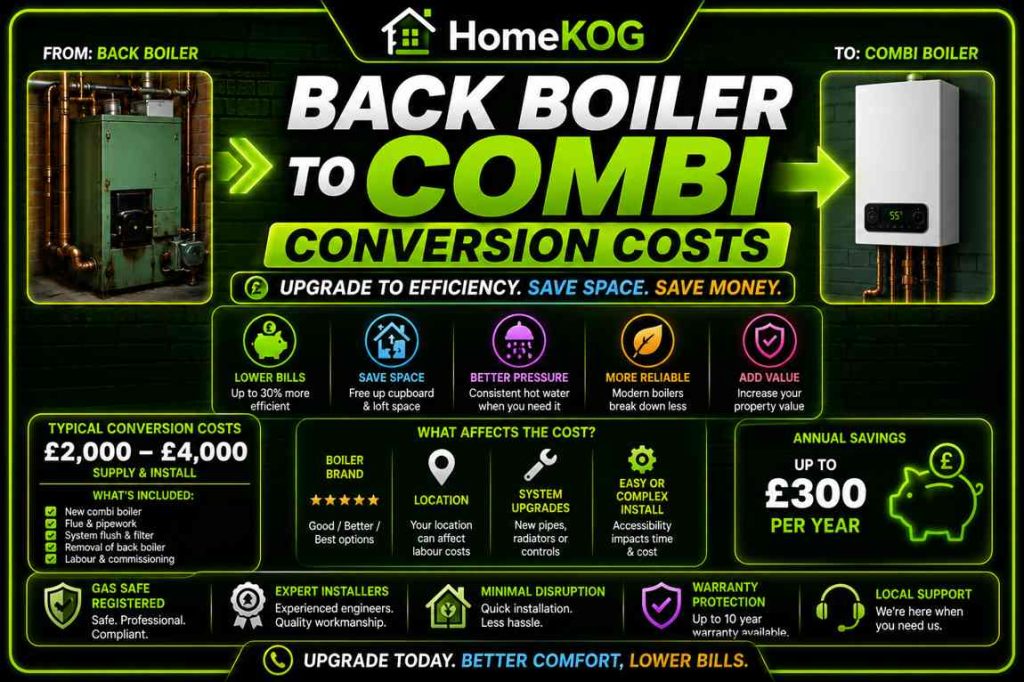
A straightforward like-for-like combi boiler replacement — the most common installation type — takes one to two days for most properties. System boiler replacements take approximately one to two days. Conversions between boiler types — from a back boiler to a combi, for example, or from a regular boiler to a combi — take two to three days depending on the pipework changes required. Relocating the boiler to a different position in the property adds time and cost to any installation type.
How to Choose the Right Boiler for Your Home
The correct boiler choice depends on the property’s specific requirements rather than any single universal recommendation. The primary factors are the number of bedrooms and bathrooms, the expected simultaneous hot water demand, available installation space, and the household’s budget and warranty priorities.
For most 2 to 3 bedroom properties with a single bathroom, a 28 to 30kW combi boiler from a reputable mid-range brand is the correct specification. For 3 to 4 bedroom properties with two bathrooms, a 30 to 35kW combi or a system boiler with a hot water cylinder is appropriate. For larger properties with multiple bathrooms and high simultaneous hot water demand, a system or regular boiler is the appropriate configuration.
On warranty and brand selection, the key considerations are: whether the brand’s maximum warranty term requires a specific accredited installer tier (Vaillant does; Worcester Bosch and Alpha do not); what heat exchanger material is used at the chosen price point (stainless steel in Viessmann, Alpha, and Vaillant across the range; stainless steel in Worcester Bosch’s 8000 series but aluminium in the 4000); and which brands have the strongest installer and parts availability network in the local area.
What Does Boiler Installation Cost?
Standard mid-range combi boiler installation costs between £1,800 and £2,500 fully installed in 2026. Premium models including the Worcester Bosch Greenstar 8000 and Viessmann Vitodens 200-W cost £2,500 to £3,500 installed. System boiler installations cost £2,000 to £3,500 depending on whether a new cylinder is required. Conversions and boiler relocations attract additional costs of £500 to £1,500 depending on the scope of pipework changes.
Summer installation pricing may be £100 to £300 lower than equivalent winter emergency pricing — a meaningful saving on top of the improved availability and reduced pressure to accept the first available quote.
FAQ
Is it cheaper to get a boiler installed in summer?
Yes, typically by £100 to £300 on the installation labour element compared to winter emergency rates. Additionally, boiler manufacturers and installation companies offer summer promotions and discounted deals during the off-peak period that are not available in winter. Comparing multiple quotes during summer from engineers who have availability to compete for the work produces better pricing than a winter emergency when the first available engineer sets the rate.
How long does a boiler last?
The average lifespan of a modern condensing combi or system boiler is 10 to 15 years with annual servicing. Boilers that are regularly serviced and installed in systems with magnetic filter protection and correct inhibitor maintenance consistently reach the upper end of this range. Boilers that have been irregularly serviced or installed in sludge-contaminated systems typically fail sooner. A boiler approaching 10 years old that is starting to develop faults is a strong candidate for proactive summer replacement rather than reactive winter breakdown.
Can I install a boiler myself?
No. Gas boiler installation requires Gas Safe registration — it is a legal requirement under the Gas Safety (Installation and Use) Regulations 1998. An unqualified installation is illegal, voids the manufacturer’s warranty, and invalidates home insurance coverage for heating-related damage. All gas boiler work must be carried out by a Gas Safe registered engineer. Verify registration at gassaferegister.co.uk before any work begins.
Should I get multiple quotes for a new boiler?
Yes. Obtaining three quotes from different Gas Safe registered engineers or installation companies provides a meaningful comparison across price, recommended model, and warranty terms. The lowest quote is not automatically the best — check what is included in each quote (filter, commissioning, warranty registration) before comparing on price alone. Summer provides the time and the engineer availability to collect and compare multiple quotes properly.
What boiler brands are best for a summer installation?
Any of the major reputable brands — Worcester Bosch, Viessmann, Ideal, Vaillant, Alpha, and Baxi — are strong choices for a summer installation. The differences between them on efficiency, warranty, and features are covered in detail in our best boiler brands guide. The choice of brand should be informed by the property’s specific requirements, the installer’s accreditation status relative to the brand’s warranty conditions, and the engineer’s recommendation based on the existing system.
Conclusion
The best time to install a boiler is before it is needed — and summer is the window that makes proactive replacement practical, affordable, and unhurried. Better engineer availability, lower installation costs, summer promotions, no disruption to essential heating, and adequate research time all combine to make a summer installation meaningfully superior to a reactive winter emergency replacement in every measurable dimension.
For homeowners with a boiler approaching 10 years old, running less efficiently than it once did, or showing early signs of developing faults, planning a summer replacement is the most financially and practically sensible course of action. The cost of a planned summer replacement is consistently lower than the equivalent emergency winter replacement — and the new boiler arrives in the cold season fully installed, commissioned, and ready to perform reliably for the next 10 to 15 years.