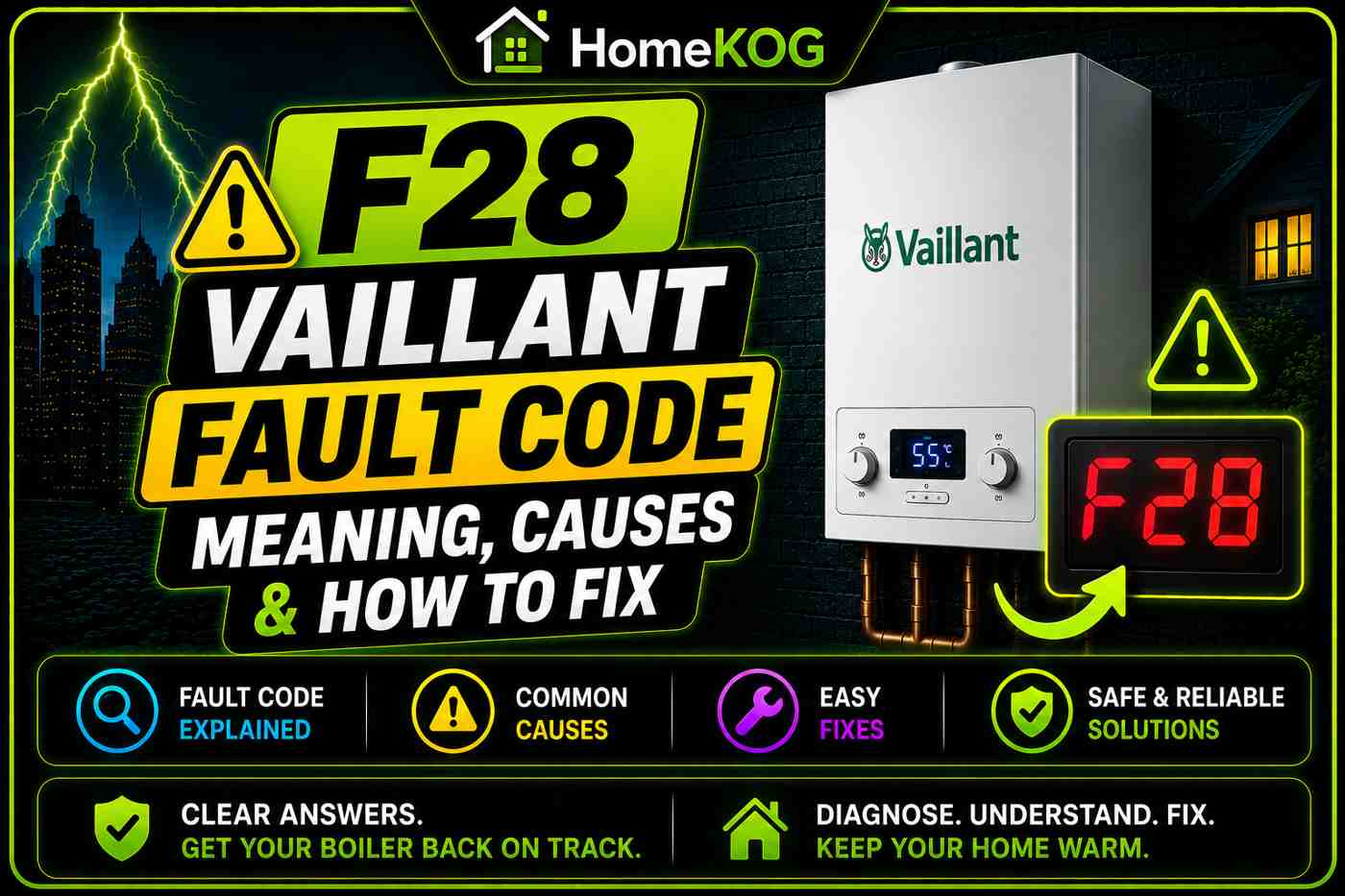

Vaillant F28 Fault Code: Meaning, Causes and How to Fix It 2026
Quick Answer: The Vaillant F28 fault code means the boiler has failed to ignite and locked out after three unsuccessful ignition attempts. The most common DIY-fixable causes are low boiler pressure (repressurise via the filling loop to 1.5 bar) and a frozen condensate pipe (thaw with warm water along the external pipe). Once the underlying cause is resolved, reset the boiler by holding the reset button for three seconds. Causes requiring a Gas Safe engineer include a faulty gas valve, failed ignition electrode, wiring fault, and PCB failure. Never reset the boiler repeatedly without identifying and resolving the underlying cause first. If you’re facing issues beyond the basics, looking into vaillant f84 fault code solutions may be necessary. Understanding these codes can help identify specific malfunctions that might not be immediately apparent. For more complex problems, consulting a qualified technician is crucial to ensure safe and effective repairs.
The F28 fault code appears on Vaillant ecoTEC Pro, ecoTEC Plus, ecoTEC Exclusive, and ecoFIT Pure models when the boiler has attempted to ignite three times and failed to detect a stable flame on any attempt. Rather than continuing to attempt ignition indefinitely — which would allow unburned gas to accumulate — the boiler locks out and displays F28 to alert the homeowner that attention is needed. This guide explains every cause of the F28 code, which can be resolved at home, and what an engineer will do when a professional repair is required. Understanding the Vaillant F27 fault code details is essential for diagnosing and resolving issues similar to the F28 error. When this code appears, it indicates a different underlying problem that may require specific troubleshooting steps. Homeowners should be aware of these codes to ensure timely interventions and prevent potential further complications with their heating systems.
What Does the Vaillant F28 Fault Code Mean?
| Code | Classification | Meaning |
|---|---|---|
| F28 | Ignition lockout | Boiler failed to ignite after three attempts — no flame detected |
The F28 is a lockout fault, not a blocking fault. A blocking fault is a temporary pause that clears automatically when the condition resolves. A lockout requires a manual reset after the cause has been identified and addressed — the boiler will not restart by itself regardless of how long it is left. Attempting to reset the boiler without resolving the underlying cause will result in F28 reappearing after the next failed ignition sequence.

What Causes the Vaillant F28 Fault Code?
1. Frozen Condensate Pipe — DIY Fix Available
In cold weather, the condensate pipe — a plastic pipe that drains acidic wastewater from the boiler’s secondary heat exchanger to an external drain — can freeze and block. When the condensate cannot drain, it backs up into the boiler and triggers an automatic lockout to prevent water flooding the combustion chamber. The F28 code is the most common fault code displayed during a condensate freeze lockout.
The frozen section is almost always on the external run of the pipe — the section exposed to outdoor temperatures. It can sometimes be identified by touch as a noticeably colder section of the pipe, or by a visual inspection of the external pipework in freezing conditions.
To thaw the pipe, pour warm — not boiling — water along the external section. A hot water bottle held against the frozen section, warm towels wrapped around the pipe, or a gentle pour of warm water from a jug are all effective approaches. Do not use boiling water — it can damage or split the plastic condensate pipe. Once the blockage clears, reset the boiler as described below.
After resolving a condensate freeze, wrap the exposed external section of the pipe in foam pipe lagging. This simple and inexpensive measure prevents the same fault from recurring in subsequent cold spells without any further intervention.
2. Low Boiler Pressure — DIY Fix Available
Low system pressure — a gauge reading below 1.0 bar — prevents the boiler from firing safely and triggers an F28 lockout. Check the pressure gauge on the boiler front panel. A reading below 1.0 bar confirms low pressure as a contributing cause.
To repressurise the boiler, locate the filling loop — typically a braided flexible hose with one or two valves beneath the boiler. Turn the boiler off and allow it to cool before repressurising. Open the filling loop valve or valves slowly and watch the pressure gauge. Close the valves when the gauge reaches 1.5 bar — do not overfill beyond this point as the pressure will rise further once the heating fires. Reset the boiler once the correct pressure is confirmed.
If pressure drops back to a low level within hours or a few days of repressurising, a system leak is causing the pressure loss. A Gas Safe engineer should locate and repair the leak rather than continuing to top up pressure indefinitely.
3. Gas Supply Interruption — Check Before Calling Engineer
If there is no gas reaching the boiler, it cannot ignite and F28 will appear. Before assuming a boiler fault, check whether other gas appliances in the property — gas hob, gas oven — are working normally. If they are not, the gas supply to the property has been interrupted and the issue is with the supply rather than the boiler.
Contact the gas supplier to check for supply interruptions or maintenance work in the area. For properties on a prepayment meter, check the meter credit — if the credit has run out, the gas supply will have stopped. Top up the meter, restore gas supply, and reset the boiler.
If other gas appliances are working normally but the boiler is still displaying F28, the fault is within the boiler’s gas supply path — the gas valve, gas pressure regulator, or gas restrictor — rather than the supply itself. These require a Gas Safe engineer.
4. Faulty Gas Valve — Engineer Required
The gas valve opens to admit gas to the burner when the boiler attempts to fire and closes when the flame is established or when shut down is demanded. On older boilers, the gas valve can develop mechanical wear — a sticking valve that fails to open fully or fails to open at all prevents gas from reaching the burner, causing every ignition attempt to fail and triggering F28 lockout.
A faulty gas valve cannot be repaired by a homeowner — it involves working directly on the gas components within the boiler and requires Gas Safe registration. A Gas Safe engineer will test the valve’s operation and gas flow, confirm the fault, and replace the valve. Gas valve replacement typically costs approximately £300 including parts and labour. On a boiler approaching 10 years old where a gas valve failure has occurred, the engineer may advise comparing the repair cost against a new boiler installation.
5. Failed Ignition Electrode or Ignition Cable — Engineer Required
The ignition electrode generates the spark that lights the gas at the burner. The ignition cable connects the electrode to the PCB. Both components are subject to wear over time and can develop faults that prevent the spark from being generated or from reaching the burner correctly — causing every ignition attempt to fail without gas or flame being the issue.
A failed electrode or cable is typically identified by a Gas Safe engineer during diagnostics — the engineer can test whether the ignition circuit is generating a spark independently of the gas and flame detection components. Electrode replacement costs approximately £25 to £40 for the part plus a labour charge. Ignition cable replacement costs approximately £33 for the part plus labour. Both are straightforward component replacements that an experienced engineer can often complete within the same visit.
6. PCB Fault or Wiring Issue — Engineer Required
The PCB (printed circuit board) is the boiler’s central control unit, managing the ignition sequence, flame detection, gas valve operation, and safety shutdown logic. A faulty PCB can cause F28 by failing to send the correct ignition signal, failing to open the gas valve at the right point in the sequence, or misinterpreting the flame detection signal. A wiring fault — a damaged or disconnected wire between the PCB and the ignition or gas valve components — produces the same symptoms.
PCB and wiring faults require a Gas Safe engineer to diagnose and repair. The engineer uses diagnostic equipment to identify whether the fault is in the PCB itself or in the wiring between components. PCB replacement is one of the more expensive boiler repairs, typically costing £300 to £500 including parts and labour. On boilers over 8 to 10 years old, the engineer may recommend comparing PCB replacement cost against a new boiler installation.
How to Reset a Vaillant Boiler After F28
Once the underlying cause of the F28 code has been identified and resolved, the boiler must be manually reset to clear the lockout and restart the ignition sequence. The reset procedure for Vaillant ecoTEC models is as follows. Vaillant boiler installation costs for homeowners can vary based on the specific model and the complexity of the installation process. It’s essential to factor in additional expenses such as any necessary upgrades to existing plumbing or electrical systems. Homeowners should also consider the long-term savings on energy bills that can result from a more efficient boiler system.
- Confirm the underlying cause has been addressed — pressure restored to 1.5 bar, condensate pipe thawed, or engineer repair completed.
- Locate the reset button on the boiler front panel — on most Vaillant ecoTEC models this is a button marked with a flame symbol or a reset symbol.
- Hold the reset button for approximately three seconds until the display acknowledges the reset.
- The boiler will attempt a new ignition sequence. Allow two to three minutes for the boiler to complete its startup routine.
- If the boiler fires successfully and F28 does not reappear, the fault has been resolved.
- If F28 reappears after the reset, the underlying cause has not been fully resolved or a different cause applies. Do not continue resetting without further investigation — repeated resets without a successful ignition cycle do not resolve the fault and may indicate a more serious underlying issue.
F28 DIY vs Engineer: Quick Reference
| Cause | DIY Fix | Action |
|---|---|---|
| Frozen condensate pipe | Yes | Thaw with warm water, reset boiler |
| Low boiler pressure | Yes | Repressurise to 1.5 bar, reset boiler |
| Gas supply interrupted (all appliances off) | Check meter/supplier | Contact supplier or top up prepayment meter |
| Faulty gas valve | No | Gas Safe engineer required |
| Failed ignition electrode | No | Gas Safe engineer required |
| Faulty ignition cable | No | Gas Safe engineer required |
| PCB fault or wiring issue | No | Gas Safe engineer required |
Repair Costs for F28 Causes
| Repair | Typical Cost |
|---|---|
| Condensate pipe thaw and reset | £0 (DIY) or £80–£120 call-out |
| Boiler repressurisation | £0 (DIY) |
| Gas valve replacement | £250–£350 |
| Ignition electrode replacement | £80–£150 |
| Ignition cable replacement | £80–£130 |
| PCB replacement | £300–£500 |
| New boiler installation (if repair uneconomic) | From £1,800 |
How to Prevent the F28 Code from Recurring
Annual boiler servicing by a Gas Safe engineer is the most effective preventative measure against F28 and all other boiler fault codes. At each service, the engineer cleans the burner and ignition components, checks the ignition electrode condition and gap, inspects the gas valve operation, tests combustion quality, and checks system pressure — addressing each of the conditions that cause F28 before they develop into a lockout fault.
Insulating the external condensate pipe after the first freeze lockout prevents recurrence. Checking the boiler pressure gauge monthly and topping up via the filling loop when pressure approaches 1.0 bar prevents low-pressure lockouts from developing. Maintaining adequate inhibitor levels in the system water — checked and replenished at each annual service — prevents the corrosion and sludge accumulation that accelerates gas valve and pump wear over time.
FAQ
What does F28 mean on a Vaillant boiler?
F28 is an ignition lockout fault — the boiler has attempted to ignite three times, failed to detect a stable flame on any attempt, and locked out as a safety measure. The display shows F28 to identify the fault category. The most common causes are low boiler pressure, a frozen condensate pipe, a faulty gas valve, a failed ignition electrode, or a PCB fault.
Can I fix the Vaillant F28 myself?
Two causes of F28 have safe DIY remedies: low boiler pressure (resolved by repressurising through the filling loop) and a frozen condensate pipe (resolved by thawing the external pipe section with warm water). Both are safe, straightforward interventions that do not require opening the boiler casing or working on gas components. All other causes require a Gas Safe registered engineer.
How do I reset a Vaillant boiler showing F28?
Hold the reset button on the boiler front panel for approximately three seconds after the underlying fault has been identified and resolved. The boiler will attempt a new ignition sequence. If F28 reappears after resetting, the cause has not been fully resolved. Do not reset the boiler repeatedly without addressing the cause — resetting does not fix the fault and repeated resets without successful ignition may indicate a more serious underlying issue.
How much does it cost to fix a Vaillant F28 fault?
If the cause is low pressure or a frozen condensate pipe, the DIY fix costs nothing. A Gas Safe engineer call-out for the same faults costs £80 to £120. A faulty gas valve costs £250 to £350 to replace. Ignition electrode or cable replacement costs £80 to £150. PCB replacement costs £300 to £500. On older boilers where the repair cost approaches or exceeds the cost of a new boiler installation, the engineer should advise on whether replacement is more cost-effective.
Should I replace my Vaillant boiler if it shows F28?
Not necessarily. F28 does not indicate boiler replacement is required — it indicates a specific fault that in most cases is repairable. Replacement becomes the more sensible financial decision when the boiler is over 10 years old, outside its warranty, and the repair cost for a gas valve or PCB fault is a significant proportion of a new boiler’s installed cost. A Gas Safe engineer can assess the boiler’s overall condition and advise on whether repair or replacement represents better long-term value for the specific situation.
Conclusion
The Vaillant F28 fault code is one of the most common boiler fault codes in the UK — particularly during cold weather when frozen condensate pipes and pressure-related lockouts account for the majority of F28 occurrences. In these cases, the fix is genuinely straightforward: thaw the pipe or repressurise the system, then reset the boiler. No engineer is needed and heating is typically restored within 30 minutes. For those encountering the Vaillant F61 fault code solutions, the troubleshooting process can be equally accessible for homeowners. Similar to the F28 issue, the key is to identify the underlying problem, which often involves checking the system pressure or inspecting the ignition components. Addressing these factors promptly can help restore your heating system efficiently and without the need for professional assistance.
Where F28 persists after the DIY checks have been completed, or where the boiler is displaying F28 without any obvious pressure or condensate cause, a Gas Safe engineer should attend to diagnose the fault accurately. Gas valve, ignition electrode, and PCB faults all require professional diagnosis and repair — attempting to investigate these components without Gas Safe registration is illegal and risks serious harm. Annual servicing remains the most reliable way to prevent F28 and other fault codes from developing in the first place, identifying the wear and contamination that leads to ignition failure before it causes a heating outage.