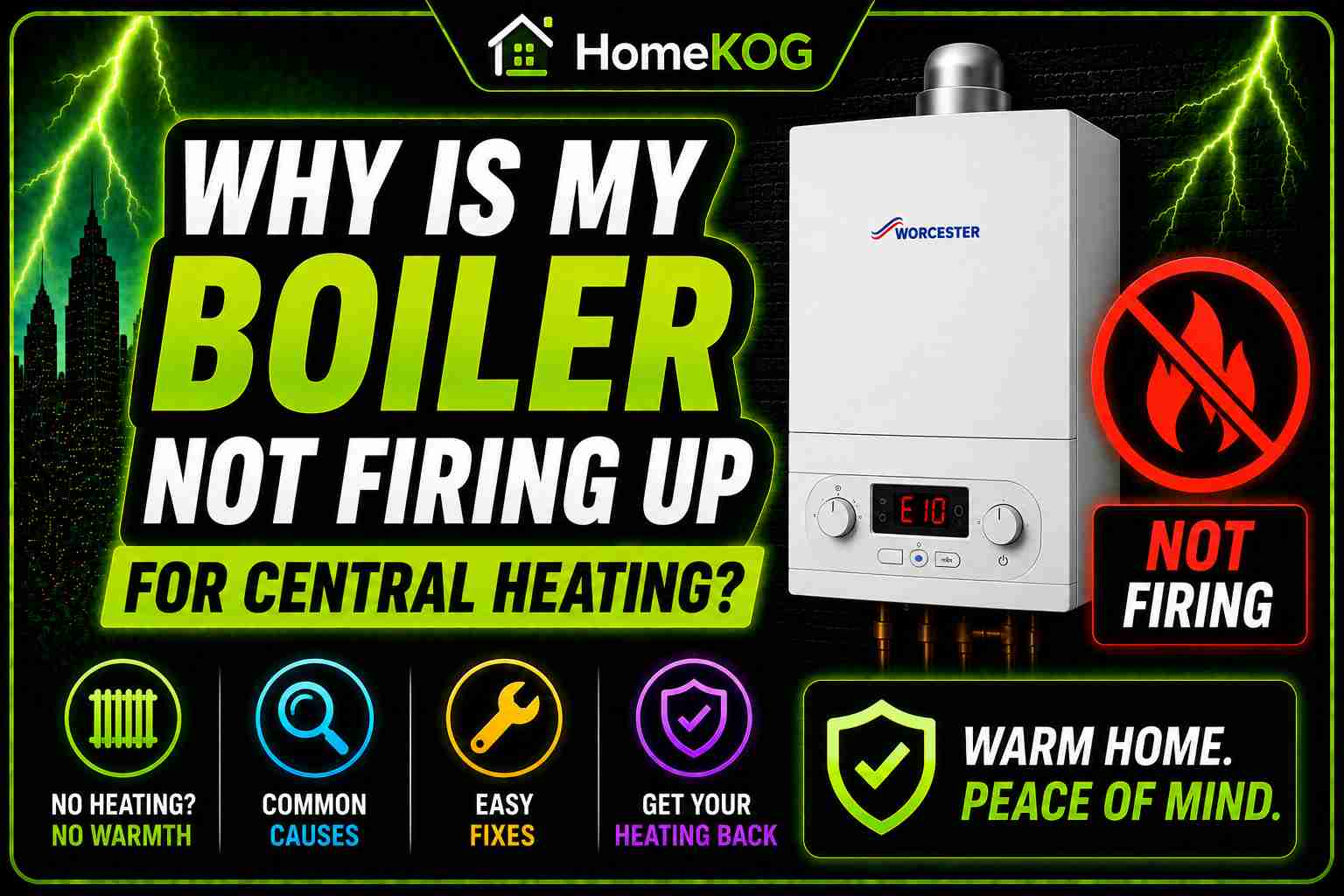

Why Is My Boiler Not Firing Up for Central Heating? 2026
Quick Answer: The most common reasons a boiler will not fire up for central heating are low boiler pressure (repressurise via the filling loop to 1.5 bar), a thermostat set below room temperature or with flat batteries, a frozen condensate pipe (thaw with warm water), a tripped fuse, or an issue with the gas supply. Check the boiler display for a fault code first — this narrows down the cause immediately. If none of these checks resolve the fault, call a Gas Safe registered engineer. Never open the boiler casing or attempt to work on gas components yourself.
A boiler that will not fire up for central heating is one of the most disruptive household faults, particularly in winter. The good news is that in a significant proportion of cases, the cause is something straightforward — low pressure, a thermostat issue, or a frozen condensate pipe — that can be identified and resolved at home without an engineer call-out. This guide works through every common cause in order of likelihood and ease of checking, so the simplest possibilities are eliminated first before progressing to faults that require professional attention.
Step One: Check for a Fault Code
Before anything else, check the boiler display panel. Most modern boilers display an alphanumeric fault code when they lock out or develop a fault. The code identifies the specific fault the boiler has detected and is the most direct route to the correct diagnosis. Look up the displayed code in the boiler manual or on the manufacturer’s website — the manual will specify whether the fault is one the homeowner can address or whether an engineer is required.
If no fault code is displayed and the boiler is simply not responding, work through the checks below.

Check 1 — Loss of Power
The most straightforward cause of a boiler not firing is a loss of electrical power. Boilers require electricity to operate the ignition, controls, and pump — even gas boilers will not fire without an electrical supply.
Confirm that the boiler’s electrical switch is turned on. This is sometimes located in an inconvenient position and can be knocked accidentally. Check whether other appliances in the property are also without power — a general power outage means the supply will restore itself without any boiler-specific action. If other appliances are working normally, check the consumer unit (fuse box) for a tripped circuit breaker on the boiler circuit. Reset the tripped breaker and attempt to restart the boiler.
If the breaker trips again immediately after resetting, there is an electrical fault in the boiler circuit that requires a Gas Safe engineer to investigate — do not continue resetting a repeatedly tripping breaker.
Check 2 — Thermostat Settings and Batteries
A boiler will not fire for central heating if the thermostat does not call for heat — meaning the room temperature is already at or above the thermostat’s set temperature. Check the thermostat and confirm that the set temperature is higher than the current room temperature. A thermostat set to 18°C will not trigger heating in a room that is already 19°C, even though the property may feel cold.
Battery-powered thermostats — including many wireless and smart thermostat models — typically require battery replacement every few months. A thermostat with flat or low batteries may disconnect from the boiler without any obvious indication, causing the boiler to stop receiving a heat demand signal. Replace the batteries and check whether the boiler responds. Smart thermostat users will typically receive a low battery notification through the app before this point is reached.
If the clocks have recently changed due to daylight saving time, check that the thermostat timer has been updated. A timer that is one hour out will cause the heating to operate at the wrong times and may mean no heating is active during the period the property feels cold.
If the thermostat recently lost power and restored, check whether it has reverted to factory default settings — some models reset to a default time, temperature, and schedule when power is interrupted, which can produce unexpected heating behaviour until the correct settings are re-entered.
Check 3 — Boiler Pressure Too Low
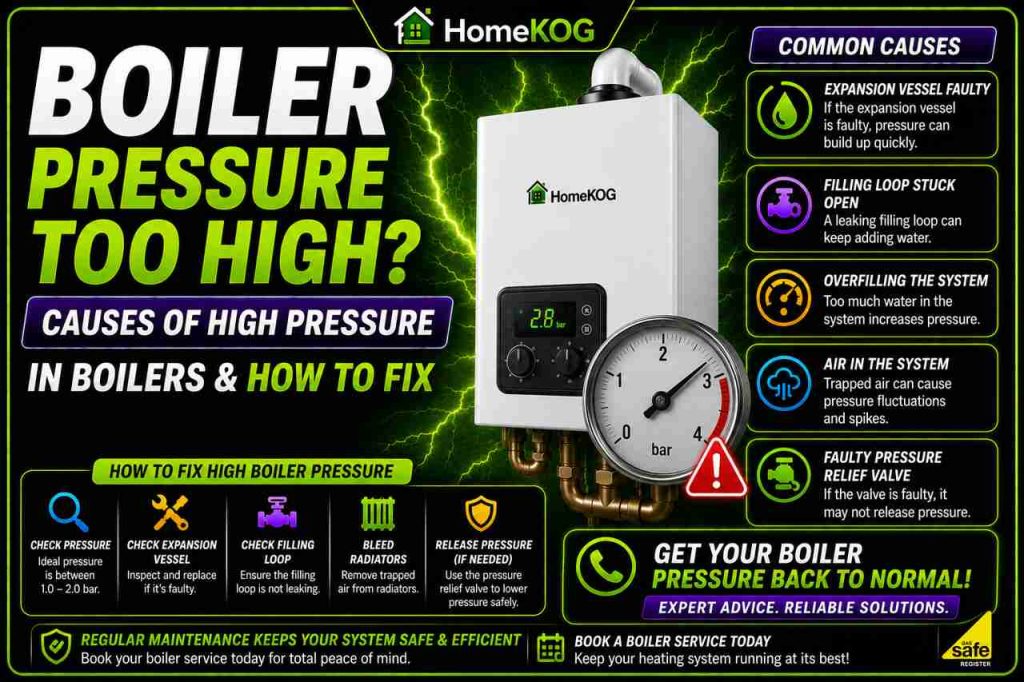
Low boiler pressure is one of the most frequently occurring causes of a boiler not firing for central heating. When pressure drops below 1.0 bar, most boilers automatically lock out to protect the system from running without adequate water. The pressure gauge on the boiler front panel will show a reading in the red zone below 1.0 bar.
The correct operating pressure for most boilers is between 1.0 and 1.5 bar. To restore pressure, locate the filling loop — typically a braided flexible hose with one or two valves located beneath the boiler — and open the valve or valves slowly. Watch the pressure gauge as pressure rises and close the filling loop valve when the gauge reaches 1.5 bar. Reset the boiler and check whether it fires normally.
If the boiler pressure drops back to a low level within a short period — hours or a day or two rather than weeks — a system leak is causing the pressure loss. Persistent pressure loss requires a Gas Safe engineer to locate and repair the leak. A one-off pressure drop is normal and does not indicate a fault — pressure drops gradually over months as small amounts of air enter the system, requiring periodic repressurisation.
Check 4 — Frozen Condensate Pipe
In cold weather — particularly when overnight temperatures fall below freezing — the condensate pipe on a condensing boiler can freeze and block. The condensate pipe is typically a white or grey plastic pipe that exits the boiler and runs to an external drain. When it freezes, the condensate backs up inside the boiler and triggers an automatic lockout to prevent damage. The boiler will usually display a specific fault code when this occurs.
To thaw a frozen condensate pipe, apply warm — not boiling — water along the external section of the pipe. A hot water bottle laid against the frozen section, warm towels wrapped around the pipe, or a container of warm water held beneath the external pipe outlet are all effective approaches. Once the blockage clears, reset the boiler following the manufacturer’s reset procedure. The boiler should fire normally once the condensate can drain freely.
After resolving the freeze, wrap the external section of the condensate pipe in foam pipe lagging to insulate it against future cold spells. This is a straightforward and inexpensive permanent fix that prevents repeated lockouts in cold weather.
Check 5 — Gas Supply
A boiler cannot fire without an operational gas supply. If the gas supply to the property has been interrupted — whether through a supply issue, a meter problem, or non-payment — the boiler will not ignite regardless of all other conditions being correct.
Test whether other gas appliances in the property are working. If the gas cooker or gas hob fires normally, the supply to the property is intact and the fault is likely specific to the boiler’s gas valve, which requires an engineer to investigate. If no gas appliances are working, the supply to the property has been interrupted. Contact the gas supplier to check whether planned maintenance work is affecting supply in the area.
If the gas meter is located externally and has been exposed to heavy snow or ice, the meter vents can become obstructed and cause gas pressure to drop. Clear loose snow from around the meter but do not attempt to chip ice from the meter body — contact the gas supplier and report the issue. Insulating the meter housing protects against this in future cold spells.
For properties using LPG rather than mains gas, check the tank gauge. An LPG tank that has run empty will cause the boiler to behave identically to a mains gas supply interruption. Arrange a delivery with the LPG supplier if the tank is empty or critically low.
If a gas leak is suspected at any point — indicated by the smell of gas — leave the property immediately, do not operate any electrical switches or create any ignition source, and call the National Gas Emergency Service on 0800 111 999 from outside the building.
Check 6 — Prepayment Meter Credit
Customers on gas prepayment meters need adequate credit on the meter for the gas supply to remain active. If the credit has run out, the gas supply will stop and the boiler will not fire — the fault will appear identical to a supply interruption from the boiler’s perspective. Check the prepayment meter and top up the credit via the payment card or the supplier’s online account system.
Check 7 — Radiators With Trapped Air
Significant trapped air in the radiators can prevent hot water from circulating effectively and may cause the boiler to fail to maintain adequate pressure, triggering a lockout or causing the heating to underperform substantially. Radiators that are warm at the bottom but cold at the top confirm trapped air is present.
Turn the heating off and allow the system to cool. Bleed each affected radiator using a radiator bleed key — starting with the ground floor radiators furthest from the boiler and working towards it, then repeating upstairs. Open each bleed valve until the hissing of escaping air gives way to a drip of water, then close the valve. After bleeding all affected radiators, check the boiler pressure gauge and repressurise via the filling loop if pressure has dropped below 1.0 bar.
Check 8 — Pilot Light (Older Boilers Only)
Modern boilers ignite using an electronic ignition system and do not have a continuously burning pilot light. On older boilers still using a standing pilot, the pilot flame can be extinguished by a draught or a gas supply interruption. If the pilot has gone out, follow the manufacturer’s instructions to re-ignite it — this process is described in the boiler manual.
If the re-ignited pilot flame burns yellow or orange rather than blue, turn the boiler off immediately and call a Gas Safe engineer. A yellow or orange pilot flame indicates incomplete combustion and potential carbon monoxide production — this is a safety issue that must not be operated until an engineer has attended. A pilot that will not re-ignite at all also requires engineer attendance, as the thermocouple or gas valve may have developed a fault.
Check 9 — Reset the Boiler
If all the above checks have been completed without identifying the cause, a soft boiler reset resolves intermittent electronic faults in many modern boilers. The reset procedure varies by manufacturer and model — the boiler manual provides the specific steps. In most cases, the reset button is located on the boiler front panel and requires holding for three to five seconds. After resetting, allow the boiler two to three minutes to complete its ignition sequence before concluding whether it has resolved the fault.
A boiler that repeatedly locks out and requires regular resetting is indicating a recurring fault that will not be resolved by resetting alone. Repeated resets should prompt an engineer call rather than continued resetting.
When to Call a Gas Safe Engineer
If all of the above checks have been completed and the boiler is still not firing, call a Gas Safe registered engineer. The remaining causes — a faulty gas valve, a failed PCB, a broken pump, a heat exchanger fault, or internal corrosion — require professional diagnosis and cannot be safely investigated or repaired by a homeowner. Opening the boiler casing without Gas Safe registration is illegal, voids the warranty, and risks serious harm from incorrect reassembly of gas components.
The causes that may be identified by an engineer in this scenario include a broken mechanical component that may be covered by the manufacturer’s warranty if the boiler is within warranty and has been annually serviced, an electrical PCB fault, a gas valve fault, or internal corrosion. If the boiler is beyond economic repair, the engineer will advise on replacement options.
Common Causes at a Glance
| Cause | DIY Fix Available? | First Action |
|---|---|---|
| No fault code, boiler unresponsive | Check power first | Verify switch on, check fuse box |
| Fault code displayed | Depends on code | Look up code in manual |
| Low pressure | Yes | Repressurise to 1.5 bar via filling loop |
| Thermostat set below room temp | Yes | Increase thermostat set temperature |
| Flat thermostat batteries | Yes | Replace batteries |
| Frozen condensate pipe | Yes | Apply warm water to external pipe |
| Gas supply interrupted | Contact supplier | Test other gas appliances |
| LPG tank empty | Contact supplier | Check tank gauge |
| Prepayment meter out of credit | Yes | Top up meter credit |
| Trapped air in radiators | Yes | Bleed radiators, repressurise |
| Pilot light out (older boilers) | Check flame colour first | Re-ignite per manual |
| Intermittent electronic fault | Yes | Reset boiler per manual |
| Gas valve, PCB, pump fault | No | Call Gas Safe engineer |
FAQ
Why does my boiler fire up then cut out?
A boiler that fires and immediately cuts out — sometimes called short cycling — is most commonly caused by low system pressure, a blocked condensate trap, a faulty thermostat sending an incorrect temperature reading, or the early stages of a heat exchanger fault. Check the pressure gauge first and repressurise if below 1.0 bar. If pressure is correct and the fault persists, a Gas Safe engineer should investigate — repeated short cycling causes accelerated wear to the ignition components and heat exchanger.
Why is my boiler not firing up for hot water but heating works?
A boiler that heats radiators but produces no hot water typically has a diverter valve fault. The diverter valve directs system water between the heating circuit and the domestic hot water heat exchanger. When the valve sticks in the heating position, hot water demand is not met. This is an engineer repair — the diverter valve cannot be accessed or repaired safely without opening the boiler casing.
Can I reset my boiler myself?
Yes. Pressing the reset button on the boiler front panel following the manufacturer’s reset procedure is a safe and appropriate first response to a boiler lockout. The reset sequence is described in the boiler manual and typically involves holding the reset button for three to five seconds. Reset is only appropriate after identifying and resolving the cause of the lockout — repeatedly resetting without understanding the cause does not fix the underlying fault.
Why does my boiler keep losing pressure?
Boiler pressure drops gradually over months through normal operation and requires occasional repressurisation — this is not a fault. Pressure that drops back to low within hours or days of repressurisation indicates a leak in the system — most commonly at a radiator valve, pipe joint, or pump seal. A Gas Safe engineer should locate and repair the leak before repressurisation is repeated.
Conclusion
A boiler that will not fire for central heating is a frustrating fault but one that is often resolved quickly by working through the most common causes systematically. Low pressure, thermostat issues, a frozen condensate pipe, and gas supply interruptions between them account for the majority of cases where homeowners report a non-firing boiler. All of these can be checked and resolved at home in under an hour without specialist tools or knowledge.
Where the straightforward checks do not identify the fault, a Gas Safe registered engineer should be called without delay. Attempting to investigate internal boiler components without Gas Safe registration is unsafe, illegal, and will void any remaining warranty — the cost of an engineer call-out is considerably lower than the consequence of an unqualified repair attempt on a gas appliance.