

Why Is My Boiler Leaking Water? Causes and Fixes 2026
Quick Answer: A boiler leaking water is most commonly caused by high system pressure, corrosion in the pipework or heat exchanger, a failed pump seal, or loose pipe connections. High pressure causing a leak from the pressure relief valve is resolved by bleeding radiators to reduce pressure. Corrosion, heat exchanger failure, and component seal failure all require a Gas Safe registered engineer. Never continue using a leaking boiler — turn off the water supply and central heating immediately and place a container under the leak while waiting for professional attention.
A leaking boiler should never be left unattended. What appears to be a minor drip can indicate a developing fault — rising pressure, a corroding heat exchanger, or a failing seal — that worsens progressively and risks damaging the boiler’s electrical components, the surrounding structure, and in serious cases, creating a safety hazard. This guide explains every common cause of a boiler water leak, what to do immediately when a leak is discovered, when DIY action is appropriate, and what professional repair costs to expect.
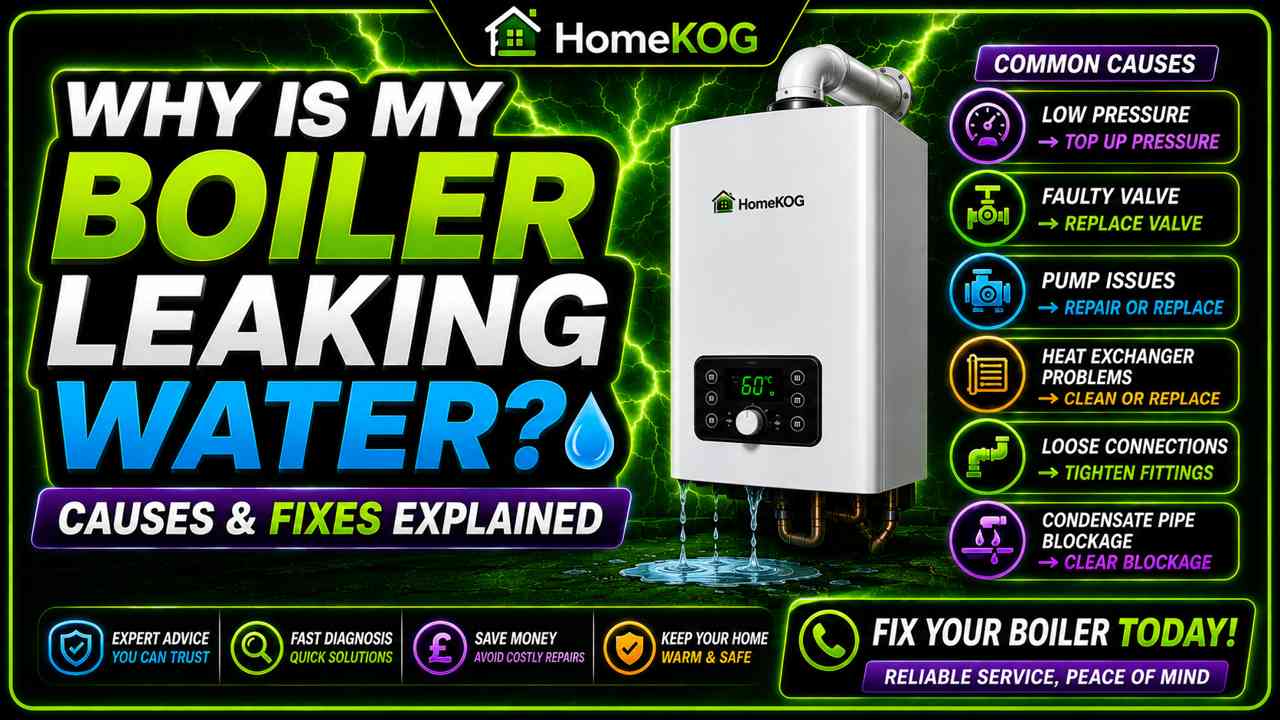
What Causes a Boiler to Leak Water?
High Boiler Pressure
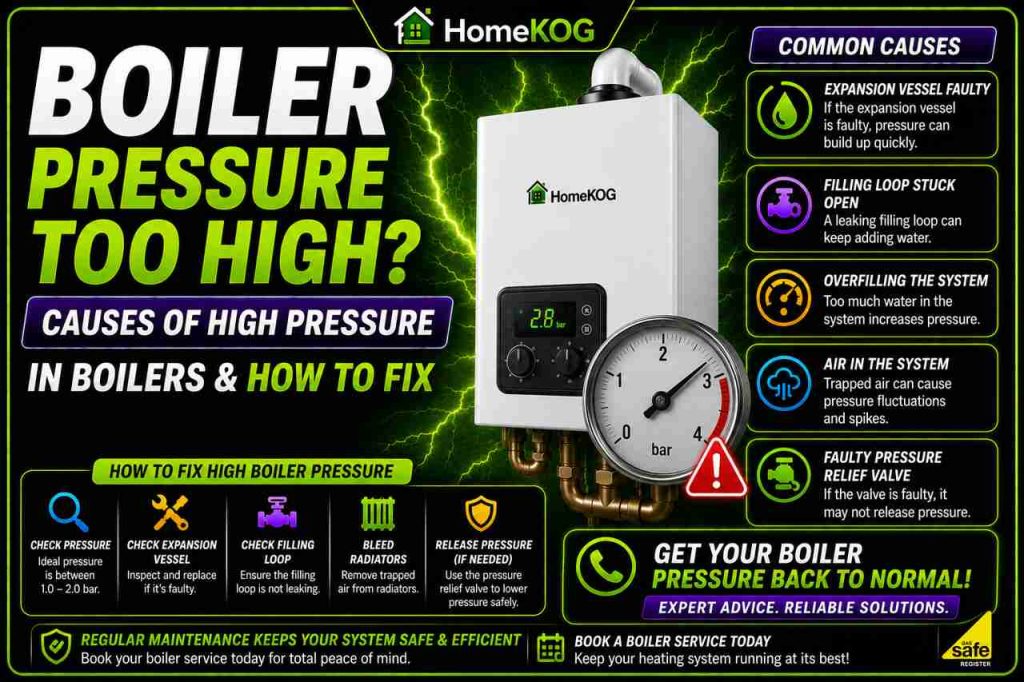
High system pressure is one of the most common causes of water appearing from a boiler. When pressure rises above the safe operating range — typically above 2.5 bar — the pressure relief valve opens automatically to discharge water and protect the system from overpressure damage. Water escaping from a copper pipe leading from the boiler to an external drain, or pooling beneath the boiler near a discharge pipe, is a characteristic sign of pressure relief valve activation.
Check the pressure gauge on the boiler front panel. A reading above the green zone — typically above 1.5 to 2 bar — confirms the system is overpressurised. To reduce pressure, turn off the heating, allow the radiators to cool fully, then bleed one or more radiators until the gauge returns to the 1.0 to 1.5 bar operating range. If the pressure relief valve continues to discharge water after pressure has been corrected, or if pressure consistently rises above the safe range without any apparent cause, a Gas Safe engineer should inspect the expansion vessel and pressure relief valve — both components that can cause persistent overpressurisation when they fail.

Corrosion in Pipework or Components
Corrosion develops progressively in aging heating systems, particularly where the system water has not been maintained with adequate inhibitor concentration. Iron oxide (magnetite sludge) and limescale accumulate inside pipework and around joints, causing rubber seals to break down and metal surfaces to develop pinhole leaks. Corroded copper pipes are a particularly common source of small but persistent drips that are easy to overlook until staining or damp patches become visible.
Corrosion-related leaks require a Gas Safe engineer to replace the affected section of pipework or component. A single corroded pipe section can be replaced without disturbing the rest of the system. Where multiple areas of corrosion are found, a system power flush combined with correct inhibitor dosing addresses the root cause and prevents further deterioration.
Faulty or Worn Seals
The boiler contains multiple rubber seals at pipe connections, around the pump, and within the heat exchanger assembly. These seals deteriorate with age and repeated thermal cycling — the expansion and contraction of components as the system heats and cools. A failed seal produces a drip or slow leak at the connection point rather than a flowing discharge. Seal replacement by a Gas Safe engineer is typically straightforward and low cost, provided the surrounding pipework and components are in good condition.
Faulty Heat Exchanger
The heat exchanger is the component through which combustion heat transfers into the system water. Cracks in the heat exchanger — caused by corrosion, overpressurisation, or thermal stress — allow water to escape from the primary circuit into the combustion chamber or externally. Heat exchanger failure is the most serious and costly boiler leak cause. Signs specific to a heat exchanger leak include water appearing from inside the boiler casing without an obvious pipe connection source, and the boiler struggling to maintain pressure even after correct repressurisation.
Heat exchanger replacement is one of the most expensive single boiler repairs, often costing £300 to £500 or more in parts and labour. On boilers over 8 to 10 years old, the cost of heat exchanger replacement may approach or exceed the cost of installing a new boiler — a Gas Safe engineer should advise on the most economical route based on the boiler’s age and overall condition.
Loose Pipe Connections
Pipe connections throughout the heating system are subject to expansion and contraction with every heating cycle. Over years of operation, threaded connections and compression fittings can work slightly loose, allowing water to escape at the joint. Loose connections are one of the few leak causes where a limited DIY intervention — carefully tightening the fitting — is appropriate as an immediate temporary measure. This should always be followed by a professional inspection to confirm the joint is holding and no other connections in the vicinity have similarly loosened.
Pump Seal Failure
The pump circulates system water continuously during heating operation and its seal is subject to continuous wear. A failed pump seal produces a drip or small flow of water from the pump body or its connections. If the leak source is confirmed to be the pump rather than adjacent pipework, a Gas Safe engineer can assess whether the seal alone can be replaced or whether the pump requires full replacement — on older pumps the latter is typically more cost-effective.
What to Do Immediately if Your Boiler is Leaking
Act quickly regardless of how minor the leak appears. Water near electrical components inside the boiler creates a risk of short circuit, and a slow drip that worsens overnight can cause significant water damage to flooring, walls, and cabinetry.
Turn off the central heating and allow the system to cool. Turn off the cold water supply to the boiler using the service valve on the cold feed pipe — typically a quarter-turn valve on the pipework feeding the boiler. Place a container or bucket under the leak to collect water and protect the floor. Dry any water that has already reached the boiler casing or surrounding surfaces with a cloth.
If the leak is from a visible pipe joint, carefully attempt to tighten the fitting — this is the only safe DIY intervention on the boiler itself. Do not attempt to open the boiler casing, disconnect gas connections, or work on internal components. Contact a Gas Safe engineer and describe the leak location and severity to help them assess urgency.
Safety Precautions
If a smell of gas accompanies the water leak, treat this as a gas emergency rather than a plumbing fault. Leave the property immediately, leave doors and windows open as you exit to help disperse gas, and call the National Gas Emergency Service on 0800 111 999. Do not operate any electrical switches or use any naked flames before leaving. Do not re-enter the property until a gas engineer has confirmed it is safe.
For oil boiler leaks, shut off the oil supply valve at the tank, ventilate the area by opening windows, and contact either a heating engineer or the emergency line on the home insurer’s policy. Oil leaks carry a contamination risk as well as a fire risk and should be treated urgently.
Who to Call for a Leaking Boiler
The correct professional depends on where the leak is located. Any leak originating from within the boiler casing, from gas pipework, or involving the heat exchanger, pump, or pressure relief valve requires a Gas Safe registered engineer. A plumber cannot legally work on gas components, and attempting to repair internal boiler leaks without Gas Safe registration is both illegal and dangerous.
Leaks in the central heating pipework away from the boiler — at a radiator valve, a pipe joint under floorboards, or at a towel rail connection — can be addressed by a qualified plumber as well as by a Gas Safe engineer, since these locations do not involve gas components.
Always ask to see the engineer’s Gas Safe ID card before work begins, or verify their registration at gassaferegister.co.uk.
How Much Does Fixing a Leaking Boiler Cost?
| Repair Type | Typical Cost |
|---|---|
| Seal replacement | £100 – £200 |
| Pipe joint repair or replacement | £100 – £250 |
| Pressure relief valve replacement | £150 – £300 |
| Pump seal or pump replacement | £150 – £350 |
| Heat exchanger replacement | £300 – £600 |
| Emergency call-out (out of hours) | £50 – £150 surcharge |
Repair costs vary by location — London and the South East attract higher labour rates — and by boiler age, where older models may require harder-to-source parts. Emergency out-of-hours attendance adds a surcharge on top of the standard labour rate. Boiler cover that includes emergency call-out eliminates the surcharge and provides parts and labour cover for qualifying repairs, which is particularly valuable for older boilers approaching the end of their expected lifespan.
Preventing Future Boiler Leaks
Annual servicing by a Gas Safe engineer is the most effective preventative measure — the engineer inspects seals, checks pipework connections, tests the pressure relief valve, and identifies early-stage corrosion before it causes a leak. The service cost of around £80 is consistently outweighed by the repair costs avoided through early detection.
Installing a magnetic filter on the return pipework captures iron oxide particles before they circulate and cause corrosion at pipe connections and heat exchanger surfaces. Maintaining correct inhibitor concentration in the system water — checked and topped up at each annual service — slows corrosion throughout the heating circuit. Monitoring the boiler pressure gauge regularly and taking immediate action when pressure exceeds the safe range prevents the pressure-related leaks that are among the most commonly reported boiler water leak causes.
FAQ
Can I still use my boiler if it is leaking?
No. Turn off the heating and water supply immediately and do not restart the boiler until the leak has been identified and repaired by a Gas Safe engineer. Water near electrical components inside the boiler creates a risk of short circuit and potential electrical fault, and a continuing leak will worsen and cause further damage the longer the boiler runs.
Why is my boiler leaking water from underneath?
Water appearing from beneath the boiler most commonly indicates a pressure relief valve discharge — the valve is releasing excess pressure through a pipe that exits at the base or side of the boiler. Check the pressure gauge immediately. If pressure is above 1.5 bar, reduce it by bleeding radiators. If pressure is within the normal range and the discharge continues, the relief valve itself may be faulty and requires replacement by a Gas Safe engineer.
Is a leaking boiler dangerous?
It can be. Water near the boiler’s internal electrical components creates a short circuit risk. A leak from the heat exchanger can introduce water into the combustion chamber. A simultaneously developing gas leak alongside a water leak — identified by a gas smell — constitutes an immediate safety emergency requiring evacuation and calling the National Gas Emergency Service on 0800 111 999. Any uncertainty about whether a gas leak is present should always be treated as if one is.
How do I reduce boiler pressure to stop a leak?
Turn off the heating and allow the system to cool completely. Bleed one or more radiators using a bleed key until water begins to drip from the valve, indicating that pressure has reduced. Check the boiler pressure gauge — stop bleeding when the gauge reads between 1.0 and 1.5 bar. If the pressure gauge does not drop during bleeding, or pressure returns to a high reading within a short period, a faulty expansion vessel or pressure relief valve requires professional inspection.
How much does it cost to fix a leaking boiler?
Repair costs range from approximately £100 for a straightforward seal or joint replacement to £600 or more for heat exchanger replacement. The average boiler leak repair costs around £300 including parts and labour. Emergency or out-of-hours call-outs carry an additional surcharge of £50 to £150 on top of standard rates. Boiler cover plans that include emergency repairs provide the most cost-effective protection against unexpected leak repair bills, particularly for boilers over five years old.
Should I repair or replace a boiler that keeps leaking?
If a boiler under 8 years old develops a single leak, repair is almost always the right decision — the cost is modest relative to replacement. For boilers over 10 years old experiencing multiple leaks, or where heat exchanger failure is the cause, replacement becomes more competitive with the combined repair cost. A Gas Safe engineer should assess the boiler’s overall condition before recommending either route — the age, warranty status, and efficiency of the current boiler all inform the decision.
Conclusion
A leaking boiler is never a problem to leave unattended. Whether the cause is high pressure, a corroding heat exchanger, a failed seal, or loose pipework connections, the consequences of inaction — water damage, electrical faults, or worsening corrosion — are consistently more costly than the repair itself.
The immediate response is always the same: turn off the heating and water supply, contain the leak with a container, and contact a Gas Safe engineer. High pressure causing a relief valve discharge is the one situation where a DIY intervention — bleeding radiators to reduce pressure — is safe and appropriate as a first step. All other causes require professional diagnosis and repair.
Annual boiler servicing, a magnetic filter, and regular pressure monitoring are the three most effective ongoing measures for preventing leaks from developing in the first place — addressing the underlying causes of corrosion, sludge accumulation, and pressure irregularities before they reach the point of causing visible water damage.