
Noisy Central Heating Pump: Causes and How to Fix It 2026
Quick Answer: A noisy central heating pump is most commonly caused by trapped air, limescale build-up, sludge blockages, incorrect pump speed settings, or pipes that are not secured correctly under floorboards. Trapped air is the most common cause and is resolved by bleeding the radiators. Limescale causing a kettling or whistling noise requires a power flush by a heating engineer. Most pump noises do not indicate a safety emergency — all modern boilers have built-in safety devices that shut down the system automatically if pressure or temperature reach dangerous levels.
Some noise from a central heating system is entirely normal. Metal pipework expands and contracts as it heats and cools, producing occasional creaking and low-level vibration that is nothing to be concerned about. The noises that indicate an actual problem are louder, more persistent, and often specific in character — a banging, gurgling, whistling, or persistent humming that was not there before. This guide explains what each type of noise means, which can be fixed without a professional, and when a heating engineer is required.
What Does a Central Heating Pump Do?
The central heating pump circulates hot water from the boiler through the radiators and back again in a continuous loop. Without it, the boiler would heat water but the heat would not reach the radiators. The pump is typically located close to the boiler — sometimes in the airing cupboard or under the stairs on older installations — and runs whenever the heating is active. A small amount of operating noise, particularly a low hum, is normal during operation.

What Different Pump Noises Mean
Banging — Water Hammer or Thermostat Issue
A banging noise when taps are opened, or when the heating switches on and off, usually indicates one of two causes. Water hammer occurs when unsecured copper pipework moves sharply as water pressure changes — the pipes knock against joists or each other under the floorboards. The fix is to turn off the heating, allow the system to cool, and pack felt around each pipe at every point where it contacts a joist or another pipe. Where pipes run freely without being clipped to the structure, adding pipe clips reduces movement and eliminates the knock.
A banging noise specifically when the heating reaches temperature can indicate the thermostat differential is set too tightly, causing the boiler to cycle on and off rapidly. Turn the heating off, allow the system to cool fully, then switch it back on and increase the thermostat until you hear a click confirming the thermostat is operating correctly. If no click is heard, or the banging persists after this test, a heating engineer should investigate. Where copper pipework noise is persistent and cannot be resolved through securing, replacing the affected section with flexible plastic pipe eliminates the problem permanently.
Gurgling — Trapped Air or Frozen Condensate Pipe
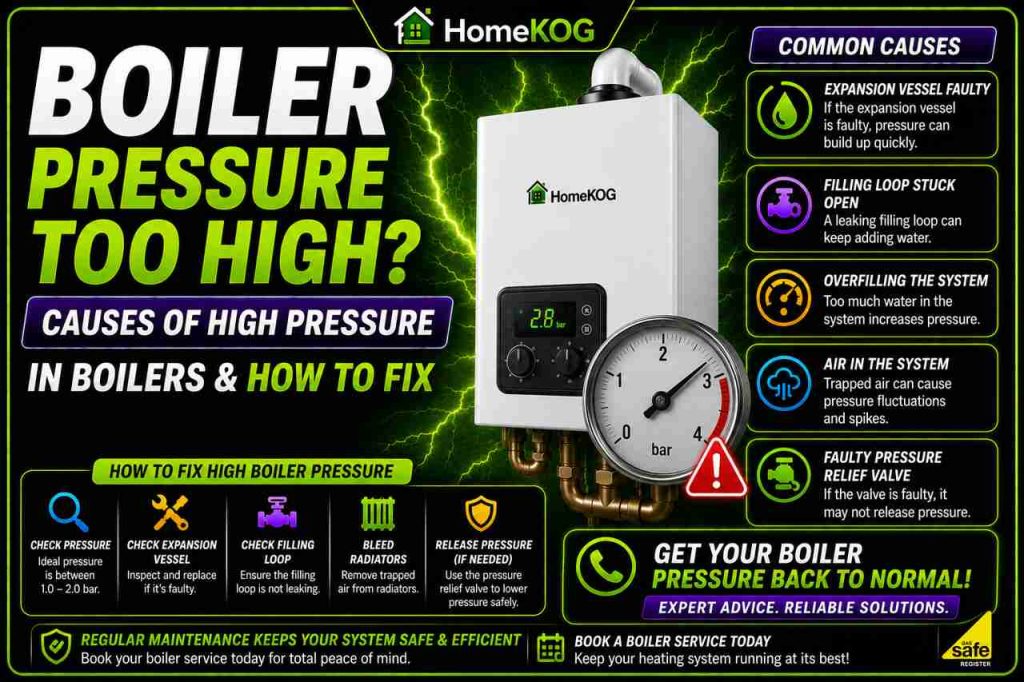
A gurgling sound resembling a slowly boiling kettle most commonly indicates trapped air in the central heating system. Air rises to the tops of radiators and prevents hot water from circulating fully, causing the water that can circulate to overheat — producing the gurgling sound. Confirm the cause by feeling the radiator: cold at the top with heat concentrated lower down indicates trapped air. The fix is to bleed the affected radiators following the standard procedure — open the bleed valve with a radiator key until hissing stops and a drip of water appears, then close the valve and check boiler pressure. Repressurising to 1.5 bar via the filling loop after bleeding is necessary if pressure has dropped.
Gurgling can also indicate a frozen condensate pipe during cold weather. The condensate pipe carries wastewater from the boiler to an external drain and is exposed to outdoor temperatures where it can freeze and block. A blocked condensate pipe causes the boiler to lock out. Thaw the frozen section by pouring warm — not boiling — water along the external pipe until the blockage clears, then reset the boiler. Lagging the exposed external section prevents recurrence.
Tapping — Limescale Build-Up
A persistent tapping noise from the pipework or pump area typically indicates limescale accumulation inside the pipes and heat exchanger. Limescale deposits form when hard water minerals precipitate onto heated metal surfaces, reducing the internal bore of pipes and creating surfaces that interfere with water flow. Turn off the heating and use a non-acidic chemical descaler flushed through the system to address limescale. A plumber’s merchant can advise on the appropriate chemical cleaner for the specific system age and condition. For older or heavily scaled systems, a full power flush carried out by a heating engineer may be required.
Humming — Pump Speed, Thermostat, or Filling Loop
A continuous humming sound often originates from the central heating pump itself running at a higher speed setting than the system requires. Most residential central heating systems operate adequately on a medium pump speed setting — the highest setting increases flow noise and electricity consumption without providing a proportional heating benefit. Locate the speed selector switch on the pump body and reduce the setting by one position, then check that radiators are still heating correctly. Always consult a heating engineer before reducing the pump speed if the system was recently installed or recently serviced, as the higher setting may have been specified for a reason.
Humming can also be caused by a thermostat fault, an incorrectly connected filling loop that has been left open or not fully disconnected after repressurising, or a loose immersion heater valve allowing continuous water flow. Check each of these before adjusting the pump speed. If none resolve the humming, a heating engineer should inspect the system.
Knocking — Pipe Expansion or Trapped Air
Knocking sounds — distinct from the sharper bang of water hammer — are most commonly caused by pipes with insufficient clearance under floorboards. As the pipes heat up and expand, they press against joists or floor timbers and knock as they move. Adding insulation around pipes where they contact structural elements provides clearance and dampens the sound. Trapped air also causes knocking in some systems — bleeding the radiators is always worth attempting before investigating the pipework.
Whistling — Limescale on Heat Exchanger (Kettling)
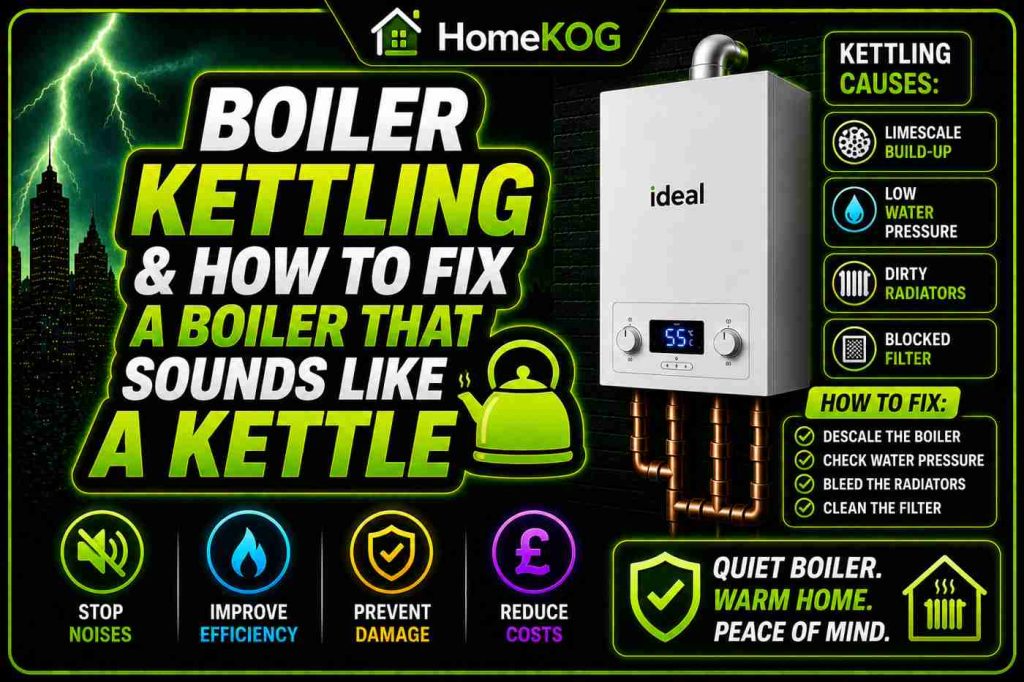
A whistling noise that sounds like a boiling kettle — often called kettling — indicates limescale build-up on the heat exchanger surface. Water trapped against the scaled surface boils locally, producing steam bubbles that collapse and create the characteristic sound. Kettling is not a DIY fix — it requires a power flush carried out by a heating engineer to clear the limescale from the heat exchanger and pipework. Left unaddressed, severe limescale build-up reduces heat exchanger efficiency and eventually causes premature failure of the heat exchanger — one of the most expensive boiler components to replace.
Common Causes of Noisy Central Heating Pumps
Sludge and Debris Blockages
Iron oxide sludge — the black magnetite produced by corrosion inside steel radiators — circulates with the system water and accumulates in the lowest points of the circuit, including inside the pump. A pump struggling to move water through partially blocked pipework runs louder than a clean system and wears more quickly. Radiators that heat slowly or unevenly alongside pump noise are a strong indicator of sludge accumulation. A magnetic filter fitted on the return pipework captures sludge particles before they reach the pump and is the most effective preventative measure available.
Pump Speed Set Too High
As described above, a pump running at a higher speed setting than the system requires creates unnecessary noise and reduces pump lifespan. Checking and adjusting the speed setting is one of the simplest pump noise fixes — but confirm with a heating engineer if there is any uncertainty about the correct setting for the specific installation.
Fan Fault
The pump fan prevents overheating of the pump motor during operation. A loose fan blade produces metallic clanking sounds that are distinct from the water-related noises described above. A fan fault requires a heating engineer to inspect and replace the affected component.
Pump Overheating
A pump that is too hot to touch indicates the motor is overheating. This most commonly occurs at the start of the heating season after an extended period without use — a seized internal component causes the motor to overwork. A light tap on the pump body can free a stuck component in some cases. If overheating recurs or the pump seizes repeatedly, replacement is the appropriate solution — a heating engineer can assess whether the pump can be freed or whether a replacement unit is required.
Incorrectly Installed Pump
A pump installed off-horizontal will become airlocked repeatedly, regardless of how many times the radiators are bled. The pump body must be mounted in a precise horizontal position with the bleed screw on the side — even a small deviation from horizontal disrupts water circulation and causes the pump shaft bearing to wear prematurely, producing a whining noise. If bleeding resolves the noise briefly but it returns within days, incorrect pump orientation is likely. A heating engineer should reposition the pump correctly.
How to Prevent Noisy Central Heating Pump Problems
Fitting a magnetic filter to the return pipework close to the boiler is the single most effective preventative measure — it removes sludge from circulation before it can accumulate in the pump or heat exchanger. The filter is cleaned at each annual boiler service.
In hard water areas, where limescale build-up is accelerated by high mineral content in the supply water, installing a water softener at the mains supply significantly reduces scale formation throughout the heating system. A more affordable alternative is an electrolytic scale reducer fitted to the incoming cold water pipe, which reduces scale formation through a small electrical charge without requiring salt replenishment.
Annual boiler servicing by a Gas Safe registered engineer provides the most comprehensive protection — the engineer inspects the pump, checks inhibitor and pH levels, and identifies developing issues before they cause noise or breakdowns. Homeowners should also be aware of the various boiler financing options for homeowners that can make the investment more manageable. Whether considering a new installation or upgrades to an existing system, these financing plans can alleviate the immediate financial burden. Exploring these options allows homeowners to ensure their heating systems are efficient and reliable without compromising their budget. Understanding boiler flue regulations explained is crucial for homeowners to ensure compliance and safety. Regular checks in accordance with these regulations can help prevent hazardous situations and maintain emissions within acceptable limits. Additionally, consulting with a qualified professional can provide clarity on specific requirements tailored to your home’s heating system.
Is a Noisy Pump a Safety Risk?
In most cases, no. The noises described in this guide indicate maintenance needs rather than safety emergencies. All modern boilers include multiple built-in safety systems. Safety valves release pressure automatically if it rises above safe limits. Low-water fuel cut-offs shut down the burner automatically if the water level drops below the safe operating threshold. The boiler’s own overheat thermostats trigger lockout if temperature rises excessively.
If the noise is accompanied by a strong smell of gas, visible signs of water leaking from the boiler body, or the boiler displaying a fault code, treat it as a more urgent situation. A persistent smell of gas requires leaving the property and calling the National Gas Emergency Service on 0800 111 999. For fault codes, water leaks, or persistent overheating, contact a Gas Safe engineer for same-day or next-day attendance. Boiler leak repair solutions are essential to prevent further damage and ensure the safety of your home. Neglecting these issues can lead to more significant problems, including increased energy bills and potential hazards. Addressing leaks promptly with professional assistance is crucial for effective repairs and maintaining boiler efficiency.
FAQ
Why is my central heating pump so loud all of a sudden?
A sudden increase in pump noise most commonly indicates trapped air in the system — bleeding the radiators is the first step. If the noise appeared after the system was last used several months ago, the pump motor may have seized slightly during the dormant period and a gentle tap can free it. Sudden loud noises accompanied by banging or vibration warrant a call to a heating engineer if bleeding and resetting do not resolve the issue.
Can I fix a noisy central heating pump myself?
Many common pump noises can be resolved without a professional. Trapped air causing gurgling is addressed by bleeding radiators. Water hammer from unsecured pipes is resolved by adding felt packing or pipe clips. A pump speed set too high is adjusted by moving the speed selector switch on the pump body. Frozen condensate pipe causing gurgling and lockout is resolved by thawing with warm water. Whistling from limescale kettling and persistent humming from a faulty pump motor or damaged fan require a heating engineer.
How do I know if my central heating pump needs replacing?
The pump likely needs replacing if it overheats to the point of being too hot to touch on multiple occasions, if it seizes repeatedly despite being freed, if it continues to airlock even after being correctly repositioned horizontally, or if a heating engineer has identified worn bearings or motor failure. A functioning pump typically lasts 10 to 15 years with a maintained system. Replacement cost is considerably lower than a full boiler replacement — a heating engineer can advise on the most appropriate pump specification for the existing system.
What is the correct speed setting for a central heating pump?
Most residential central heating systems operate correctly on a medium speed setting. The highest setting is intended for larger properties or systems with a high number of radiators that require greater flow volume. For a typical two or three-bedroom property, reducing from the highest to the middle speed setting should maintain correct radiator heating while reducing both noise and electricity consumption. Check radiator temperatures after adjusting — if any radiators become significantly slower to heat, return the pump to the previous setting and consult a heating engineer.
How do I bleed a central heating pump?
The central heating pump has a bleed screw, typically located on the front of the pump body. Turn off the heating and allow the system to cool slightly. Place a cloth beneath the bleed screw, then turn the screw anticlockwise by half a turn using a flat-head screwdriver or bleed key. Air will escape as a hiss — close the screw when water begins to drip. This releases air trapped directly in the pump and is particularly effective when the pump has been recently installed or has been running without heating for an extended period.
Conclusion
The majority of noisy central heating pump problems have straightforward causes and practical solutions available to the homeowner without a heating engineer. Trapped air — resolved by bleeding — is the most common cause of gurgling and knocking. Incorrectly set pump speed accounts for many cases of continuous humming. Pipe movement under floorboards is resolved with felt packing and pipe clips.
The two causes that consistently require professional attention are kettling from limescale on the heat exchanger, which needs a power flush, and a pump that overheats repeatedly or has worn bearings, which needs replacement. Annual boiler servicing is the most effective long-term strategy for preventing pump noise — a Gas Safe engineer inspecting the system each year identifies sludge accumulation, limescale, and component wear before they generate the noises that indicate a system under stress.