
What is a Power Flush and Is It Worth It? Complete Guide 2026
Quick Answer: A power flush is a professional process that pumps water and chemicals through a central heating system at high velocity to remove sludge, limescale, and debris that block radiators and reduce boiler efficiency. It costs between £300 and £500 depending on property size, takes 6 hours to 2 days to complete, and is recommended every five years for maintained systems. Power flushing is not suitable for systems older than 15 years, pipework narrower than 15mm, or where rusty radiators or significant component faults are already present.
When a central heating system gradually becomes less efficient — radiators slow to heat, cold patches appearing, boiler noise increasing — the cause is frequently the accumulation of magnetite sludge, limescale, and debris in the pipework and radiators over years of use. A power flush clears this contamination and restores circulation, but it is not the right solution in every situation. This guide explains what a power flush involves, how to tell if one is needed, what it costs, and when alternative approaches or a new boiler installation make more sense.
What Does a Power Flush Do?
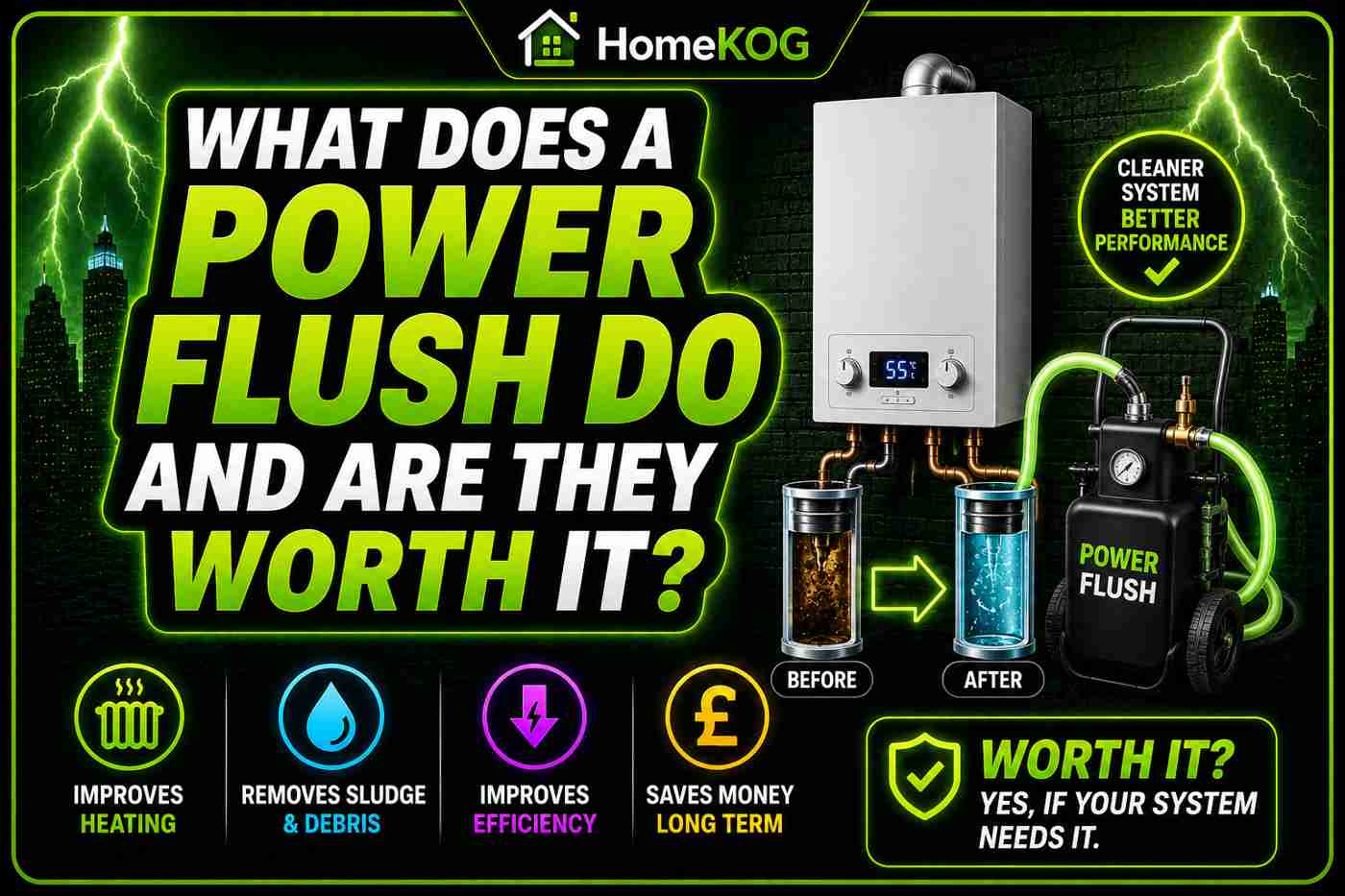
A power flush removes the sludge, rust particles, limescale, and debris that accumulate inside a central heating system’s pipework, radiators, and heat exchanger over time. This contamination — predominantly black iron oxide (magnetite) shed from steel radiators — restricts the flow of water through the system, causes cold spots in radiators, increases boiler noise, reduces heating efficiency, and accelerates wear on the pump and heat exchanger.
A pumping station connected to the system forces water through the pipework in both directions at high velocity, dislodging and carrying away accumulated deposits. Chemical cleaning agents are added to break down stubborn sludge and scale. Once the system runs clean, an inhibitor is added to prevent future corrosion and slow the rate at which new sludge accumulates.

Signs That a Power Flush May Be Needed
Several symptoms indicate that sludge or debris has built up to the point where system performance is being affected. Any combination of the following signs suggests that a heating engineer should assess the system.
Radiators that require frequent bleeding, or that produce brown or black water when bled, indicate contamination in the system. Cold patches at the bottom of radiators — where sludge settles — are one of the most distinctive signs that magnetite has accumulated. Radiators that are slow to warm up, or that heat unevenly compared to others in the same system, suggest restricted flow through the affected panels.
Excessive noise from the boiler — particularly a kettling sound similar to a boiling kettle — points to limescale on the heat exchanger surface causing localised boiling. A boiler that frequently breaks down or needs repeated restarting may be overheating due to restricted water flow through a contaminated heat exchanger. Pump failure is also associated with debris circulating in the system and damaging the pump’s internal components.
Attaching a magnet to an exposed section of copper pipework can indicate whether iron sludge is present in the system — if the magnet adheres unusually firmly, iron oxide particles are circulating in the water.
How a Power Flush Works: Step by Step
A power flush is a multi-stage process carried out by a qualified heating engineer using a specialised pumping station. The connection point depends on the system type — the pumping station connects either to the pump head, circulation pump, or across the tails of a radiator.
- The engineer connects the pumping station to the central heating system and circulates clean water through the full system in both directions for approximately 90 minutes until the water runs visibly cleaner.
- For particularly contaminated radiators, an agitator — a hard-wearing pad attached to a hammer-action drill — is used to physically dislodge compacted sludge from the radiator body before flushing.
- If contamination is severe, a blend of chemical cleaning agents is flushed through the pipework to break down sludge and scale deposits that water flow alone cannot shift.
- Clean mains water is then forced through the system to remove all contaminated liquid, which is disposed of responsibly by the engineer.
- A chemical neutraliser is washed through the system to address any residual acidity from the cleaning agents, and the pH balance is tested to confirm it is within the safe range to prevent internal corrosion.
- A dose of inhibitor fluid is added to the system to prevent future corrosion and slow the reaccumulation of sludge.
On a combi boiler installation, the engineer can additionally remove the hot water heat exchanger and flush it separately on both sides before refitting — particularly valuable because a faulty or scaled heat exchanger is an expensive component to replace. the function of heat exchangers in boilers is crucial, as they allow for efficient heat transfer between liquids. Ensuring these components are clean and operational can significantly enhance the overall energy efficiency of the system. Regular maintenance can prevent costly repairs and extend the lifespan of the boiler, making it a wise investment for homeowners.
How Long Does a Power Flush Take?
The duration depends on the size and condition of the central heating system. A three-bedroom property with a reasonably maintained system and no parts requiring replacement typically takes around six hours. Larger properties, heavily contaminated systems, or systems where individual components need attention can take up to two full days. A combi or sealed system boiler installation may complete more quickly than an open-vented system because the cold feed and expansion pipework do not need to be capped off.
How Much Does a Power Flush Cost in 2026?
| Property Size | Typical Power Flush Cost |
|---|---|
| 1–2 bedroom flat or house | £300 – £350 |
| 3 bedroom house | £350 – £450 |
| 4–5 bedroom house | £450 – £600 |
| Large property or complex system | £600+ |
Prices vary by location, with London and the South East running higher than the national average. The cost includes the engineer’s time, the pumping station equipment, chemical cleaning agents, neutraliser, and inhibitor. Any parts that need replacement during the flush — such as a seized radiator valve or a failed pump — are charged in addition to the base flush cost.
Is a Power Flush Always the Right Solution?
No. A power flush addresses contamination and restricted flow but cannot fix mechanical faults, pressure loss, or component failures. There are also circumstances where power flushing carries a greater risk of causing damage than it resolves.
Power flushing is not recommended for systems older than 15 years, where the age of the pipework, radiators, and joints makes them more susceptible to developing leaks under the pressures involved. Where rusty radiators or known areas of pipework weakness are already present, the pressure from flushing can cause leaks that did not previously exist. Systems with pipework narrower than 15mm diameter and radiators with twin-entry valves are not suitable for power flushing. Electric heating systems cannot be power flushed.
For one or two underperforming radiators in an otherwise functional system, a chemical flush without a pump — where cleaning agents are circulated through specific radiators only — can resolve localised contamination without the cost and disruption of a full system power flush. A heating engineer can assess whether targeted chemical treatment is appropriate before committing to the more extensive procedure.
If the boiler is old and the heating system shows severe contamination, the combined cost of a power flush and any subsequent boiler repairs may exceed the cost of a new boiler installation. A new boiler receives a dynamic flush with clean mains water as standard during installation — if the system contamination is being assessed because a new boiler is being considered, it is worth comparing the full costs before proceeding with a flush on old equipment.
How to Prevent Power Flushing Being Needed
Three preventative measures significantly reduce the rate at which sludge accumulates in a central heating system and extend the interval between necessary power flushes. Installing a magnetic filter — such as an Adey Magnaclean or Fernox TF1 — on the return pipework close to the boiler captures iron oxide particles before they can circulate and accumulate in radiators and the heat exchanger. The filter is cleaned at each annual service, removing the captured sludge from the system permanently.
Maintaining the correct inhibitor concentration in the system water slows corrosion in steel radiators and the resulting shedding of magnetite particles. Inhibitor levels are checked and topped up during an annual boiler service. An annual boiler service also gives the engineer an opportunity to visually inspect the system for early signs of contamination, corrosion, or developing faults before they become more costly problems.
How Often Does a Central Heating System Need a Power Flush?
Building regulations advise that a system cleanse is carried out whenever a new boiler is installed, to prevent existing contamination from the old system damaging the new boiler’s heat exchanger. For maintained systems with a magnetic filter, correct inhibitor levels, and annual servicing, a full power flush should only be required once every five years. Systems without these preventative measures may require attention more frequently.
FAQ
Can I power flush my central heating system myself?
No. Power flushing should always be carried out by a qualified heating engineer. The process involves specialised pumping equipment, chemical cleaning agents, and neutralisers that require professional handling. Incorrectly applied chemicals or excessive pressure can damage pipework, cause leaks, or leave the system in worse condition than before. Attempting a power flush without the correct equipment also risks invalidating the boiler’s manufacturer warranty.
Does a power flush fix a noisy boiler?
It can, if the noise is caused by limescale on the heat exchanger — the kettling sound that resembles a boiling kettle is typically caused by localised water boiling on scaled heat exchanger surfaces. A power flush removes limescale deposits and can significantly reduce or eliminate kettling noise. However, boiler noise caused by a failing pump, air in the system, or a faulty component will not be resolved by power flushing alone.
Will a power flush damage my radiators?
On well-maintained systems with radiators in reasonable condition, the risk of damage from power flushing is low. On systems where radiators are already visibly corroded or rusting, or where the pipework is old and shows signs of weakness, the pressure involved in power flushing can cause leaks at vulnerable points. A heating engineer will assess the condition of the system before proceeding and should advise against power flushing if significant risk of damage is identified.
Is a power flush necessary with a new boiler?
When a new boiler is installed, the system receives a dynamic flush with clean mains water as standard. If the existing central heating system shows signs of contamination — cold spots, black sludge when radiators are bled, or boiler noise — the installing engineer should check the system pH and assess whether a chemical flush or full power flush is needed before or alongside the new boiler installation. Installing a new boiler into a heavily contaminated system without flushing risks early heat exchanger damage, which would void the warranty.
What is an inhibitor and why is it added after a power flush?
An inhibitor is a chemical additive introduced into the central heating system water after flushing to slow the corrosion process that produces magnetite sludge. Steel radiators corrode in contact with water over time, shedding iron oxide particles that accumulate as black sludge. Inhibitor reduces the rate of this corrosion significantly, extending the life of radiators, the pump, and the heat exchanger. Inhibitor concentration depletes over time and should be checked and topped up at each annual boiler service.
When is the best time to book a power flush?
Summer is the best time to book a power flush. Heating engineers are less busy between May and August, making appointments easier to secure at preferred times. Any issues identified during the flush — such as a seized valve or a radiator requiring replacement — can be addressed without leaving the home without heating in cold weather. Engineers are significantly busier from October through February, when boiler breakdowns also compete for appointment slots. Understanding the differences between heating engineers and plumbers is crucial when planning maintenance or repairs. Heating engineers specialize in systems requiring a specific skill set for installation and troubleshooting, while plumbers typically focus on water supply and drainage systems. This distinction becomes particularly important during peak seasons, as hiring the right professional can save time and ensure efficient service.
Conclusion
A power flush is an effective solution for a central heating system suffering the accumulated effects of sludge, limescale, and debris — restoring circulation, reducing noise, improving efficiency, and extending the working life of the boiler and heat exchanger. At £300 to £500 for a typical property, it costs considerably less than most boiler repairs and far less than boiler replacement.
The key caveat is that power flushing is not appropriate in all situations. Systems older than 15 years, visibly corroded radiators, or pipework narrower than 15mm are at greater risk of damage than benefit from the process. Where a system is heavily contaminated and the boiler is also aging, comparing the combined cost of power flushing and any required repairs against a new boiler installation is worthwhile before proceeding.
For homeowners with maintained systems, annual servicing, a magnetic filter, and correct inhibitor levels, a power flush every five years is sufficient to keep the central heating system running cleanly and efficiently throughout its operational life.