
Hive vs Nest Smart Thermostat: Which is Best for Your Boiler in 2026?
Quick Answer: Nest offers more features than Hive at a similar price — including self-learning, built-in motion sensing, and up to 20 heating zones versus Hive’s 3. Nest is also compatible with a wider range of heating systems including heat pumps and biomass boilers. Hive is the simpler, more accessible option with battery-powered operation that keeps working during power cuts and a lower entry price for British Gas customers. Both can save up to £154 per year on energy bills.
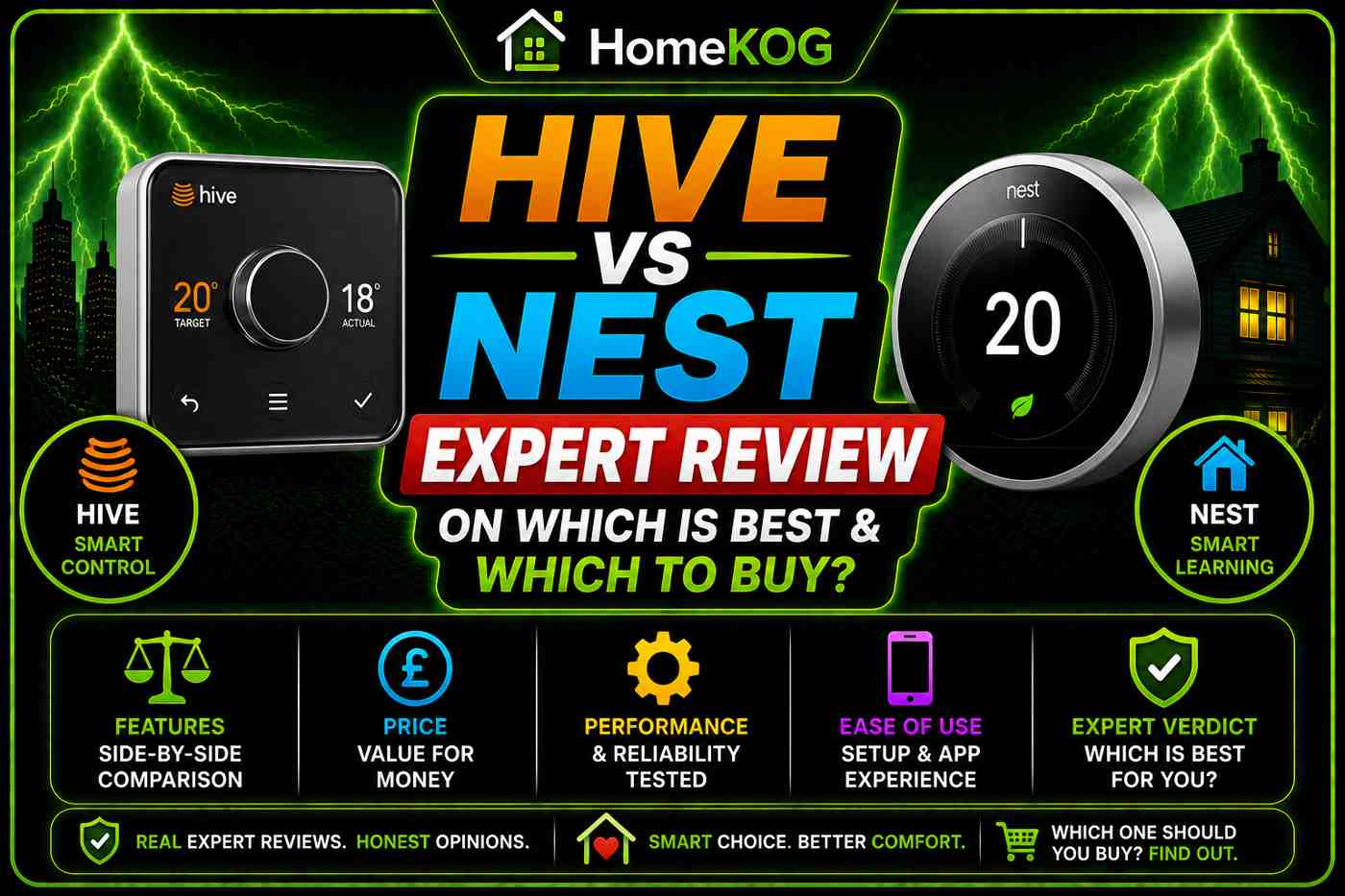
Hive and Nest are the two dominant smart thermostats in the UK market and between them account for the majority of smart heating installations in British homes. Hive is owned by Centrica and backed by British Gas’s engineer network. Nest is owned by Google and leads on intelligent features. Both connect to a boiler via a wireless receiver, are controlled by a smartphone app, and are compatible with Amazon Alexa and Google Home. The right choice depends on boiler compatibility, feature priorities, and whether self-installation or professional installation is preferred.
Do Smart Thermostats Lower Energy Bills?
Yes — and the savings are meaningful. Average savings from using a smart thermostat are reported at up to £154 per year, driven by more precise control of when heating runs and the elimination of energy waste in empty properties through geofencing. Over 1.67 million UK homes currently use smart thermostats, and research suggests that if all UK homes adopted them, the reduction in wasted heating could cut national CO2 emissions by up to 18.3 million tonnes per year. The geofencing function alone — preventing heating running in an empty property — is typically the single largest contributor to bill savings.

Hive vs Nest: Feature Comparison at a Glance
| Feature | Hive Active Heating 2nd Gen | Nest Learning Thermostat 3rd Gen |
|---|---|---|
| Price (self-install) | From £179 (£99 for British Gas customers) | From £199 |
| Professional installation | Approx £70 | Approx £80 |
| Design | Square, central dial, 3 buttons | Round, touchscreen, rotary dial |
| Power | 4 x AA batteries (2-year life) | Mains-powered (built-in rechargeable) |
| Self-learning | No | Yes |
| Motion sensor | Separate purchase | Built-in |
| Zones | Up to 3 | Up to 20 |
| Voice control | Yes | Yes |
| Smart device compatibility | Google Home, Alexa, Apple HomeKit | Google Home, Alexa, Apple HomeKit, Siri |
| GPS geofencing | Yes | Yes |
| Frost protection | Yes | Yes |
| Warranty | 1 year | 2–3 years |
| Family accounts | Shared login | Up to 10 separate accounts |
Features Both Thermostats Share
Remote and Voice Control
Both Hive and Nest allow full remote control of heating and hot water from anywhere in the world via a smartphone app. Both support voice commands through Amazon Alexa and Google Home, meaning the heating can be adjusted without touching a screen or button. Both use the IFTTT (if this, then that) logic framework for creating highly personalised automation rules.
GPS Geofencing
Both thermostats use the smartphone’s GPS to detect when the household has left and returned home, adjusting heating automatically at a set perimeter distance. This prevents the common energy waste of heating running on a fixed schedule in an empty property and is the feature that delivers the most consistent bill savings for households with variable daily schedules.
Frost Protection
Both include automatic frost protection that detects when the indoor temperature drops to a critical level and activates heating briefly to prevent pipe damage. This feature is particularly valuable for second homes, holiday properties, or any property left unoccupied during cold weather.
Data Security
Both brands operate multiple layers of encryption and data security to protect the household data their systems collect. The learning and geofencing features require sharing location and usage data, and both Hive and Nest are consistently updated to address emerging security vulnerabilities.
What Makes Nest Better
Self-Learning
The Nest Learning Thermostat monitors the household’s heating adjustments over the first week of use and builds a personalised schedule automatically. It refines the schedule continuously as patterns change with seasons, school terms, or work arrangements. This is Nest’s most distinctive feature and the one that most differentiates it from Hive — for households with consistent enough routines for the system to learn from, it eliminates manual programming entirely over time.
Built-in Motion Sensor and Farsight
Nest includes a built-in occupancy sensor that detects when the property is empty and enters an energy-saving mode automatically, without relying solely on GPS geofencing. The Farsight feature activates the thermostat display when the sensor detects someone entering the room, showing the current temperature, time, and weather at a glance without any interaction. Hive can replicate occupancy sensing but requires a separately purchased motion sensor to do so.
20-Zone Control
Nest supports up to 20 individual heating zones, allowing precise room-by-room temperature control across large properties. For smaller homes this distinction matters little, but for homes with four or more rooms where individual zone control is genuinely useful, Nest’s capacity far exceeds Hive’s maximum of 3 zones.
Wider Heating Compatibility
Nest is compatible with gas, oil, LPG, and electric boilers, air-source heat pumps, ground-source heat pumps, biomass boilers, and domestic hot water tanks with full OpenTherm temperature control. Hive covers gas, oil, LPG, and electric boilers and domestic hot water tanks — but hot water tank control is limited to on/off switching with no temperature control, and heat pumps are not supported. For homes with or planning heat pumps, Nest is the only option of the two.
Longer Warranty
Nest carries a 2 to 3-year warranty depending on the model. Hive provides a 1-year warranty. For a device integral to the home’s heating system, the longer warranty period is a meaningful practical advantage.
What Makes Hive Better
Battery-Powered Operation
Hive runs on 4 AA batteries with approximately 2 years of battery life. Nest requires a mains connection and carries only 1 to 2 hours of backup power during a power cut before it stops functioning. In a grid outage during cold weather, Hive continues to manage the heating while Nest does not. For households in areas prone to power interruptions, this is a significant practical advantage.
Lower Entry Price for British Gas Customers
Current or new British Gas customers can purchase the Hive Active Heating thermostat for £99 — a significant saving versus the standard retail price of £179 for self-installation. No equivalent discount applies to Nest. For British Gas customers, this pricing advantage is one of the most compelling reasons to choose Hive over Nest at similar feature levels for straightforward heating control. When considering options for smart home heating, tado smart thermostat usability features stand out thanks to their user-friendly interface and energy-saving capabilities. Additionally, tado offers unique geofencing technology that adapts settings based on your location, maximizing comfort and efficiency. This level of customization can provide a competitive edge over other smart thermostats in the market.
Simpler Setup for Less Tech-Confident Users
Hive’s interface — a central dial and three buttons — is more immediately familiar to users accustomed to traditional thermostats. The app is straightforward and while it lacks Nest’s automated learning, it provides clear manual control of heating and hot water schedules without requiring any period of adaptation. For households where one or more users are less comfortable with smart technology, Hive’s simplicity is a genuine benefit.
Boiler Compatibility
Both thermostats work with most modern gas, oil, LPG, and electric boilers. For standard combi boiler installations — the most common heating setup in UK homes — both will work without any compatibility issues on the following popular models. The Worcester Bosch 4000, Worcester Bosch 8000, Worcester Bosch 2000, Viessmann Vitodens 050-W, and Viessmann Vitodens 100-W are all confirmed compatible with both Hive and Nest. Always confirm compatibility with the specific boiler model via each manufacturer’s compatibility checker before purchasing.
The critical distinction is that Nest supports heat pumps and biomass boilers while Hive does not. Any household with a heat pump already installed, or planning to install one ahead of the 2035 gas boiler phaseout, should choose Nest to avoid replacing the thermostat when the heat source changes.
Design
Nest’s round glass-faced touchscreen with a metal rim is widely regarded as the most elegant thermostat design in the UK market and has received multiple design awards. Available in stainless steel, copper, black, and white, it suits both modern and traditional interior aesthetics. The rotary dial around the rim adjusts temperature and the device can be pushed to confirm settings.
Hive’s square format with a central dial and three buttons is available in dark grey with a choice of 12 coloured frames — providing more personalisation options than Nest in terms of matching room decor. It is wall-mounted or can sit on a freestanding base, giving slightly more placement flexibility than Nest’s wall-only mounting. Both designs are considerably more attractive than traditional programmable thermostats.
Installation
Both thermostats can be self-installed or professionally fitted. Each comes with two primary components — the thermostat itself and the receiver or heat link that connects to the boiler — plus instructions for wiring and app setup.
Nest connects to the mains, which provides continuous power but requires a mains connection at the installation point. The receiver, called the Heat Link, connects to the boiler’s standard wiring terminals and communicates wirelessly with the thermostat. Nest recommends professional installation but supports self-installation for confident DIYers.
Hive requires internal wall mounting and runs on batteries rather than mains power. The receiver, called simply the receiver, connects to the boiler terminals and communicates wirelessly with the thermostat. British Gas engineers are available to install Hive for approximately £70, and self-installation is supported with detailed in-box instructions.
When a new boiler is being installed, the most convenient and cost-effective approach is to add either thermostat to the installation order — the Gas Safe engineer installs the receiver, connects the thermostat, and completes the app setup as part of the boiler installation visit. For homeowners considering an upgrade, exploring boiler financing options for homeowners can make the process more manageable. Many suppliers offer tailored payment plans to suit different budgets, allowing families to invest in energy-efficient models without a large upfront cost. Additionally, these financing solutions often include warranties that provide peace of mind for new boiler installations.
Hive vs Nest: Verdict
Nest is the stronger technical choice for most UK homeowners in 2026 — more features at a comparable price, broader heating system compatibility including heat pumps, a longer warranty, and the self-learning capability that genuinely reduces heating waste without any manual programming effort. For larger homes needing more than 3 zones, Nest is the only practical option of the two.
Hive is the better choice for British Gas customers who access the £99 pricing, for households where battery-powered operation during power cuts is a priority, for users who prefer a simpler interface without a learning curve, or for those who only need basic remote on/off and scheduling control without advanced automation.
FAQ
Which is better for a UK home — Hive or Nest?
Nest offers more features for a similar price and is compatible with a wider range of heating systems including heat pumps. For most homeowners who want the most capable smart thermostat available, Nest is the stronger choice. For British Gas customers, homeowners who prefer simplicity, or those where battery-powered operation is important, Hive is a compelling and more straightforward alternative.
Can Hive and Nest work with any boiler?
Both work with most modern gas, oil, LPG, and electric boilers. Nest additionally supports air-source heat pumps, ground-source heat pumps, and biomass boilers. Hive does not support heat pumps. Always confirm compatibility with the specific boiler model via the manufacturer’s compatibility checker before purchasing either device.
How much can I save with a Hive or Nest thermostat?
Average savings are reported at up to £154 per year from more precise heating control and the elimination of energy waste through geofencing. Actual savings depend on how efficiently heating was previously managed — households that regularly left heating running on fixed schedules in empty properties will see the largest savings.
Does Nest work during a power cut?
No. Nest is mains-powered and carries only 1 to 2 hours of backup power in the built-in rechargeable battery before it stops functioning during a power cut. Hive runs on 4 AA batteries with approximately 2 years of battery life and continues operating normally during power interruptions.
Can I install Hive or Nest myself?
Yes, both support self-installation with detailed instructions included in the box. The process requires basic confidence with wiring — the receiver connects to the boiler’s existing thermostat wiring terminals. For homeowners not comfortable with wiring, professional installation costs approximately £70 for Hive and £80 for Nest. Both are also available with professional installation included when purchased alongside a new boiler installation.
How do I reset a Hive thermostat?
To reset a Hive thermostat, turn the wall outlet off and back on, wait a few minutes for the thermostat to reactivate, then refresh the Hive app. If the thermostat remains offline after this, contact Hive support — multi-zone systems in particular may require additional steps.
Which smart thermostat should I choose if I’m planning to get a heat pump?
Choose Nest. Hive is not compatible with heat pumps, while Nest supports both air-source and ground-source heat pumps as well as standard gas boilers. With the UK government’s target to phase out new gas boiler installations by 2035, choosing a thermostat that is already heat pump-compatible future-proofs the heating control investment regardless of when the heat source changes. When considering the best heat pump brands in the UK, it’s essential to evaluate efficiency ratings and customer reviews to ensure reliability. A well-chosen heat pump can significantly reduce energy costs and environmental impact. Additionally, investing in a reputable brand often comes with better support and warranty options, making it easier to maintain and operate your system over time.