
Alpha Boiler Error Codes: Full Guide to Causes and Fixes 2026
Quick Answer
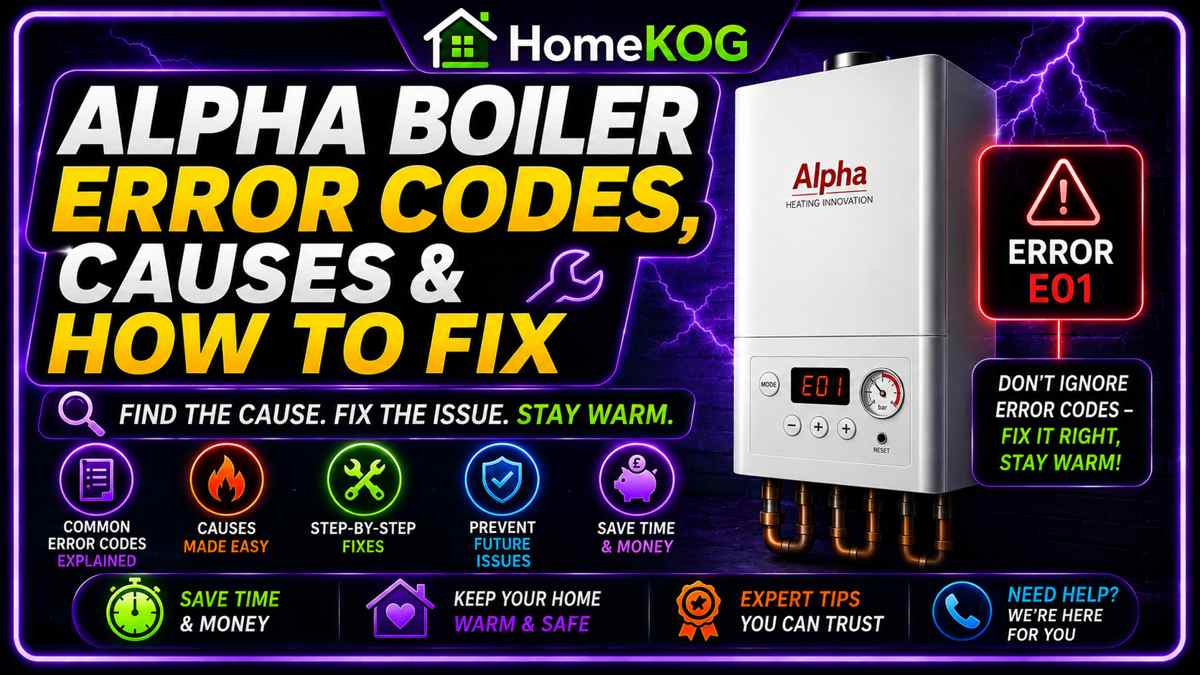
The most common Alpha boiler error codes are E10 (low system pressure), E01 (ignition failure), E20 (flame not detected), and E96 (fan fault or blocked flue).
E10 is the only fault most homeowners can resolve themselves, by repressurising the system above 0.6 bar. All other Alpha fault codes need the gas supply checked and, at most, one reset attempted before calling a Gas Safe registered engineer.
If you want to see how these reliability figures hold up in real owner experience, our alpha boiler performance ratings and reviews covers feedback on efficiency and long-term reliability from current Alpha owners.

Alpha is one of the most popular boiler brands in the UK, scoring 4.8 out of 5 on Trustpilot, the highest rating of any boiler manufacturer. Part of the Italian Immergas group, Alpha boilers are well regarded for reliability and value, but like all boilers they’ll develop faults over time.
Understanding what each error code means is the fastest way to decide whether a simple fix will restore heating and hot water, or whether a Gas Safe engineer needs to be called. Annual servicing by a Gas Safe engineer remains the most effective way to prevent Alpha fault codes appearing in the first place.
If you’re weighing Alpha against another brand before your next boiler purchase, our alpha boilers product comparisons looks at how Alpha stacks up against Worcester Bosch on price, warranty and efficiency.
Common Alpha Boiler Error Codes
E10 — Low System Pressure
The E10 fault code is the most commonly seen Alpha boiler error and means the system water pressure has dropped below 0.6 bar, the minimum required for the boiler to operate safely. It’s the only Alpha fault code most homeowners can resolve without a Gas Safe engineer.
Adding water to the system via the filling loop raises the pressure back to the required level and clears the E10 code in most cases. The method varies between Alpha models, and the boiler manual confirms the correct procedure and target pressure for the specific model. Most Alpha boilers need pressure restored to between 1 and 1.5 bar when cold.
A persistent or rapidly recurring E10 is more likely to indicate a leak somewhere in the central heating system than natural pressure loss. If pressure drops again shortly after being topped up, a Gas Safe engineer should locate and repair the leak rather than the homeowner continuing to repressurise the system repeatedly.
Can you fix it yourself? Yes, repressurise above 0.6 bar via the filling loop. Call an engineer if pressure drops repeatedly.
E01 — Ignition System Failure
The E01 code indicates a problem with the ignition system, most commonly that no flame was detected when the burner attempted to light. The boiler typically shuts down when E01 appears, to prevent unburned gas building up in the combustion chamber.
Checking the gas supply is the first step, confirming that other gas appliances in the property are working normally rules out a supply interruption. If the supply is fine and a single reset attempt doesn’t clear E01, the fault is most likely one of: damaged pressure tubes, a gap in the ignition electrode, a gap in the flame sensor electrode, a damaged ignition generator or lead, or an incorrect gas valve setting. All of these need a Gas Safe engineer to diagnose and repair.
Can you fix it yourself? Check gas supply and attempt one reset. Call a Gas Safe engineer if E01 persists.
E20 — Flame Not Detected
The E20 code is related to but distinct from E01. Where E01 covers a general ignition system failure, E20 specifically means the boiler’s flame sensing system can’t detect a flame, the boiler has attempted to fire but the flame detection electrode hasn’t confirmed a flame is present. The boiler shuts down as a safety measure to prevent a potentially dangerous build-up of unburned gas.
The causes of E20 are component-level faults within the flame detection circuit, a failed or contaminated flame sensing electrode, wiring damage between the electrode and the PCB, or a PCB fault, all of which need a Gas Safe engineer to inspect and resolve. As with E01, checking the gas supply before calling an engineer is a practical first step.
Can you fix it yourself? Check gas supply and attempt one reset. Call a Gas Safe engineer if E20 persists.
E96 — Faulty Fan or Blocked Flue
The E96 code means either a problem with the combustion fan or a blockage in the flue. Both scenarios need the boiler casing removed for inspection, which means a Gas Safe engineer must carry out the work. The fan controls combustion air supply and expels flue gases; a fan that isn’t running correctly stops the boiler firing safely, and a blocked flue creates a safety hazard by preventing flue gases from being expelled from the property.
If the boiler is near a wall where the external flue terminal could realistically have become blocked by debris, snow, or bird nesting material, checking whether the terminal is physically clear is a practical homeowner step before calling an engineer. If the terminal looks clear and E96 persists, a Gas Safe engineer should inspect the fan and internal flue components.
Can you fix it yourself? Check the external flue terminal is clear. Call a Gas Safe engineer if E96 persists.
Full Alpha Boiler Error Code Reference
| Code | Fault | DIY Fix? |
|---|---|---|
| 1 | Ignition system failure | Check gas supply, attempt reset, then engineer |
| 2 | Boiler overheat lockout | No, engineer required |
| 3 | Thermostat temperature too high | No, engineer required |
| 4 | Gas valve electrical connection fault | No, engineer required |
| 5 | Heating flow sensor fault | No, engineer required |
| 6 | Domestic hot water sensor fault | No, engineer required |
| 8 | Maximum resets threshold exceeded | No, engineer required |
| E10 | Low primary system pressure | Yes, repressurise above 0.6 bar |
| 12 | Cylinder sensor fault | No, engineer required |
| 15 | Internal wiring fault | No, engineer required |
| 16 | Faulty fan | No, engineer required |
| E20 | Flame sensing fault | Check gas supply, attempt reset, then engineer |
| 24 | Control panel button fault | No, engineer required |
| 25 | Overheat lockout | No, engineer required |
| 27 | Insufficient primary flow | No, engineer required |
| 29 | Flue sensor fault | No, engineer required |
| 31 | Communication lost with external control | Check external control power, then engineer |
| 37 | Supply voltage too low | Check consumer unit, contact electricity provider |
| 38 | Flame loss rectification | Attempt reset, engineer if recurring |
| 43 | Flame loss rectification | Attempt reset, engineer if recurring |
| 44 | Safety lockout | No, engineer required |
| 46 | External sensor intervention | No, engineer required |
| 47 | Burner output reduced | No, engineer required |
| E96 | Faulty fan or blocked flue | Check external flue terminal, then engineer |
Troubleshooting a Different Boiler Brand?
If you landed here searching for a fault code but your boiler isn’t an Alpha, the good news is that most brands follow a similar logic: pressure faults are usually DIY-fixable, ignition and sensor faults usually aren’t.
Our brand-specific guides cover the same ground for other manufacturers: Ariston boiler troubleshooting steps, Navien boiler error code troubleshooting, Biasi boiler error code meanings, keston boiler error code faqs, and Ferroli boiler error code solutions.
Fault Code Detail: Key Secondary Codes
Code 2 and Code 25 — Overheat Lockouts
Both codes mean the boiler has detected an overtemperature condition and entered lockout to prevent heat exchanger damage. Code 2 is triggered by the boiler’s primary overheat safety device, code 25 is a secondary overheat lockout.
The most common underlying causes are a pump failure reducing water circulation, an airlock in the heating circuit, or a closed radiator valve preventing adequate heat distribution. Both need a Gas Safe engineer to identify and resolve the cause before the lockout is reset, since repeatedly resetting an overheating boiler without addressing the cause risks progressive, expensive heat exchanger damage.
Code 3 — Thermostat Temperature Too High
Code 3 means the thermostat is reading a temperature above the safe operating range. This can be caused by a faulty thermostat reading incorrectly, a genuine overtemperature condition in the system, or a wiring fault between the thermostat and the PCB. A Gas Safe engineer should inspect the thermostat and its wiring before any components are replaced.
Code 4 — Gas Valve Electrical Connection Fault
Code 4 means an electrical fault in the connection between the boiler’s PCB and the gas valve. This can be caused by a wiring fault, a failed connector, or a gas valve with an internal electrical fault. As the gas valve controls fuel delivery to the burner, any fault with its electrical connection should be addressed by a Gas Safe engineer promptly. If your own boiler happens to be a Biasi rather than an Alpha, our Biasi boiler error code meanings guide covers the equivalent fault codes for that range.
Codes 5 and 6 — Sensor Faults
Code 5 means a fault with the heating flow sensor, which monitors the temperature of water entering the heating circuit. Code 6 means a fault with the domestic hot water sensor. Both sensors monitor water temperature at key points, and their failure can cause the boiler to misread temperatures and shut down. Sensor replacement is typically an inexpensive repair when the component has genuinely failed, and the engineer should check the wiring first, since a disconnection can produce the same code.
Code 8 — Maximum Resets Exceeded
Code 8 appears when the boiler has been reset more times than its permitted threshold within a given period. This is a safety feature that stops the boiler being repeatedly forced into operation when an underlying fault is causing it to lock out. A Gas Safe engineer should identify and resolve the underlying fault that has been triggering the repeated lockouts before the boiler is returned to service.
Code 12 — Cylinder Sensor Fault
Code 12 means a fault with the hot water cylinder sensor, which applies to Alpha boilers installed as part of a system with a hot water storage cylinder. A failed cylinder sensor stops the boiler correctly managing hot water temperature. Sensor replacement by a Gas Safe engineer is required.
Code 15 — Internal Wiring Fault
Code 15 means a wiring fault within the boiler’s internal electrical system. Wiring faults need a Gas Safe engineer to trace and repair systematically, since incorrect wiring can affect multiple components and is difficult to locate without specialist testing equipment. If you’re troubleshooting a Keston or Ferroli boiler instead, our keston boiler error code faqs and Ferroli boiler error code solutions cover the equivalent codes for those ranges.
Code 16 — Faulty Fan
Code 16 is the direct fan fault code, where the fan has been confirmed as the failing component rather than the broader E96 diagnosis that covers both fan and flue causes. Fan replacement or repair must be carried out by a Gas Safe engineer.
Code 27 — Insufficient Primary Flow
Code 27 means water flow through the primary heating circuit is below the minimum required level. The most common causes are a failing or seized pump, an airlock, or a system blockage. A Gas Safe engineer should inspect the pump and full heating circuit before recommending repair or replacement of specific components.
Code 29 — Flue Sensor Fault
Code 29 means a fault with the flue sensor, which monitors flue gas temperatures as a safety measure. A failed flue sensor stops the boiler confirming safe flue gas expulsion and will cause a lockout. Sensor replacement by a Gas Safe engineer is required, and the engineer should also inspect the flue system to confirm there’s no underlying condition that caused the sensor failure.
Code 31 — Communication Lost with External Control
Code 31 appears when the boiler loses communication with an external control device such as a smart thermostat or programmer. Checking that the external control has power, including replacing batteries on wireless devices, is a practical homeowner step before calling an engineer. If the external control has power and communication is still lost, a Gas Safe engineer should inspect the wiring between the control and the boiler.
Code 37 — Supply Voltage Too Low
Code 37 means the electrical supply to the boiler is below the required voltage. This isn’t a boiler fault, it points to an issue with the property’s mains electricity supply. Checking the consumer unit for tripped breakers and contacting the electricity network operator if the supply looks abnormal are the right first steps.
Codes 38 and 43 — Flame Loss Rectification
Both codes mean the boiler has detected flame loss and is attempting to rectify the situation automatically. A single reset attempt is appropriate for both. If either code returns after resetting, the underlying cause, which may be a gas supply interruption, a failing gas valve, or a deteriorating flame detection electrode, needs a Gas Safe engineer to investigate.
Code 44 — Safety Lockout
Code 44 is a general safety lockout meaning the boiler has detected a condition that could be dangerous and has shut down as a precaution. Because the specific cause isn’t identified by the code itself, a Gas Safe engineer should carry out a full inspection before any reset is attempted.
Code 46 — External Sensor Intervention
Code 46 means an external sensor, such as a frost thermostat or outdoor temperature sensor, has triggered the boiler to modify or shut down its operation. Checking whether frost protection has been activated by genuinely cold conditions is a practical first check. If conditions don’t warrant a frost protection activation, the external sensor or its wiring may be faulty and a Gas Safe engineer should investigate.
Code 47 — Burner Output Reduced
Code 47 means the boiler has automatically reduced its burner output, typically in response to a detected fault or condition preventing full output being delivered safely. Understanding system boiler operation explained can help homeowners recognise when their heating isn’t performing as it should. A Gas Safe engineer should identify what’s caused the output reduction before the boiler is expected to deliver full heating performance again.
FAQ
What does the Alpha boiler E10 fault code mean?
The Alpha boiler E10 fault code means the system water pressure has dropped below 0.6 bar, the minimum required for safe operation. It’s the most common Alpha fault code and the only one most homeowners can resolve themselves.
Adding water to the system via the filling loop to restore pressure to between 1 and 1.5 bar clears E10 in most cases. If pressure drops again shortly after topping up, a leak in the central heating system is the likely cause, and a Gas Safe engineer should investigate.
What is the Alpha boiler E01 fault code?
The Alpha E01 fault code means an ignition system failure, the boiler attempted to light the burner and no flame was detected. The most common causes are a gas supply interruption, a gap in the ignition or flame sensor electrode, damaged pressure tubes, a faulty ignition generator, or an incorrect gas valve setting.
Confirming the gas supply is active and attempting one reset is the first step. If E01 persists after one reset, a Gas Safe engineer should inspect all components in the ignition system.
Can I fix Alpha boiler faults myself?
E10 is the only Alpha fault code most homeowners can resolve themselves, by repressurising the system above 0.6 bar via the filling loop. Checking the gas supply and attempting a single reset is appropriate for E01, E20, and codes 38 and 43 before calling an engineer.
Checking the external flue terminal is clear is a practical first step for E96. Code 31 is worth checking the external control has power for before calling an engineer, and code 37 is worth checking the consumer unit for. All other Alpha fault codes need a Gas Safe registered engineer.
What does the Alpha E96 fault code mean?
The Alpha E96 fault code means either a faulty fan or a blockage in the flue system, both of which need the boiler casing removed for proper inspection. The fan controls combustion air supply and flue gas exhaust, and a fault with either the fan or the flue prevents safe boiler operation.
Checking whether the external flue terminal is physically blocked is a worthwhile homeowner check. If the terminal is clear and E96 persists, a Gas Safe engineer should inspect the fan motor, fan wiring, and internal flue components.
Why does my Alpha boiler keep showing E10?
A recurring E10 code that returns shortly after the system has been repressurised means there’s a leak somewhere in the central heating system causing ongoing pressure loss. The leak may be very small, producing no obvious wet patch or dripping, but even a very slow leak will cause the pressure to drop below 0.6 bar over time.
A Gas Safe engineer should carry out a system pressure test to locate the source of the leak and repair it. Continuing to repressurise the system repeatedly without addressing the underlying leak isn’t an effective long-term solution.
How do I reset an Alpha boiler?
The reset procedure varies between Alpha models. The boiler manual for your specific model confirms the correct method, available as a free PDF download from Alpha’s own site. On most Alpha boilers, reset is performed by pressing and holding the reset button on the control panel until the boiler attempts to restart.
A single reset attempt is appropriate for most Alpha fault codes as a first step. If the fault code returns after one reset, a Gas Safe engineer should identify and repair the underlying cause rather than the homeowner continuing to reset.
When should I replace my Alpha boiler rather than repair it?
An Alpha boiler under 10 years old with a single fault is almost always worth repairing. For boilers over 10 to 12 years old where multiple faults are recurring, or where a major component such as the PCB or heat exchanger needs replacing at a cost exceeding 50% of a new boiler installation, replacement is likely the better long-term investment.
The Alpha E-Tec Plus range comes with a 10-year standard warranty, extendable to 13 years with the Premier Pack Plus, one of the longest out-of-the-box warranties on any UK boiler, making it a straightforward replacement for an ageing Alpha or competing brand boiler. Our guide to alpha boiler lifespan expectations covers how maintenance history and servicing affect how long you can realistically expect a unit to last.
Who can I contact if a fault code isn’t in this guide?
Alpha’s technical support team can be reached through their customer support pages, where model-specific manuals and full fault code lists are available as free downloads. It’s worth having your model number and Gas Council (GC) number to hand, both are printed on the boiler’s data badge, since fault code numbering can vary slightly between older and newer Alpha ranges.
Conclusion
Alpha’s fault code system covers the full range of faults across the E-Tec, Eco, InTec, and other models in the range. Of all the codes in this guide, E10 is the only one most homeowners can resolve independently by repressurising the system.
Checking the gas supply and attempting a single reset is appropriate for E01 and E20 before calling an engineer, and checking the external flue terminal for E96 may save an unnecessary call-out in cases where the terminal has become physically blocked.
For all other Alpha fault codes, and particularly the overheat lockouts (codes 2 and 25), the safety lockout (code 44), and the internal wiring fault (code 15), a Gas Safe registered engineer should be called without attempting a reset first. You can confirm any engineer’s registration at gassaferegister.co.uk before they start work.
Annual servicing by a Gas Safe engineer remains the most effective way to prevent Alpha fault codes, keep the boiler running at its rated efficiency, and maintain the manufacturer’s warranty throughout the boiler’s operational life.