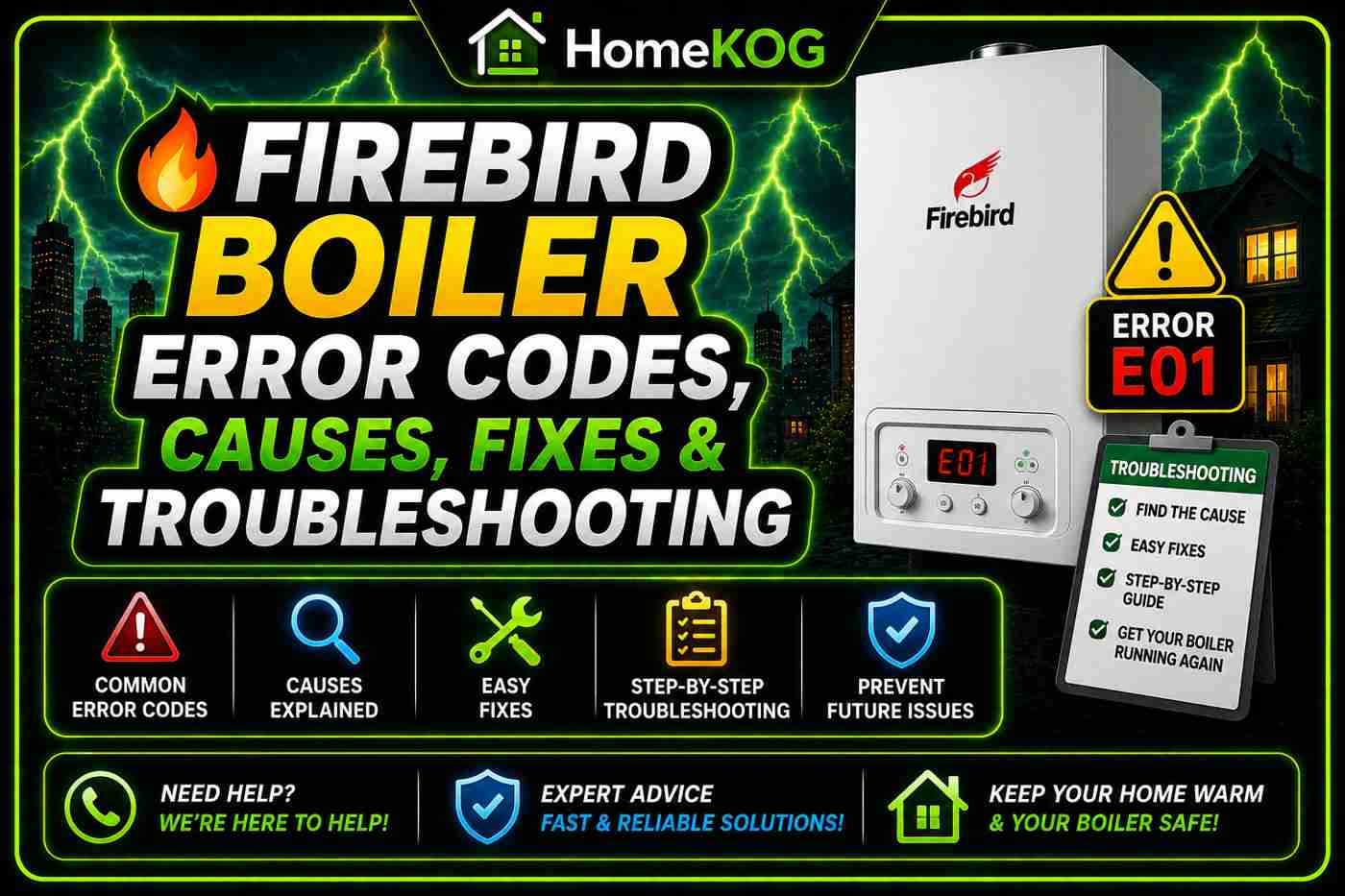

Firebird Boiler Error Codes: Causes, Fixes and Troubleshooting Guide 2026
Quick Answer: Firebird boilers use four error codes — E1 (control thermistor fault), E2 and E3 (flue thermistor faults), and E5 (burner fault which may cause lockout). The E5 code has several possible causes, some of which homeowners can address themselves including low pressure, a frozen condensate pipe, and a water leak. E1, E2, and E3 all require an OFTEC-registered engineer for oil boilers or a Gas Safe engineer for gas models.
Firebird is an Irish manufacturer with a long track record in oil-fired central heating boilers, producing a range of combi, system, and regular boiler types across their Enviromax and Xcel ranges. When something goes wrong, Firebird keeps the fault code system deliberately simple — just four codes cover the full range of faults that the control system can display. This guide explains what each code means, what typically causes it, and what action to take.
Firebird Boiler Lockout: What It Is and Why It Happens
A boiler lockout is a safety shutdown that occurs when the boiler’s control system detects that the appliance is operating outside safe parameters. Firebird boilers enter lockout mode when pressure is too high or too low, when fuel supply is insufficient or absent, when a system blockage is detected, or when the electrical supply is interrupted or unstable.
When a lockout occurs, the boiler shuts down entirely and will not restart until the underlying cause has been identified and resolved. The error code displayed on the control panel at the point of lockout is the fastest way to establish what triggered the shutdown and whether it can be resolved by the homeowner or requires a qualified engineer. Always check the display panel first before calling out an engineer, as some lockouts have straightforward DIY solutions. If the error code pertains to a common issue, follow the warmflow boiler error troubleshooting steps to diagnose the problem. These steps can often save time and money, allowing for a quick resolution right at home. However, if the problem persists or the error code indicates a more serious issue, it is advisable to contact a qualified heating engineer for further assistance.

Firebird Boiler Error Codes Explained
E1 — Control Thermistor Fault
The E1 code indicates a fault with the control thermistor — the sensor that works alongside the boiler’s temperature potentiometer and printed circuit board to determine the correct amount of fuel needed to bring water to the required temperature. All three components work together to regulate heat output, and a fault in the thermistor disrupts this control loop and can cause the boiler to overheat, underheat, or shut down entirely.
The most common causes of an E1 fault are scale deposits accumulating on the thermistor — particularly in hard water areas where limescale builds up rapidly on internal components — and water ingress into the thermistor housing or its connecting wiring. Both scenarios affect the thermistor’s ability to accurately sense temperature, and neither can be properly inspected or resolved without accessing the boiler’s internal components.
Because the E1 requires internal inspection of the control system, a qualified engineer must carry out the diagnosis and repair. For oil-fired Firebird boilers, this must be an OFTEC-registered engineer. For any gas variants, a Gas Safe registered engineer is required.
Can you fix it yourself? No — an OFTEC or Gas Safe engineer is required depending on the fuel type.
E2 — Flue Thermistor Fault
The E2 code indicates a fault with the flue thermistor, which monitors the temperature of gases as they pass through the flue system. The flue thermistor plays a safety role by confirming that flue gases are being expelled at an appropriate temperature — if they are too hot, it can indicate combustion problems or heat exchanger issues, and if they are too cold, it may indicate incomplete combustion.
A failed or incorrectly reading flue thermistor will cause the boiler to shut down as a precaution, as the control system can no longer confirm that flue gas temperatures are within safe parameters. Thermistor replacement is typically an inexpensive repair when the component itself has failed, but the engineer should also inspect the flue and heat exchanger to confirm there is no underlying condition that caused the thermistor to fail. Proper maintenance of the boiler flue is essential for ensuring safety and efficiency. A boiler flue installation compliance checklist should be followed to guarantee that all components meet regulatory standards, thereby preventing potential hazards. Regular inspections according to this checklist can help identify issues before they escalate, ensuring a reliable heating system.
Can you fix it yourself? No — an OFTEC or Gas Safe engineer is required.
E3 — Flue Thermistor Fault (Variant)
The E3 code indicates the same category of fault as E2 — a problem with the flue thermistor system. On certain Firebird models and control board configurations the E3 may refer to a different thermistor position within the flue circuit or a variant reading from the same sensor, but the diagnosis and resolution process is the same as for E2. An engineer should inspect the flue thermistor, its wiring, and the flue itself before replacing any components.
Can you fix it yourself? No — an OFTEC or Gas Safe engineer is required.
E5 — Burner Fault (Possible Lockout)
The E5 is the most commonly seen Firebird fault code and covers a broader range of underlying causes than the other three codes. It indicates a problem with the boiler’s burner, but the cause may be mechanical, pressure-related, or environmental — and not all causes require an engineer’s visit. Working through the possible causes in order from simplest to most complex is the most efficient approach.
Low Boiler Pressure
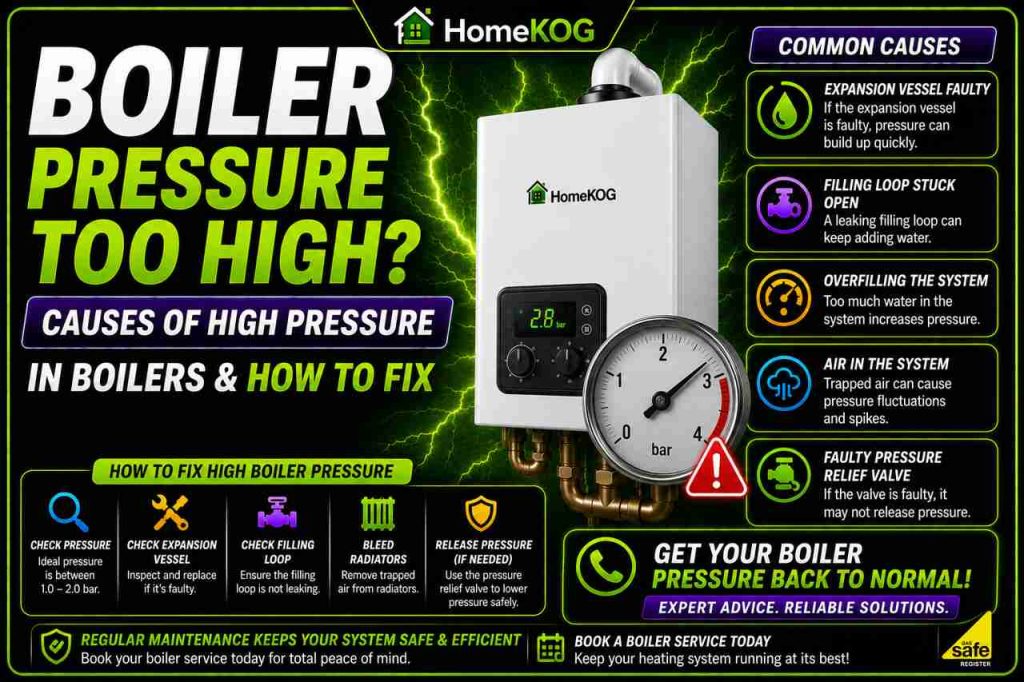
If the system pressure gauge reads below 0.5 bar, low pressure is the most likely cause of the E5 fault and the most straightforward to resolve. Adding water to the system via the filling loop — as detailed in the boiler’s instruction manual — to restore pressure to the manufacturer’s recommended level will resolve the fault in this case without any engineer involvement. Once pressure is restored, attempt to restart the boiler and check that the E5 code has cleared.
If pressure drops again shortly after being restored, a slow leak is present in the system and an engineer should locate and repair the source rather than the homeowner continuing to top up the pressure as a temporary measure.
Frozen Condensate Pipe
During cold weather, the condensate pipe — which carries acidic wastewater produced during condensing boiler operation to an external drain — can freeze solid. Firebird combi boilers can produce two to three litres of condensate water per hour of operation, and that water will freeze rapidly in the pipe if external temperatures fall below zero and the pipe is exposed or inadequately lagged.
A frozen condensate pipe causes the burner to shut down as a safety measure, triggering the E5 code. This is one of the most straightforward DIY fixes available — pouring warm water gently along the length of the external condensate pipe until the ice melts is all that is required. Do not use boiling water as this can crack the plastic pipe. Once thawed, press the reset button and the boiler should restart normally.
Lagging the external section of the condensate pipe with foam pipe insulation after thawing is a worthwhile precaution that prevents the same fault from recurring in future cold spells.
Water Leak
A water leak anywhere in the central heating system can contribute to an E5 fault by causing pressure to drop below operating parameters or by affecting components the water contacts. If a leak is suspected or visible, the boiler should be switched off immediately and the mains water supply isolated at the stopcock before any further investigation.
Even a very small leak — one that produces no obvious dripping or wet patch — can cause significant problems over time, including corrosion of internal components and progressive pressure loss. An engineer should locate and repair the source of any confirmed or suspected leak before the boiler is returned to service. Do not restart a leaking boiler.
Other Causes Requiring an Engineer
If none of the above causes apply and the E5 fault persists after a reset attempt, the burner fault has a mechanical or electrical origin that requires professional diagnosis. A faulty ignition electrode, a failed oil pump, a blocked burner nozzle, or a problem with the gas valve on gas models are all potential causes that an OFTEC or Gas Safe engineer should investigate and resolve.
Can you fix it yourself? Partially — check and restore pressure if below 0.5 bar, thaw a frozen condensate pipe if temperatures have been below zero, and isolate a water leak immediately. All other E5 causes require a qualified engineer.
Full Firebird Error Code Reference Table
| Code | Fault | DIY Fix? |
|---|---|---|
| E1 | Control thermistor fault | No — OFTEC or Gas Safe engineer required |
| E2 | Flue thermistor fault | No — OFTEC or Gas Safe engineer required |
| E3 | Flue thermistor fault (variant) | No — OFTEC or Gas Safe engineer required |
| E5 | Burner fault / possible lockout | Partial — check pressure, condensate pipe, and leaks first |
FAQ
What does the Firebird E5 fault code mean?
The Firebird E5 fault code indicates a problem with the burner that has either caused or risks causing a boiler lockout. It is the most commonly seen Firebird error code and can be triggered by several different causes including low system pressure, a frozen condensate pipe, a water leak reducing pressure, or a mechanical fault within the burner itself. Low pressure and a frozen condensate pipe can be resolved by the homeowner without calling an engineer. A water leak requires the boiler to be switched off immediately and an engineer contacted. Any other cause of E5 requires an OFTEC or Gas Safe engineer to diagnose and repair.
Can I fix a Firebird boiler fault myself?
Some Firebird E5 fault causes can be resolved by the homeowner. Repressurising the system via the filling loop when pressure has dropped below 0.5 bar, and thawing a frozen condensate pipe by pouring warm water along its external length, are both straightforward DIY fixes that can restore the boiler to operation without a call-out charge. The E1, E2, and E3 codes all require an engineer, as do any E5 faults caused by mechanical or electrical component failure within the burner.
How do I fix a frozen condensate pipe on a Firebird boiler?
A frozen condensate pipe on a Firebird boiler can be thawed by pouring warm water gently along the external section of the pipe until the ice blockage melts. Warm water rather than boiling water should always be used, as the high temperature of boiling water can crack or deform the plastic pipe. Once the pipe is clear, press the boiler’s reset button to attempt a restart — the E5 code should clear and the boiler should return to normal operation. Fitting foam pipe insulation around any exposed external section of the condensate pipe after thawing is the most effective way to prevent the fault from recurring during future cold weather.
What causes the Firebird E1 fault code?
The Firebird E1 fault code is caused by a fault with the control thermistor, most commonly due to limescale deposits accumulating on the sensor surface in hard water areas or water ingress into the thermistor housing or wiring. The thermistor works alongside the temperature potentiometer and PCB to control fuel delivery, and a faulty or incorrectly reading thermistor disrupts this control loop. An OFTEC engineer for oil boilers or a Gas Safe engineer for gas variants must inspect and replace the thermistor and check for any underlying cause of the failure.
Do I need an OFTEC engineer for Firebird boiler repairs?
Yes, if the Firebird boiler is an oil-fired model — which covers the majority of the Firebird range including the Enviromax and Xcel series — all servicing, maintenance, and repairs must be carried out by an OFTEC-registered engineer. OFTEC is the registration body for oil heating technicians, equivalent to Gas Safe for gas appliances. Using an unregistered person to work on an oil boiler is illegal, creates serious safety risks, and will invalidate the boiler’s warranty. OFTEC-registered engineers can be found using the technician finder on the OFTEC website.
How often should a Firebird boiler be serviced?
A Firebird boiler should be serviced annually by an OFTEC-registered engineer for oil models. Annual servicing is the most effective way to prevent fault codes from appearing, as it includes cleaning the burner nozzle and ignition components, checking the oil supply and pressure, inspecting the flue and thermistors, testing all safety devices, and identifying any components approaching the end of their service life. Many of the most common Firebird fault codes — including E1, E2, and recurring E5 faults — are directly preventable through regular professional maintenance.
When should I replace a Firebird boiler rather than repair it?
A Firebird boiler under 10 years old with a single straightforward fault is almost always worth repairing. For boilers over 10 to 12 years old with recurring fault codes, multiple component failures, or where a major repair such as PCB or heat exchanger replacement costs more than 50% of a new boiler installation, replacement is likely the more economical long-term decision. A modern A-rated oil boiler replacement will deliver meaningful running cost savings compared to an ageing less efficient model, and an OFTEC engineer can provide an honest assessment of whether repair or replacement represents the better investment for a specific boiler’s age and condition. When considering a replacement, homeowners should explore various boiler financing options for homeowners that can make the transition more affordable. These options can help spread the cost over time, ensuring that the upfront expense of a new, high-efficiency boiler is manageable. Additionally, investing in a new boiler with the right financing can lead to lower energy bills and increased comfort in the home.
Conclusion
Firebird’s four-code fault system is one of the simplest in the boiler market and makes initial diagnosis straightforward for both homeowners and engineers. The E5 code is the one most likely to be resolved without professional help — low pressure, a frozen condensate pipe, and an isolated water leak all have clear DIY responses that can restore heating and hot water quickly without a call-out charge. The E1, E2, and E3 codes, by contrast, all require a qualified engineer to inspect and repair internal components safely.
Annual servicing by an OFTEC-registered engineer for oil Firebird boilers is the most reliable way to keep the system running without unexpected fault codes, catch developing component faults before they cause a lockout, and maintain the boiler’s efficiency throughout its operational life. For boilers where repair costs are escalating or recurring faults are becoming the norm, a new A-rated replacement will deliver better long-term reliability and lower running costs from the day of installation.