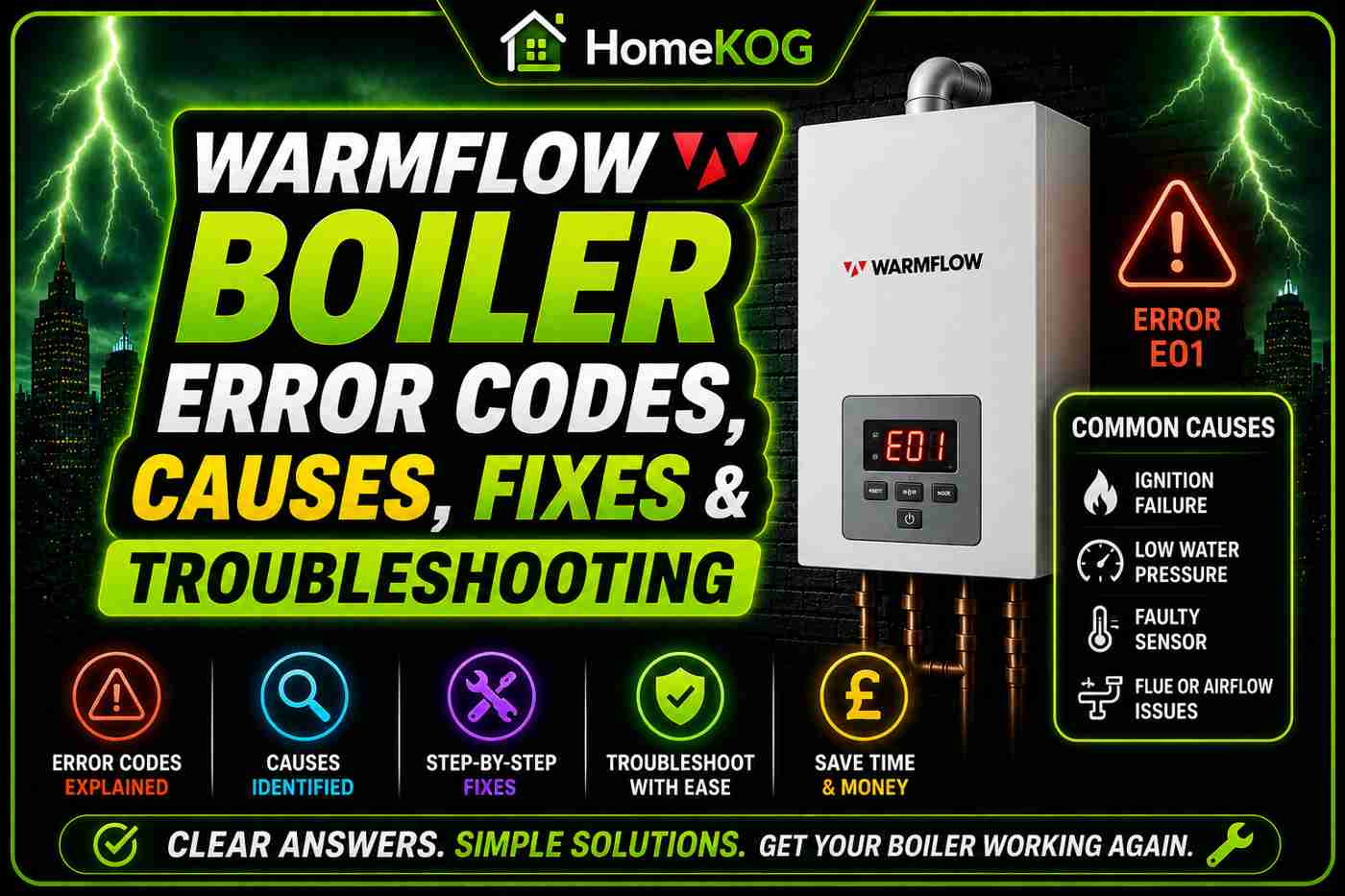

Warmflow Boiler Error Codes: Causes, Fixes and Troubleshooting Guide 2026
Quick Answer: The most common Warmflow boiler error codes are E01 (no flame detected), E02 (safety thermostat tripped), E03 (flue thermofuse tripped), and H20 (low system pressure). H20 is the only fault code on this list that most homeowners can resolve themselves by repressurising the system via the filling loop. All other codes require an inspection by a qualified OFTEC-registered oil boiler engineer. In addition to Warmflow, understanding Ravenheat boiler error code meanings can also help homeowners identify issues before they escalate. Familiarizing yourself with these codes equips you with the knowledge to communicate effectively with a technician if needed. Regular maintenance can reduce the frequency of such errors and prolong the life of your heating system.
Warmflow is a Northern Irish manufacturer of oil-fired boilers with a strong reputation in the UK and Irish markets. Like all boilers, Warmflow units use a fault code system to communicate what has gone wrong and help homeowners and engineers identify the source of the problem quickly. Understanding what each code means helps you decide whether a call-out is required immediately, whether a simple DIY fix will restore operation, or whether a replacement boiler is the more economical path forward.
Common Warmflow Boiler Fault Codes
E01 — No Flame Detected
The E01 fault code appears when the boiler’s control system cannot detect a flame during the start-up sequence. When this code is active the red reset button on the boiler’s control panel will be illuminated. The most common cause is insufficient fuel reaching the burner, but the fault can also be triggered by a failed ignition electrode, a blocked burner nozzle, or a fault with the photocell sensor that detects the flame.
The first step is to check the oil supply. Confirm that the oil tank has adequate fuel, that the supply valve is fully open, and that there are no blockages in the oil feed line. If the fuel supply appears normal, pressing the reset button once will attempt a restart. Warmflow allows up to two reset attempts before the boiler locks out permanently until an engineer investigates. If two resets do not restore the flame, a qualified OFTEC-registered engineer should carry out a full inspection of the burner, ignition system, and fuel delivery components.
Can you fix it yourself? Check the fuel supply and attempt up to two resets. If the fault persists, call an OFTEC engineer.
E02 — Safety Thermostat Tripped
The E02 code means the boiler’s safety thermostat has activated at 95°C, shutting down the boiler to prevent overheating damage to internal components. This protection mechanism is designed to activate before the boiler reaches a temperature that could cause serious damage to the heat exchanger or other parts.
The cause may be a genuine overheating event — often triggered by poor water circulation, a blocked or closed radiator valve, or a failing pump — or it may indicate a faulty thermostat that is tripping at a lower temperature than intended. In either case the underlying cause needs to be identified before the boiler is restarted, as repeatedly resetting an overheating boiler without establishing why it is overheating can cause progressive heat exchanger damage that is expensive to repair. An OFTEC-registered engineer should inspect the system before the boiler is returned to service. In some cases, radiator heating issues in winter can stem from air trapped in the system, which can hinder effective heating. This can often be resolved by bleeding the radiators to release the trapped air, ensuring that hot water can circulate freely. Additionally, regular maintenance checks can help prevent these issues from arising, providing peace of mind during the coldest months.
Can you fix it yourself? No. An OFTEC engineer must inspect and clear the fault.
E03 — Flue Thermofuse Tripped
The E03 fault code indicates that the flue thermofuse has tripped. The thermofuse is a safety device designed to shut the boiler down if it detects excessive heat in the flue, which can indicate heat exchanger damage or a blockage preventing proper flue gas exhaust. It acts as a last line of defence against operating the boiler in a condition that could be dangerous or cause irreversible internal damage. Proper maintenance and adherence to boiler flue installation requirements are essential for ensuring the safe operation of the system. Regular inspections and compliance with local regulations can prevent issues that lead to safety hazards or costly repairs. By understanding the necessary standards for installation, homeowners can contribute to the longevity and reliability of their heating systems.
As with the E02, the E03 may indicate either a genuine flue or heat exchanger fault or a thermofuse that has failed and is tripping without a genuine overheat condition present. The distinction between the two cannot be established without a professional inspection. An OFTEC-registered engineer should assess the flue, heat exchanger, and thermofuse before the boiler is restarted.
Can you fix it yourself? No. An OFTEC engineer must inspect and clear the fault.
H20 — Low System Pressure
The H20 fault code is the most straightforward on this list and is the only Warmflow fault that most homeowners can resolve without calling out an engineer. It indicates that the system water pressure has dropped below the minimum threshold required for safe and effective operation. Low pressure is commonly caused by a small leak in the system, natural pressure loss over time, or a recent radiator bleed.
To resolve the H20 fault, attach the flexible filling loop to the system and open the valve slowly while watching the pressure gauge on the front of the boiler. Fill until the gauge reads 1 bar with the boiler cold, then close the valve fully before removing the filling loop. A small amount of water at the point of disconnection is normal and will stop quickly. Once pressure is restored, the boiler should restart without requiring a reset.
How often should pressure need topping up? A small pressure drop is normal in the first week of operation after a new installation and the gauge should be checked daily during this period. After the initial settling period, monthly checks are sufficient for a system without an underlying leak. During normal operation the pressure will rise to approximately 2.5 bar as the system heats up — this is expected and requires no action. If pressure drops persistently despite regular topping up, a leak is almost certainly present and an engineer should locate and repair it.
Can you fix it yourself? Yes. Repressurise via the filling loop to 1 bar cold. If pressure drops repeatedly, call an engineer to investigate the underlying cause.
E05 — Heating Sensor Fault
The E05 code indicates a fault with the heating sensor, which monitors the temperature of the water in the central heating circuit. A failed or incorrectly reading sensor can cause the boiler to behave erratically — failing to reach the set temperature, overheating, or locking out unexpectedly. Sensor replacement is a straightforward job for a qualified engineer and is typically an inexpensive repair.
Can you fix it yourself? No. An OFTEC engineer should replace the sensor.
E16 — Parameter Programming Request
The E16 code is not a fault in the conventional sense — it indicates that the boiler’s control system requires parameter programming. This typically appears after a power reset or control board replacement and means the boiler’s settings need to be reconfigured by an engineer using the manufacturer’s commissioning procedure. The boiler may not operate until the programming is completed.
Can you fix it yourself? No. An OFTEC engineer familiar with Warmflow commissioning should carry out the programming.
E22 — Fan Fault
The E22 code indicates a fault with the boiler’s fan, which is responsible for drawing combustion air into the burner and expelling flue gases safely from the property. A fan that is not running correctly will prevent the boiler from firing as a safety measure, since operating without adequate combustion air or flue exhaust would be dangerous.
Fan faults can be caused by a failed motor, a wiring fault between the fan and the control board, or physical obstruction of the fan blades. Component replacement is required in most cases and must be carried out by a qualified engineer.
Can you fix it yourself? No. An OFTEC engineer should inspect and replace the fan if necessary.
E35 — Ionisation Electrode Fault
The E35 code indicates a fault with the ionisation electrode, which is the component responsible for detecting whether a flame is present during and after the ignition sequence. If the electrode is dirty, damaged, or incorrectly positioned, the boiler’s control system cannot confirm flame presence and will shut down as a safety precaution even if the burner has actually ignited.
Ionisation electrode cleaning or replacement is a standard part of an annual oil boiler service and is one of the most common maintenance tasks on oil-fired appliances. If an E35 appears between services, accelerated contamination of the electrode by incomplete combustion or oil residue is the most likely cause.
Can you fix it yourself? No. An OFTEC engineer should inspect and service or replace the electrode.
E42 — Fan PCB Fault
The E42 code indicates a fault with the fan’s printed circuit board rather than the fan motor itself. The fan PCB controls the fan’s operation and communicates with the main boiler control board — a fault here can prevent the fan from running at all or cause it to operate incorrectly. PCB replacement requires a qualified engineer and the correct replacement part for the specific Warmflow model.
Can you fix it yourself? No. An OFTEC engineer should diagnose and replace the faulty PCB.
Full Warmflow Error Code Reference Table
| Code | Fault | DIY Fix? |
|---|---|---|
| E01 | No flame detected during start-up | Partial — check fuel supply, attempt two resets |
| E02 | Safety thermostat tripped at 95°C | No — OFTEC engineer required |
| E03 | Flue thermofuse tripped | No — OFTEC engineer required |
| H20 | Low system pressure | Yes — repressurise to 1 bar cold |
| E05 | Heating sensor fault | No — OFTEC engineer required |
| E16 | Parameter programming request | No — OFTEC commissioning required |
| E22 | Fan fault | No — OFTEC engineer required |
| E35 | Ionisation electrode fault | No — OFTEC engineer required |
| E42 | Fan PCB fault | No — OFTEC engineer required |
When to Consider a Boiler Replacement
If the repair cost for a Warmflow fault is approaching or exceeding 50% of the cost of a new boiler installation, replacement is usually the more economical long-term decision — particularly if the boiler is over 10 years old and has a history of repeated faults. Heat exchanger failure, multiple PCB faults, and recurring E01 or E35 codes on an older boiler are the scenarios most likely to tip the balance towards replacement rather than repair.
An OFTEC-registered engineer can give an honest assessment of whether the boiler is worth repairing based on its age, condition, and the nature of the fault, and can advise on the most cost-effective path forward for the specific situation.
FAQ
What does the Warmflow E01 fault code mean?
The Warmflow E01 fault code means the boiler’s control system detected no flame during the start-up sequence. The most common cause is a fuel supply issue — insufficient oil in the tank, a closed supply valve, or a blockage in the feed line. It can also be caused by a failed ignition electrode, a faulty photocell, or a blocked burner nozzle. Check the oil supply first and attempt up to two resets using the red reset button. If two resets do not restore the flame, an OFTEC-registered engineer should carry out a full inspection of the ignition and fuel delivery system.
Can I fix Warmflow boiler faults myself?
The H20 low pressure fault is the only Warmflow fault code that most homeowners can resolve themselves, by repressurising the system via the filling loop to 1 bar with the boiler cold. All other fault codes — including E01, E02, E03, E05, E16, E22, E35, and E42 — require inspection and repair by a qualified OFTEC-registered engineer for an oil boiler. Attempting to reset or bypass safety faults such as E02 and E03 without establishing the underlying cause risks damage to the heat exchanger and other expensive components.
What causes the Warmflow H20 fault code?
The Warmflow H20 fault code indicates low water pressure in the central heating system, typically caused by a small leak in the system, natural pressure loss over time, or a recent radiator bleed. It is resolved by connecting the filling loop and topping up the system until the pressure gauge reads 1 bar with the boiler cold. If pressure drops repeatedly after topping up, a leak is present somewhere in the system and an engineer should locate and repair it rather than the homeowner continuing to repressurise indefinitely.
What is the Warmflow E02 fault code?
The Warmflow E02 fault code means the boiler’s safety thermostat has tripped at 95°C. This can indicate genuine overheating caused by poor water circulation, a blocked radiator valve, or a failing pump, or it may indicate a faulty thermostat that is activating at a lower temperature than intended. In either case the boiler should not be restarted until an OFTEC-registered engineer has inspected the system and confirmed the cause, as repeated operation of an overheating boiler can cause progressive and expensive damage to the heat exchanger.
Do I need an OFTEC engineer for Warmflow boiler repairs?
Yes. Warmflow boilers are oil-fired appliances and all servicing, maintenance, and repairs must be carried out by an OFTEC-registered engineer rather than a Gas Safe engineer. OFTEC is the equivalent registration body for oil heating technicians, and using an unregistered person to work on an oil boiler is illegal, will invalidate the manufacturer’s warranty, and creates potential safety risks. OFTEC-registered engineers can be found using the OFTEC technician finder on the OFTEC website.
How do I prevent Warmflow boiler faults?
Annual servicing by an OFTEC-registered engineer is the most effective way to prevent Warmflow boiler faults. During a service the engineer will clean the burner nozzle and ionisation electrode, check the ignition system, inspect the flue, test all safety devices, and identify components approaching the end of their service life. Many of the most common Warmflow fault codes — including E01 and E35 — are directly preventable through regular maintenance. Keeping the oil tank adequately filled and ensuring the supply line is free from contamination also reduces the likelihood of fuel-related faults.
Is it worth repairing a Warmflow boiler or should I replace it?
For a Warmflow boiler under 10 years old with a single straightforward fault, repair is almost always the more cost-effective option. For boilers over 10 to 12 years old with multiple recurring faults or a major component failure such as heat exchanger damage, replacement often provides better long-term value — particularly as a new A-rated oil boiler will be significantly more efficient than an older model, reducing running costs from the point of installation. An OFTEC engineer can assess the specific boiler’s condition and give an honest recommendation on whether repair or replacement is the right course of action. Homeowners should also consider various boiler finance options for homeowners, as these can help spread the cost of a new boiler over manageable payments. Many providers offer flexible plans that can adapt to different budgets, making it easier for families to invest in a more efficient heating system. By exploring these finance options, homeowners can ensure they maintain a comfortable and energy-efficient home without a significant upfront expense.
Conclusion
Warmflow boiler error codes are a useful diagnostic tool that quickly identifies the source of a fault and clarifies whether it requires a professional engineer or can be resolved by the homeowner. Of the nine codes covered in this guide, only the H20 low pressure fault is a straightforward DIY fix — the remaining eight all require inspection and repair by a qualified OFTEC-registered engineer. Understanding firebird boiler error code explanations is essential for homeowners looking to troubleshoot their heating systems. Each code indicates a specific issue, providing valuable insights into what might be malfunctioning. Familiarizing yourself with these codes can empower you to communicate more effectively with your engineer, ensuring a more efficient resolution to any heating problems.
Annual servicing by an OFTEC engineer remains the most effective way to prevent Warmflow faults from occurring in the first place. Faults caught during a service cost a fraction of what they would as an emergency call-out, and many of the most common codes on this list are directly preventable through routine cleaning and component inspection. For boilers where repair costs are becoming disproportionate relative to the boiler’s age and condition, a modern A-rated replacement is likely to offer better long-term value and meaningfully lower running costs from the day of installation.