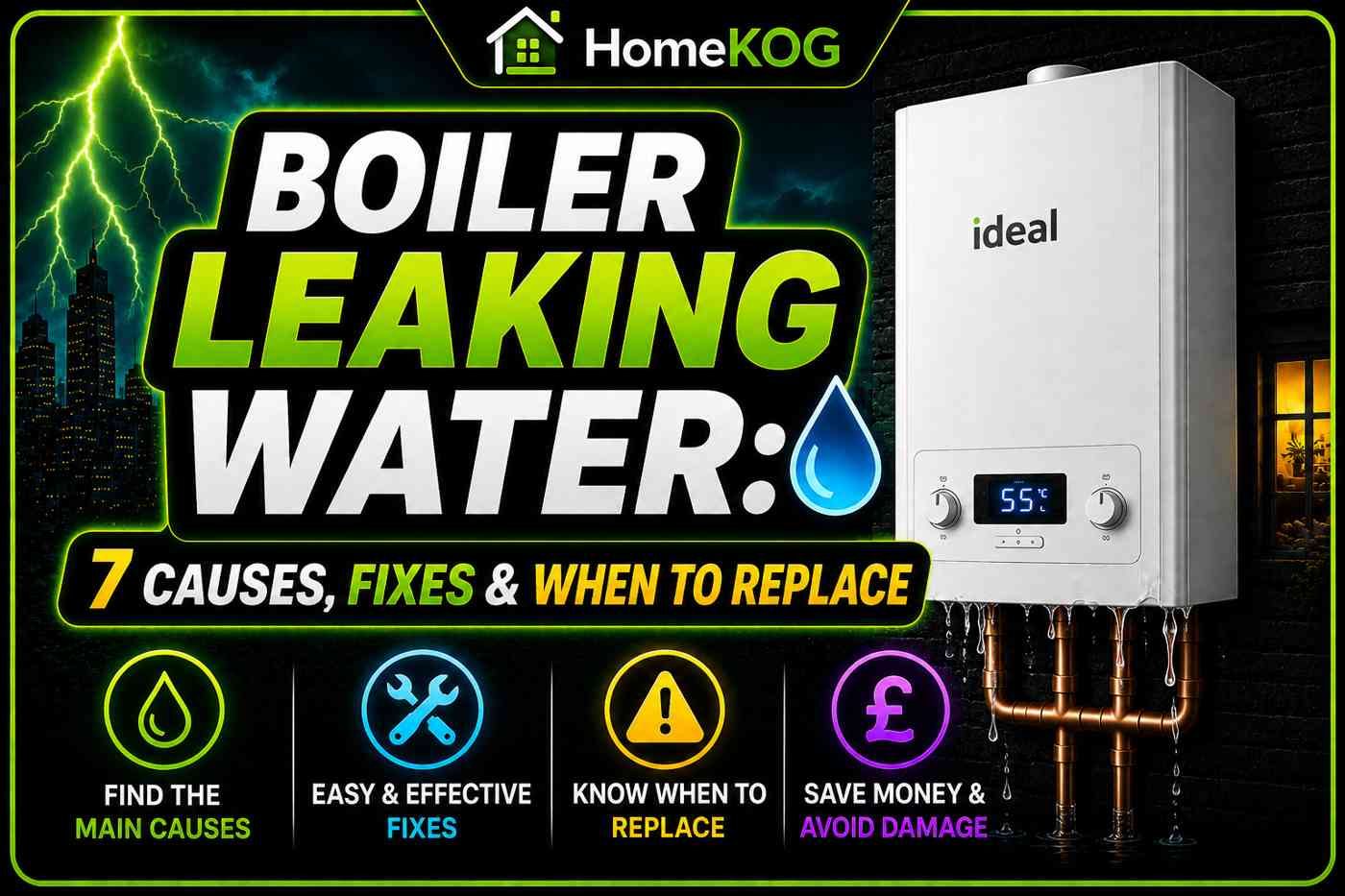

Boiler Leaking Water: 7 Causes, How to Fix Each & When to Replace
Quick Answer: A boiler leaking water is most commonly caused by high system pressure, a faulty expansion vessel, corroded pipes, worn internal seals, a damaged heat exchanger, or loose joints. If your boiler is leaking, turn off the boiler and close the mains water stop tap immediately — do not continue using it. Some causes can be repaired cost-effectively; others — particularly heat exchanger failure in an older boiler — make replacement more economical than repair. While understanding boiler leakage causes and solutions is crucial for effective maintenance, it is also important to schedule regular inspections to catch potential issues early. Additionally, ensuring that your boiler is correctly serviced can significantly reduce the likelihood of leaks occurring. Regular maintenance not only extends the lifespan of the boiler but also enhances its efficiency and performance.
Get boiler cover with a free annual service >
Introduction
A boiler leaking water is one of the most alarming faults a homeowner can discover — and one of the most important to address without delay. A slow drip that is left unchecked can escalate into water damage to floors, ceilings, and walls, and a small leak today almost always becomes a larger and more expensive problem within weeks if ignored.
The first step is always the same: switch off the boiler and turn off the mains water supply at the stop tap — usually found beneath the kitchen sink. This stops further water from entering the system while you identify the cause and arrange a repair.
This guide covers all seven common causes of a leaking boiler, how to identify which one applies to your situation, what you can safely check yourself, when a Gas Safe engineer must be involved, and how to decide whether repair or replacement is the better option.
Understanding Boiler Leaks: The Core Relationships
A boiler leak connects several interrelated components and conditions — identifying which one is responsible determines whether the repair is straightforward or a signal to consider replacement.
- A pressure relief valve (PRV) is a safety device that automatically releases water from the sealed central heating system when pressure exceeds the safe maximum — water dripping from the PRV overflow pipe outside the property indicates the system is overpressurised.
- An expansion vessel is a sealed chamber inside or adjacent to the boiler that accommodates the thermal expansion of water as it heats — a failed expansion vessel diaphragm causes pressure fluctuations, PRV discharge, and eventually a leak.
- A heat exchanger is the most expensive component inside a combi boiler — its internal passages transfer heat from the gas burner to the water circuit, and corrosion or cracking of these passages causes water to leak internally.
- A condensate pipe carries acidic wastewater from the boiler’s condensing process to an external drain — drips from the condensate outlet are normal operation, not a leak.
- Corrosion is the progressive deterioration of metal pipes and boiler components caused by the oxygen and chemical reactions in the heating water — adding central heating inhibitor slows corrosion significantly.
- Internal seals prevent water from escaping around the connections between internal boiler components — they degrade over time and under overpressure conditions, causing internal or visible leaks.
- Pipe joints throughout the central heating circuit use compression fittings, push-fit connections, or soldered joints that can loosen or fail through the thermal expansion and contraction cycles of daily heating use.
- Overpressure occurs when the sealed system pressure exceeds 2.5 bar — it causes the PRV to discharge, stresses internal seals and joints, and is one of the most common causes of leaks in sealed combi and system boiler installations.
- A stop tap is the main cold water supply valve, typically located beneath the kitchen sink — closing it immediately when a boiler leak is discovered prevents further water entering the system.
- A Gas Safe registered engineer is the only professional legally qualified to diagnose and repair internal boiler component faults including heat exchanger failure, expansion vessel replacement, and internal seal repair.
- Boiler replacement becomes more economical than repair when the repair cost exceeds 50% of a new boiler installation cost, when the boiler is over 10 years old, or when the heat exchanger has failed.
- Central heating inhibitor is a chemical additive in the system water that significantly slows internal corrosion — it is the primary preventative measure against pipe and component degradation that leads to leaks.
Is a Leaking Boiler Dangerous?
In most cases, a leaking boiler is not immediately dangerous — the primary risk is water damage and, if left unaddressed for long enough, potential flooding. However, there are circumstances where a leaking boiler creates a more serious hazard:
- If the leak is near electrical components — water near the boiler’s electrical connections, controls, or wiring creates an electrocution and fire risk. Do not investigate or touch any components if the leak appears to be near electrical parts.
- If the leak is accompanied by a smell of gas — gas smell near a leaking boiler indicates a separate and serious fault. Leave the property immediately, do not operate any switches or flames, and call the National Gas Emergency Service on 0800 111 999.
- If the pressure relief valve is continuously discharging — a PRV that continuously releases water indicates persistent overpressure, which stresses all system components and can accelerate multiple failures simultaneously.
Immediate actions when you discover a boiler leak:
- Switch the boiler off at its controls.
- Close the mains water stop tap (beneath the kitchen sink).
- Place a bowl or towels to contain the water if possible.
- Contact a Gas Safe registered engineer.
Do not continue using a leaking boiler. Even a slow drip that seems minor will worsen over time and the water damage it can cause is disproportionate to the size of the visible leak.
7 Causes of a Leaking Boiler
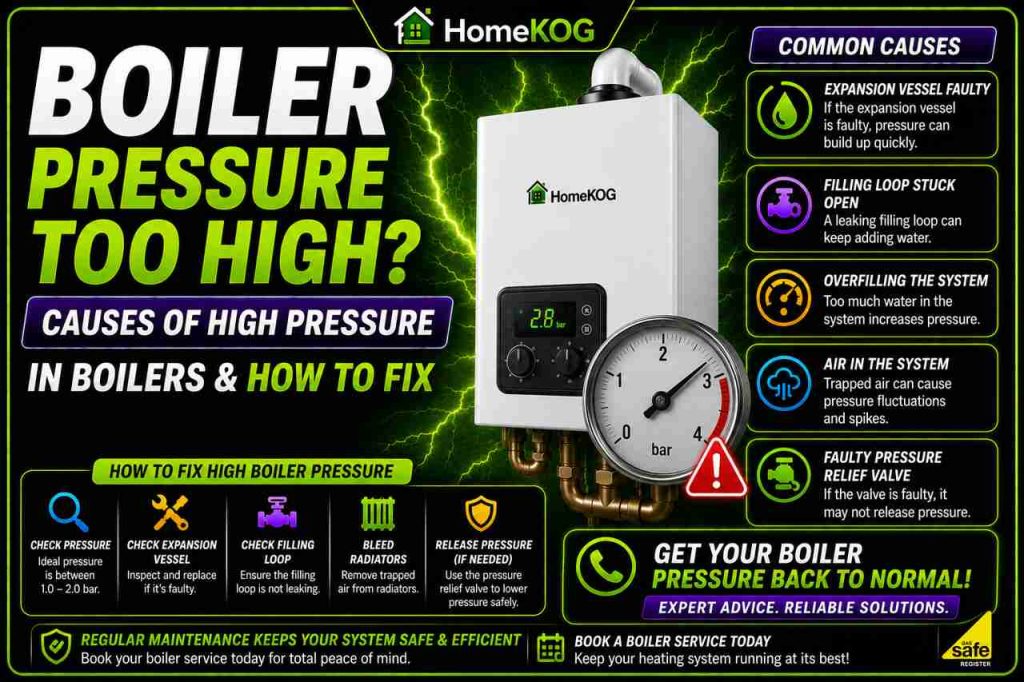
Cause 1: High Boiler Pressure
Excessive system pressure is one of the most common causes of boiler leaks. When a sealed central heating system is overpressurised — typically above 2.5 bar — the pressure relief valve opens automatically to discharge water and protect the system. This is the PRV doing its job. However, repeated PRV discharge indicates the underlying pressure problem has not been resolved.
How to identify it: Check the pressure gauge on the front of the boiler. A reading above 2.0 bar when cold, or above 2.5 bar when warm, indicates overpressure. The PRV overflow pipe — a small pipe that exits through the wall near the boiler — may be dripping or wet.
What you can do: If the system is overpressurised due to an incorrectly filled system, you can reduce the pressure by bleeding a radiator slightly — open a bleed valve briefly to release a small amount of water until the pressure gauge drops to between 1.0 and 1.5 bar. Ensure the filling loop taps beneath the boiler are fully closed.
When to call an engineer: If pressure rises repeatedly after being corrected, the expansion vessel has likely failed and requires professional replacement.
Cause 2: Expansion Vessel Failure
The expansion vessel is an internal component (sometimes external on older systems) that contains a sealed air chamber separated from the heating water by a flexible diaphragm. As the system water heats and expands, it compresses the air in the vessel — this is what prevents pressure from rising excessively. When the diaphragm fails, the vessel loses its ability to accommodate expansion, causing pressure spikes and PRV discharge.
How to identify it: The leak typically starts only after the boiler has been running for some time — the pressure is initially normal, then rises as the system heats up. This pattern — normal cold pressure, rising to high pressure when warm — is a strong indicator of expansion vessel failure.
What you can do: A temporary workaround involves converting a radiator you don’t need into a makeshift expansion vessel by bleeding it to create an air pocket at the top — bleed until the radiator is approximately half full. This is a temporary measure only. A proper repair requires an engineer.
When to call an engineer: Expansion vessel replacement or recharging is a repair that requires a Gas Safe engineer. It is a relatively common and manageable repair when diagnosed promptly.
Cause 3: Corroded Pipes
Corrosion is the progressive degradation of copper and steel pipes by the chemical reactions of heating water circulating through them. Over time, metallic debris accumulates in the system water and corrodes the copper pipes, eventually creating small gaps or pinhole leaks that allow water to escape.
How to identify it: Look along the visible pipework connected to the boiler and around the radiators. If the pipes are cool enough to touch safely, feel for a damp patch. If the pipes are hot, shine a torch across the surface and look for a drip forming. The source of the leak will be a visible wet patch, water staining, or a small droplet forming at a specific point on the pipe.
In new installations: Corroded or leaking pipework in a recently installed boiler indicates an installation fault — poorly joined fittings or incorrectly prepared pipe ends. Report this to your installer immediately; the repair should be carried out at no charge under the installation warranty.
When to call an engineer: Pipe repair or replacement requires a Gas Safe engineer. Adding central heating inhibitor during the refill prevents future corrosion from occurring at the same rate.
Cause 4: A Worn-Out Boiler
A boiler that has been in service for over 10 to 12 years may develop leaks simply because its components have worn beyond their operational tolerance. Corrosion, repeated thermal cycling, and the gradual degradation of seals and joints combine to make older boilers increasingly prone to leaks — often from multiple locations simultaneously.
How to identify it: Visible corrosion — brown or orange staining on the boiler casing, pipework connections, or radiators — is the key indicator. If corrosion is widespread, the leaks may be coming from several points.
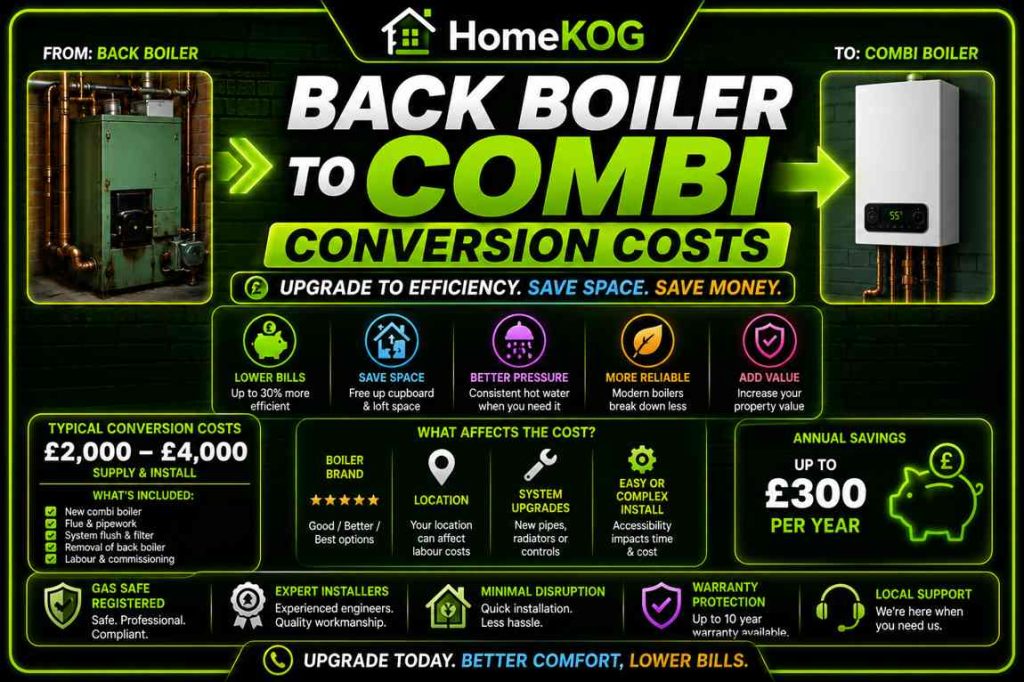
Repair or replace? With an older boiler showing significant corrosion or multiple leaks, replacement is almost always more economical than repair. Each individual repair may be affordable, but an old boiler will continue developing new leaks as the underlying material degradation progresses. A new A-rated condensing boiler also reduces gas bills by up to £800 per year compared to an old G-rated model, making the investment recover its cost relatively quickly.
Cause 5: Failed Internal Seals
Inside the boiler, rubber and polymer seals prevent water from escaping around the connections between internal components — the pump, heat exchanger, diverter valve, and other parts. These seals degrade over time and are particularly vulnerable to damage from overpressure, which forces them to flex beyond their design tolerance.
How to identify it: Internal seal failure typically produces a drip or small flow of water from the bottom of the boiler casing — the water has leaked internally and run down to exit at the lowest point. You may be able to remove the outer casing cover and look inside without touching any components. A visible wet area inside the boiler casing confirms an internal leak.
When to call an engineer: Internal seal replacement requires a Gas Safe engineer. Most seal repairs are relatively affordable compared to major component replacements.
Cause 6: Heat Exchanger Failure
The heat exchanger is the most expensive component inside a combi boiler. It consists of a network of narrow passages through which combustion gases and water flow in close proximity, transferring heat between them. Corrosion or cracking of these passages allows water to escape internally, causing a leak that may not be immediately visible from outside the boiler.
How to identify it: Heat exchanger failure can be difficult to diagnose without professional inspection. Signs include water dripping from the base of the boiler casing, unusual smells from the boiler, a kettling or rumbling noise (caused by limescale on the heat exchanger surface), and unexplained pressure loss. A Gas Safe engineer can confirm heat exchanger failure definitively.
Repair or replace? The heat exchanger is the most expensive repair available on a boiler — replacement costs can equal or exceed 50% of the cost of a new boiler installation. For any boiler over 8 years old, heat exchanger replacement is rarely economical. A new boiler is almost always the better long-term investment when the heat exchanger has failed in an older unit.
Cause 7: Loose Pipe Joints
As water in the central heating system heats and cools through thousands of daily cycles, the thermal expansion and contraction places stress on the connections between pipes and components. Over time, compression fittings and push-fit connections can loosen slightly, allowing small amounts of water to escape at the joint. These leaks can lead to various noisy central heating pump symptoms, which may indicate that maintenance is needed. Homeowners should pay attention to unusual sounds, as they can signal underlying issues with the heating system. Ignoring these symptoms could result in more severe problems and higher repair costs in the long run.
How to identify it: Look for drips or water staining specifically at the connection points — where two pipes join, or where a pipe connects to a radiator valve, a pump, or the boiler itself. The drip will be localised to the joint rather than appearing along the middle of a pipe.
When to call an engineer: Joint tightening and recoupling is one of the most straightforward and least expensive boiler repairs available — a short professional call-out in most cases. Do not attempt to tighten boiler connections yourself without Gas Safe registration, as incorrect tightening can damage the fitting and worsen the leak.
Repair or Replace? How to Decide
The decision between repairing and replacing a leaking boiler comes down to a simple financial comparison: When considering boiler finance options for homeowners, it’s essential to evaluate the long-term costs of each choice. Many financing plans provide flexibility, making it easier for homeowners to manage their budgets. It’s also wise to consult with local providers to uncover the best deals tailored to specific needs.
- Repair makes sense when the fault is isolated (a single joint, a seal, a pipe section), the boiler is under 10 years old, the repair cost is below 30% to 40% of the cost of a new boiler installation, and the boiler is otherwise in good condition.
- Replacement makes sense when the heat exchanger has failed, the boiler is over 10 years old and showing multiple signs of wear, the repair cost approaches or exceeds 50% of a new installation, or when multiple different components have failed within a short period.
A Gas Safe engineer can assess the specific fault and provide a repair cost estimate that enables a direct comparison with new boiler installation costs.
Frequently Asked Questions
Why is my boiler leaking water?
The seven most common causes of a leaking boiler are: high system pressure causing the pressure relief valve to discharge, expansion vessel failure, corroded pipes, a worn-out boiler with degraded components, failed internal seals, heat exchanger failure, and loose pipe joints. The correct diagnosis requires a Gas Safe engineer to inspect the boiler. As an initial check, look at the pressure gauge — a reading in the red zone above 2.0 bar when cold indicates overpressure as the likely cause.
Is a leaking boiler dangerous?
In most cases, a leaking boiler is not immediately life-threatening, but it should be treated as a serious fault requiring prompt attention. Water near the boiler’s electrical components creates an electrocution risk. A leak accompanied by a smell of gas is an emergency — leave the property immediately and call 0800 111 999. The most common risk from a leaking boiler is water damage, which worsens the longer it is left unaddressed.
What should I do if my boiler is leaking water?
If your boiler is leaking water, switch it off immediately at its controls, close the mains water stop tap (usually beneath the kitchen sink), place a bowl or towels to contain the water, and contact a Gas Safe registered engineer. Do not continue using a leaking boiler. The stop tap location is important — knowing where it is before a problem occurs means you can act quickly when a leak is discovered.
Can I fix a leaking boiler myself?
Some basic checks can be performed safely — checking the pressure gauge, ensuring the filling loop taps are closed, and reducing overpressure by bleeding a radiator slightly. Pipe corrosion can be identified by feeling or torchlight inspection. However, any repair work on a gas boiler — including replacing seals, joints, or internal components — must be carried out by a Gas Safe registered engineer. Attempting internal boiler repairs without Gas Safe registration is illegal and potentially dangerous.
Should I repair or replace a leaking boiler?
If the boiler is under 10 years old and the leak is from an isolated cause — a single pipe joint, an internal seal, or a pipe section — repair is typically cost-effective. If the heat exchanger has failed, the boiler is over 10 years old and showing widespread corrosion or multiple leaks, or the repair cost approaches 50% of a new boiler installation cost, replacement is almost always the better long-term investment. A Gas Safe engineer can provide a repair cost estimate to support a direct comparison.
How much does it cost to fix a leaking boiler?
The cost of repairing a leaking boiler depends on the cause. Loose joint tightening or resealing is typically £50 to £150. Expansion vessel replacement or recharging costs £150 to £350. Internal seal replacement costs £100 to £250. Corroded pipe repair costs £100 to £350, depending on the extent. Heat exchanger replacement — the most expensive common repair — costs £300 to £600 or more. For boilers over 10 years old, this cost typically makes a new boiler installation more economical than repair.
Conclusion: Act Quickly, Assess Honestly
A leaking boiler is not a problem to monitor and hope improves — it is a fault to act on immediately. Turn off the boiler, close the stop tap, and call a Gas Safe engineer. The longer a leak is left, the more water damage accumulates and the more other components are stressed by the underlying fault.
Most boiler leaks are repairable at a reasonable cost when caught early. The exceptions — heat exchanger failure in an older boiler, or widespread corrosion indicating general component degradation — make replacement the more sensible path. A Gas Safe engineer can assess the specific fault and provide the information you need to make that decision with confidence.
Annual boiler servicing remains the most effective preventative measure — it identifies developing faults, including early-stage corrosion, seal wear, and pressure issues, before they produce visible leaks and more costly damage. Additionally, understanding boiler flue installation requirements is crucial for ensuring safe and efficient operation. Proper installation minimizes risks associated with improper venting, which can lead to hazardous carbon monoxide buildup. Regular inspections of the flue system also complement annual servicing by catching potential obstructions or failures early.