
Conventional Boiler: What It Is, How It Works & Which Homes Need One
Quick Answer: A conventional boiler — also known as a regular, traditional, or heat-only boiler — heats water stored in a hot water cylinder and uses a separate cold water storage tank in the loft. It is best suited to larger homes with multiple bathrooms and high simultaneous hot water demand. Unlike a combi boiler, it can supply hot water to several outlets simultaneously without reducing pressure.
Introduction
The conventional boiler is the oldest and most established type of central heating system in the UK. While the combi boiler has overtaken it as the most common boiler type in modern homes, there are still plenty of households where a conventional boiler is not just acceptable — it is the most suitable choice available.
A conventional boiler works alongside a hot water storage cylinder and a cold water feed tank to deliver large volumes of hot water to multiple outlets simultaneously. It suits older properties with existing pipework infrastructure, large families with high hot water demand, and homes where low incoming mains pressure makes a combi boiler impractical.
Modern conventional boilers from manufacturers including Worcester Bosch, Viessmann, Ideal, and Baxi are now hydrogen-ready to a 20% blend, meaning they are compliant with future fuel transition requirements and unaffected by the government’s restrictions on new gas boiler installations. This guide covers what a conventional boiler is, how it works, who it suits, its pros and cons, and how it compares to system and combi alternatives.

Understanding Conventional Boilers: The Core Relationships
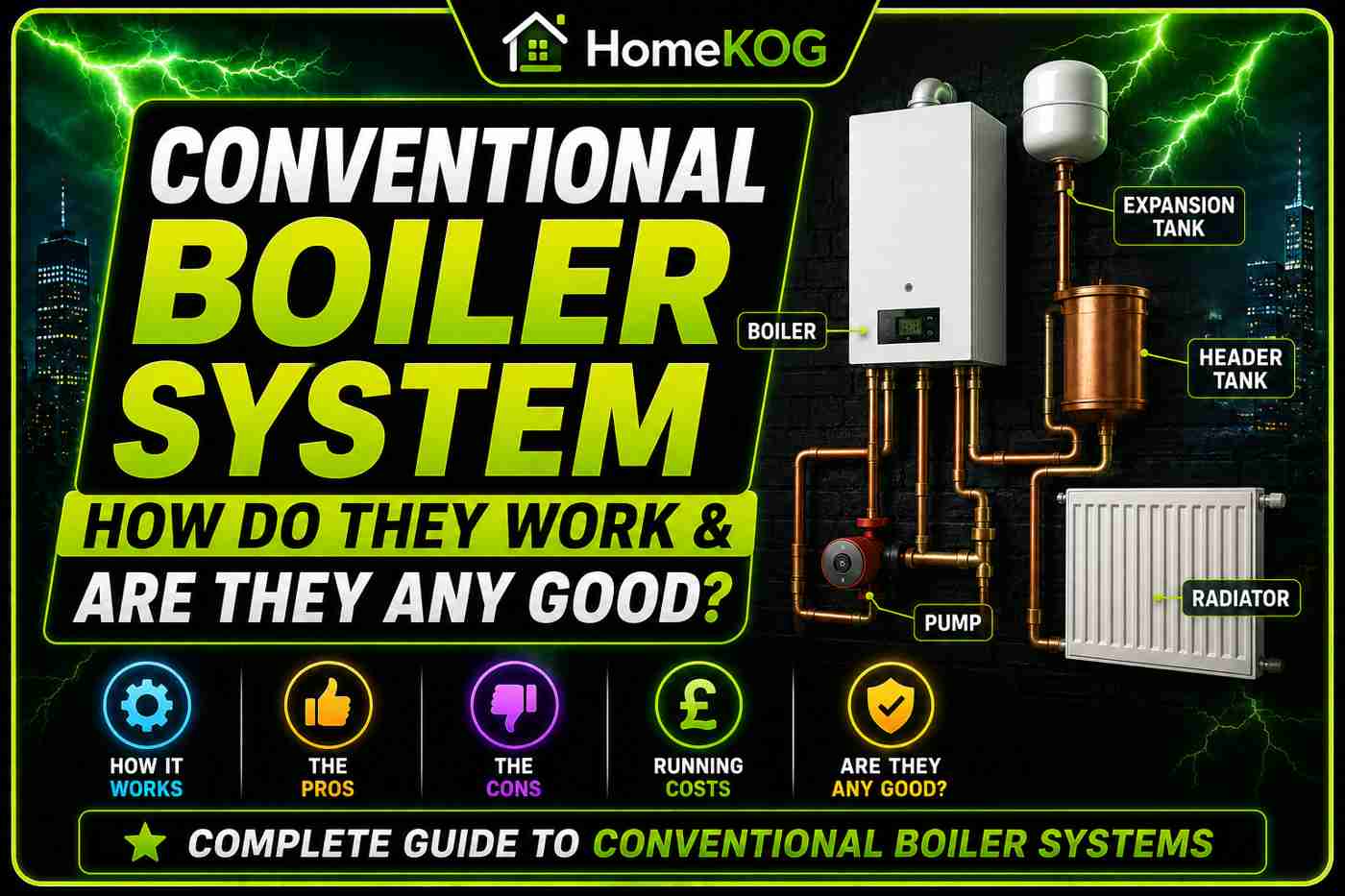
A conventional boiler system involves several interconnected components — understanding how they relate to each other clarifies how the system functions and why it suits certain properties.
- A conventional boiler is a heat-only boiler that heats water for both central heating and domestic hot water, distributing it through a connected system of a hot water cylinder and cold water storage tank.
- A hot water storage cylinder stores the pre-heated domestic hot water supply and is connected to the boiler via a primary circuit — when a tap is opened, hot water is drawn from this cylinder.
- A cold water storage tank — typically installed in the loft — feeds the hot water cylinder with cold water by gravity, replenishing the cylinder as hot water is drawn off.
- A feed and expansion tank is a smaller secondary tank also located in the loft that accommodates the expansion of water as it heats and maintains the correct water level in an open vented system.
- An open vented conventional system is connected to atmospheric pressure via the feed and expansion tank, allowing excess pressure to vent naturally without a sealed pressure vessel.
- A sealed conventional system is closed to the atmosphere and uses a pressurised expansion vessel instead of a feed and expansion tank, operating at mains pressure throughout.
- A central heating pump circulates hot water from the boiler through the radiator circuit and returns cooled water to the boiler for reheating in a continuous cycle.
- Solar thermal compatibility enables a conventional boiler system to accept heat input from roof-mounted solar collectors, reducing the gas required to maintain the hot water cylinder temperature.
- An immersion heater installed in the hot water cylinder provides an electric backup heat source, allowing domestic hot water to be produced independently if the boiler develops a fault.
- Hydrogen-ready conventional boilers are compatible with gas supplies containing up to 20% hydrogen by volume, future-proofing the installation against the UK’s planned transition away from pure natural gas.
- A Gas Safe registered engineer is required to install, service, and repair all conventional boiler systems — incorrectly installed gas appliances carry carbon monoxide and fire risks.
- Annual boiler servicing maintains the efficiency of the conventional boiler and is a condition of keeping most manufacturer warranties valid throughout their term.
What Is a Conventional Boiler?
A conventional boiler — also referred to as a regular boiler, traditional boiler, heat-only boiler, or open vent boiler — is a central heating unit that heats water and distributes it to both the central heating circuit and a separate hot water storage cylinder.
Unlike a combi boiler, which heats domestic hot water on demand directly from the mains, a conventional boiler system stores a volume of pre-heated hot water in a cylinder, ready to be drawn on whenever a tap or shower is opened. The cold water used to replenish the cylinder comes from a cold water storage tank in the loft, which is gravity-fed from the mains.
This configuration means a conventional boiler system has more physical components than a combi or system boiler. It requires space for the boiler unit itself, a hot water cylinder (typically in an airing cupboard), and a cold water storage tank and feed and expansion tank in the loft. In properties that already have this infrastructure, replacement is straightforward and cost-effective. In properties being converted from a combi boiler, the additional pipework and components represent a more significant installation project.
Other Names for a Conventional Boiler
The conventional boiler is referred to by several different names in the UK heating industry. All of the following terms describe the same type of boiler:
- Regular boiler
- Traditional boiler
- Heat-only boiler
- Open vent boiler
- Conventional heating system
The variation in terminology can create confusion when researching or requesting quotes — confirming that your engineer understands you are referring to a boiler that requires both a hot water cylinder and a loft-mounted cold water tank avoids any misunderstanding.
How Does a Conventional Boiler Work?
Open Vented System
In an open vented conventional system, the central heating circuit is connected to the atmosphere through the feed and expansion tank in the loft. Cold mains water enters the cold water storage tank, which feeds the hot water cylinder by gravity. The feed and expansion tank — a smaller separate tank — accommodates the slight expansion of water as it heats, preventing pressure build-up within the open circuit.
The boiler heats water in the primary circuit, which circulates through the hot water cylinder’s internal coil, transferring heat to the stored domestic hot water. A central heating pump circulates the primary circuit water through the radiators. When a tap is opened, hot water flows from the cylinder under gravity pressure to the outlet.
Sealed System
A sealed conventional system — sometimes called a pressurised system — replaces the loft-mounted feed and expansion tank with a sealed expansion vessel, typically located near the boiler. The system operates at mains pressure rather than gravity pressure, which improves flow rates at outlets and eliminates the need for loft-mounted components.
Sealed conventional systems are less common than open vented configurations but offer better flow rate performance and remove the loft space requirement for the expansion and feed tanks.
The Hot Water Cycle
- Cold water from the mains fills the cold water storage tank in the loft.
- The cold water storage tank feeds the hot water cylinder by gravity, maintaining the cylinder’s water level.
- The boiler heats primary circuit water and circulates it through the internal coil inside the hot water cylinder.
- The coil transfers heat to the stored domestic hot water, raising it to the thermostat’s target temperature — typically 60°C.
- When a tap or shower is opened, hot water flows from the cylinder to the outlet at gravity pressure.
- The cold water storage tank automatically replenishes the cylinder as hot water is drawn off.
- The boiler fires to reheat the cylinder when the stored temperature drops below the thermostat’s set point.
Is a Conventional Boiler Right for Your Home?
A conventional boiler is the right choice for specific types of properties and households. The easiest way to determine whether one is suitable for your home is to assess the existing heating infrastructure and hot water demand.
How to Identify What Boiler Type You Currently Have
- If your home has a boiler, a hot water cylinder in an airing cupboard, and a tank in the loft — you have a conventional boiler system.
- If your home has a boiler and a hot water cylinder but no loft tank — you have a system boiler.
- If your home has only a wall-hung boiler unit with no cylinder or loft tank — you have a combi boiler.
Properties Best Suited to a Conventional Boiler
A conventional boiler is most appropriate for:
- Large homes with multiple bathrooms — the hot water cylinder stores a substantial volume of pre-heated water that can be delivered to several outlets simultaneously without pressure reduction.
- Households with high simultaneous hot water demand — families where multiple people regularly shower, bathe, or use hot water outlets at the same time benefit significantly from the cylinder’s stored supply.
- Properties with low mains water pressure — a combi boiler relies on adequate mains pressure to deliver hot water. Where mains pressure is low, a conventional boiler system using stored cylinder water at gravity pressure is often more practical.
- Older properties with existing conventional infrastructure — replacing a conventional boiler like-for-like is significantly less disruptive and less expensive than converting to a combi, as the existing cylinder, tanks, and pipework can often be retained.
- Properties with solar thermal panels — conventional boiler systems are compatible with solar thermal collectors, which can contribute a proportion of the heat required to maintain the cylinder’s temperature and reduce gas consumption.
Conventional Boiler vs System Boiler vs Combi Boiler
| Feature | Conventional Boiler | System Boiler | Combi Boiler |
|---|---|---|---|
| Hot water cylinder required | Yes | Yes | No |
| Cold water loft tank required | Yes | No | No |
| Simultaneous hot water outlets | Multiple | Multiple | Limited (1–2) |
| Mains pressure dependent | No (gravity fed) | Yes | Yes |
| Space required | High | Medium | Low |
| Best for | Large older homes | Larger modern homes | Smaller modern homes |
| Solar thermal compatible | Yes | Yes | No |
| Installation cost | Lower (if existing system) | Medium | Lower (new install) |
Converting from a Conventional Boiler to a Combi Boiler
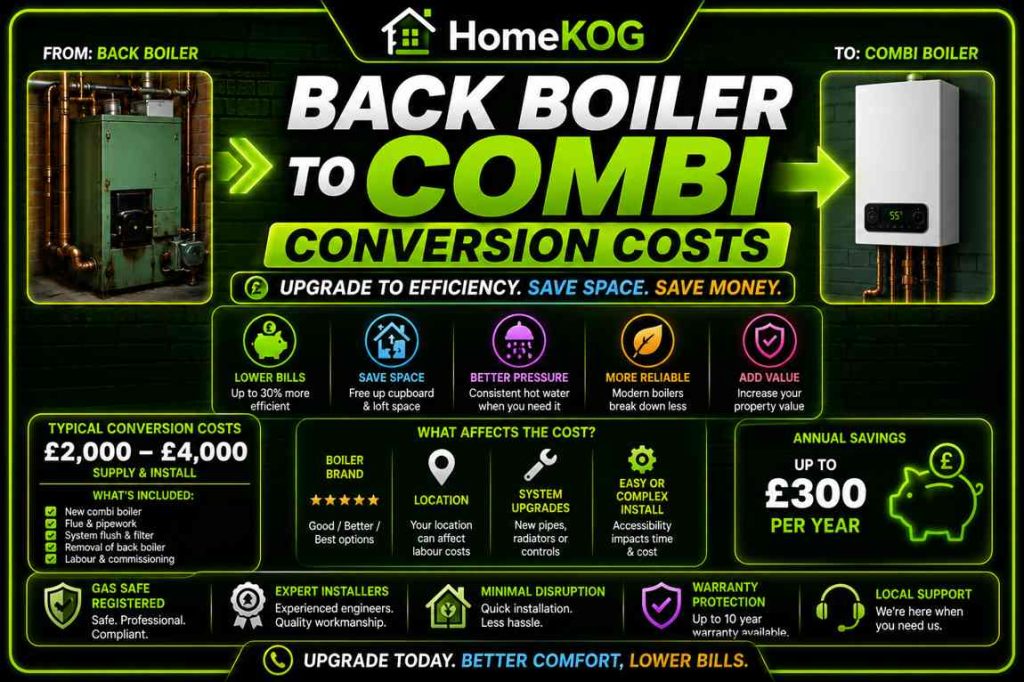
Converting from a conventional boiler to a combi boiler is a popular choice for homeowners who want to free up the space occupied by the hot water cylinder and loft tanks. The conversion removes all cylinder and tank components, eliminates the need for loft space, and provides instant mains-pressure hot water from a single compact unit.
However, conversion carries a higher upfront cost than a like-for-like replacement because of the additional pipework work involved. The cold water storage tank, hot water cylinder, and associated pipework must all be removed, and the new combi boiler requires its own dedicated flue and connections.
The cost of converting from a conventional boiler to a combi boiler typically ranges from £2,000 to £3,000, depending on the property size, the chosen combi boiler model, and the complexity of the pipework modifications required. Obtaining multiple quotes from Gas Safe-registered engineers before proceeding is advisable.
A combi boiler is not always the right replacement for every home. Properties with more than two bathrooms or households with four or more occupants with simultaneous hot water demand may find that a combi boiler cannot match the output performance of the conventional or system boiler it replaces.
Pros of a Conventional Boiler
- High volume hot water supply — the hot water cylinder stores a large pre-heated volume that supplies multiple bathrooms and outlets simultaneously without the pressure reduction that affects combi boilers under concurrent demand.
- Suitable for low mains pressure properties — a gravity-fed conventional system delivers adequate hot water flow even in properties where mains pressure is insufficient for a combi boiler to perform well.
- Cost-effective like-for-like replacement — replacing a conventional boiler in a home that already has the cylinder, tanks, and pipework infrastructure avoids the additional costs of conversion and is typically faster to install.
- Solar thermal compatible — conventional boiler systems accept heat input from solar thermal collectors, reducing gas consumption and carbon emissions throughout the year.
- Immersion heater backup — a conventional hot water cylinder can accommodate an electric immersion heater, providing a backup hot water source if the boiler develops a fault.
- Suits older properties — the open vented design is well matched to older homes with existing pipework layouts that would require significant modification to accommodate a sealed, pressurised system.
- Hydrogen-ready — modern conventional boilers from leading manufacturers are compatible with hydrogen-blend gas fuels up to 20%, future-proofing the installation against the UK’s planned gas network transition.
Cons of a Conventional Boiler
- Requires significant space — a conventional boiler system needs space for the boiler unit, a hot water cylinder (typically in an airing cupboard), and a cold water storage tank plus feed and expansion tank in the loft. Properties without adequate loft and storage space cannot accommodate this configuration.
- Hot water volume is finite — the available hot water is limited to the capacity of the storage cylinder. Once the cylinder is exhausted during high-demand periods, users must wait for it to reheat before full hot water availability is restored.
- Higher installation cost in new properties — fitting a conventional system in a property without existing cylinder and tank infrastructure costs more than installing a combi boiler, due to the additional components and pipework required.
- Running costs can be higher — heating and maintaining a full cylinder of water continuously uses more energy than a combi boiler that only heats water when it is demanded, particularly in households with lower hot water usage.
- More components to maintain — a conventional system has more individual components than a combi boiler — the cylinder, tanks, valves, and associated pipework all require periodic inspection and maintenance.
Frequently Asked Questions
What is the difference between a conventional boiler and a combi boiler?
A conventional boiler heats water stored in a hot water cylinder and uses a separate cold water storage tank in the loft to supply the cylinder. A combi boiler heats domestic hot water on demand directly from the mains water supply, without any cylinder or storage tank. A conventional boiler can supply multiple outlets simultaneously from its stored volume, while a combi boiler splits its on-demand output between concurrent demands, which can reduce pressure when several outlets are in use at once.
What is the difference between a conventional boiler and a system boiler?
Both a conventional boiler and a system boiler use a hot water storage cylinder and can supply multiple outlets simultaneously. The difference is that a conventional boiler also requires a cold water storage tank and a feed and expansion tank in the loft, making it an open vented system. A system boiler does not require a loft tank — it connects directly to the mains water supply using a sealed, pressurised system with an integral expansion vessel, removing the loft space requirement.
Is a conventional boiler suitable for a large home?
Yes — a conventional boiler is one of the most suitable options for large homes with multiple bathrooms and high simultaneous hot water demand. The hot water cylinder stores a substantial volume of pre-heated water that can be delivered to several outlets at the same time without pressure reduction. This makes it significantly better suited to large family homes than a combi boiler, which struggles to maintain adequate flow when multiple outlets are in use concurrently.
How long does a conventional boiler last?
A correctly installed, regularly serviced, and used conventional boiler typically lasts between 10 and 15 years. Some well-maintained units have operated reliably for up to 20 years. The hot water cylinder and cold water storage tank are separate components with their own lifespans — cylinders typically last 20 to 25 years if made from copper or stainless steel. Annual servicing by a Gas Safe engineer is the most effective way to maximise boiler longevity.
Can I replace a conventional boiler with a combi boiler?
Yes — converting from a conventional boiler to a combi boiler is possible and a popular choice for homeowners who want to free up space in the cylinder and loft tank. The conversion involves removing the hot water cylinder, cold water storage tank, and feed and expansion tank, along with their associated pipework, and installing a new combi boiler with its own flue. The cost of conversion typically ranges from £2,000 to £3,000. A combi boiler may not be the right replacement for large homes with multiple bathrooms and high simultaneous hot water demand.
Are conventional boilers being phased out?
Conventional boilers that are hydrogen-ready to a 20% blend are not subject to the current restrictions on new gas boiler installations and are compliant with current and near-future regulations. The UK government’s plan to transition to low-carbon heating will eventually affect all gas boilers, but modern hydrogen-ready conventional boilers provide a compliant solution for the foreseeable future. When the time comes to upgrade further, a heat pump or hydrogen boiler may be considered — but a current hydrogen-ready conventional boiler is not at immediate risk of becoming non-compliant.
What size conventional boiler do I need?
The correct conventional boiler size depends on the number of radiators in the property and the volume of the hot water cylinder. A Gas Safe engineer will carry out a heat loss calculation during a survey to determine the required output in kilowatts. As a general guide, a 3- to 4-bedroom home typically requires a conventional boiler in the 24kW to 30kW range, while a larger 5-bedroom property with multiple bathrooms may require 30kW to 40kW. The hot water cylinder should be sized to the household’s peak demand — typically 150 to 250 litres for most family homes.
Conclusion: Is a Conventional Boiler the Right Choice?
A conventional boiler remains the best solution for a specific type of UK home — larger properties with multiple bathrooms, older infrastructure, low mains pressure, or households where simultaneous high-volume hot water demand is a daily reality. For these properties, no other boiler type matches the performance and practicality of a properly specified conventional system.
A conventional boiler requires more space and more components than a combi, but in homes it suits, it delivers reliable hot water performance that combi boilers cannot replicate. Modern conventional boilers are hydrogen-ready, energy-efficient, and compatible with solar thermal systems — making them a forward-looking choice as well as a traditional one.
Get a quote from a Gas Safe-registered engineer, confirm the correct boiler output for your property, and ensure the replacement is installed correctly to protect the manufacturer’s warranty. A well-maintained conventional boiler will serve your home efficiently for 15 years or more.